
Erie is currently committed to increasing its affordable housing stock to 12% by 2035, and no project looms larger in that effort than the Village at Coal Creek, a 46-acre property near Old Town that the town purchased in 2023 for $6.9 million. The money came from federal American Rescue Plan Act (ARPA) dollars and the town’s Open Space and Trails Advisory Board (OSTAB) fund, and the land was initially promoted as a future mixed-income neighborhood with trails, parks, and workforce-level housing. In practice, the project has been mired in uncertainty and bureaucratic delay that has been driven in part by Mayor Andrew Moore, who has repeatedly urged the council to slow down on decisions about the property’s future. Last April, Moore questioned whether the land would be better served as a park. By November, he was floating something else entirely.
At the November 17th Town Council meeting, Moore proposed that the Coal Creek land be used to relocate St. Scholastica, an Erie Catholic Church currently located on Highway 52.
“Does it make more sense to put a place of worship, possibly St. Scholastica, on this property?” he asked, before adding that Catholic Charities might be a resource for incorporating affordable housing into such a plan. “[…] that’s really as far as the thought got.”
Council members Anil Peseramelli and Dan Hoback were both caught off guard. Hoback told Yellow Scene the proposition was “sprung on the council” without warning. Peseramelli said, “I would have expected to hear this before. We did study sessions on [Coal Creek Property] and it never came up in those sessions.”
But emails obtained through the Colorado Open Records Act (CORA) tell a different story. The idea had gone considerably further than Moore’s “thought” framing suggested.
The CORA records reveal that a planning process involving St. Scholastica, Catholic Charities, a project management firm, the Mayor, and other Erie figures had been privately underway for at least five months before Moore raised it at the November council meeting. Aside from Pro Tem Brandon Bell, no other council members were included in the conversations Yellow Scene Magazine obtained.
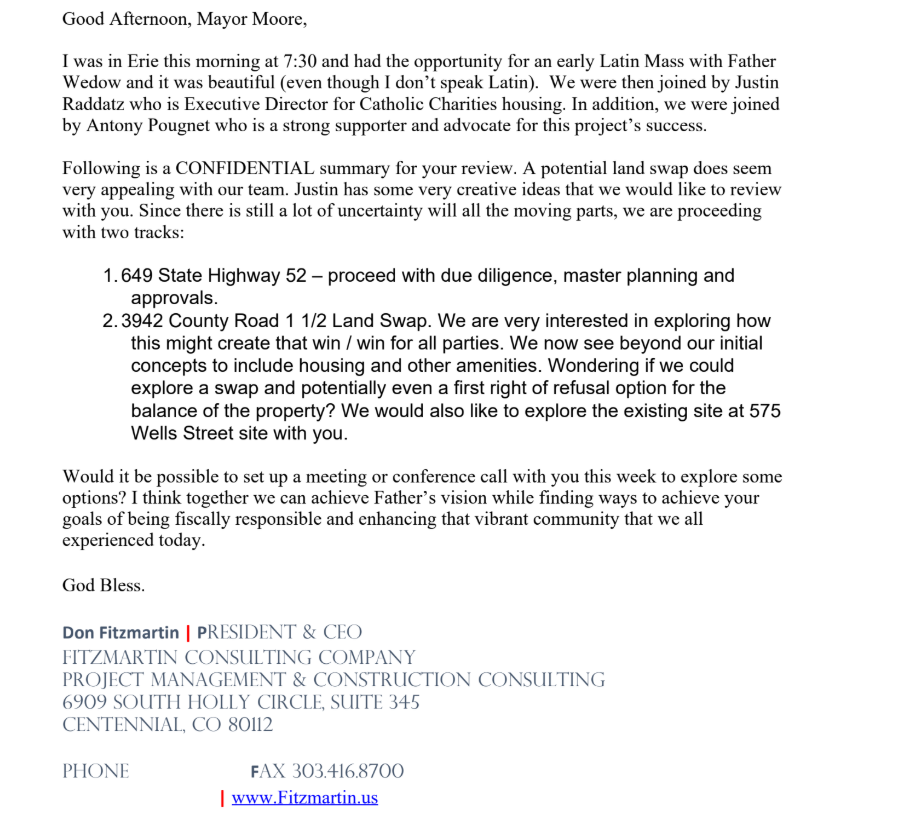
One notable email is dated June 20th and was sent by Don Fitzmartin, President and CEO of Fitzmartin Consulting. Its language references prior meetings, suggesting the process was already in motion. Fitzmartin laid out two tracks: continuing development on a 10-acre parcel St. Scholastica had purchased near Highway 52 in 2020, or pursuing a land swap that would give the church a foothold at Coal Creek instead. The email also floated a “first right of refusal” on the balance of the Coal Creek property meaning the church could claim additional portions ahead of any other use, including affordable housing. That provision doesn’t reappear in later emails, but the land swap remains central to two more emails and a meeting agenda in the CORA records.
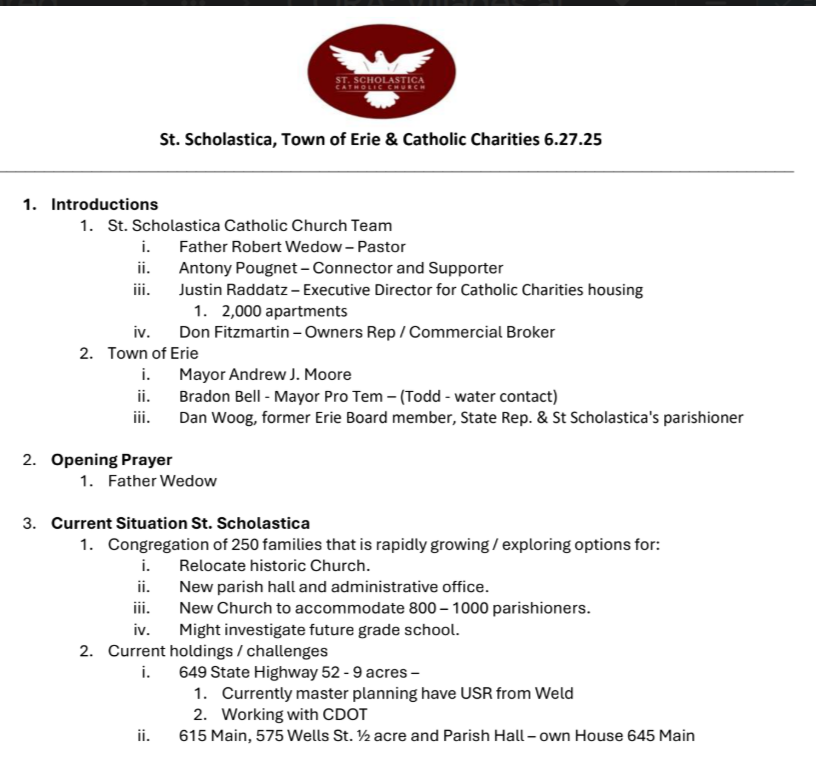
A June 27th meeting agenda for a gathering between “St. Scholastica, the Town of Erie, & Catholic Charities” makes clear how much the church had riding on Coal Creek. The agenda outlines what the church hoped to build at Coal Creek: a new church for 800 to 1,000 parishioners, a parish hall and administrative offices, and a possible future grade school. The scale of St. Scholastica’s Coal Creek ambitions represents a striking departure from where the church’s priorities appeared to be just four years ago. In a January 2021 newsletter, Development Committee Chair Mike Crader wrote that the Highway 52 property the church had just purchased would “provide for the community for the next 100 to 150 years”. By 2024, that property appears in the CORA records only as a bargaining chip in a land swap. What St. Scholastica now intends to do with Highway 52 is unclear, and the church did not respond to Yellow Scene’s Magazine’s request for comment about the shift.
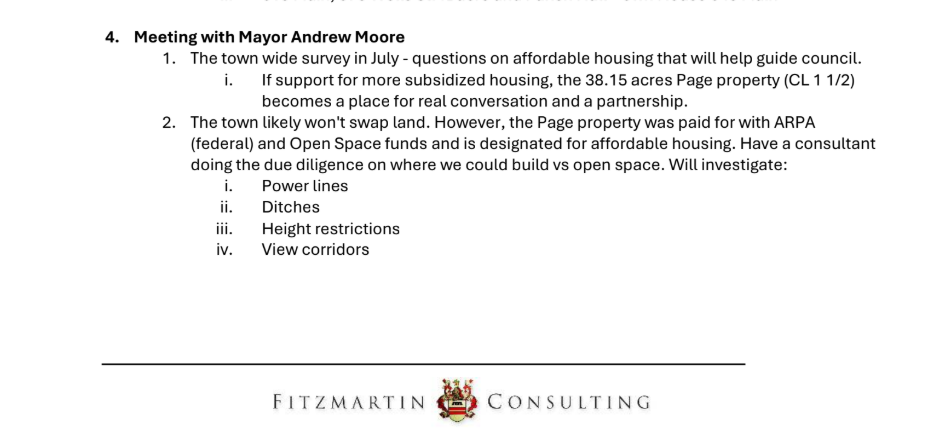
Moore’s portion of the June 27th agenda focuses entirely on the land swap. It references the town-wide survey planned for July 2025, noting that if results showed public support for affordable housing, the Coal Creek property “becomes a place for real conversation and a partnership”, and frames Dig Studio’s ongoing land-use analysis as relevant due diligence for the St. Scholastica plan. That analysis eventually produced five options for Coal Creek, varying the balance between housing and open space. None includes a church. Aly Burkhalter, the Villages at Coal Creek project manager and Dig Studio Senior Planner, does not appear anywhere in the five months of emails.
The July survey did show affordable housing and open space as top priorities for Erie residents — neither of which a church development cleanly satisfies. The fact that Mayor Moore may have been privately advancing an alternative plan while that survey was being conducted and processed strikes some council members as potentially problematic.
“One, it’s about respecting people’s opinions,” council member Peseramelli told Yellow Scene. “Two, it’s about transparency, because it is taxpayers’ money [going toward the project].”
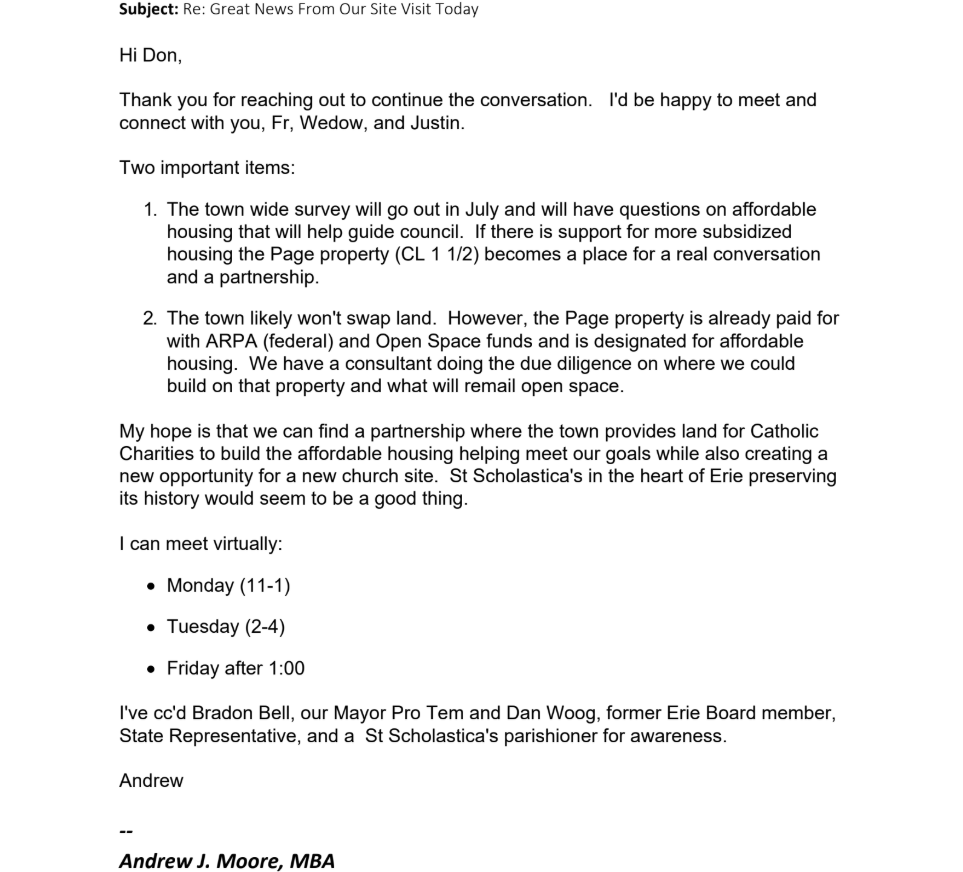
Moore’s own emails are telling. On June 22nd, he wrote: “The town likely won’t swap land. However, the Paige property is already paid for with ARPA (federal) and Open Space funds and is designated for affordable housing […] My hope is that we can find a partnership where the town provides land for Catholic Charities to build the affordable housing, helping meet our goals while also creating a new opportunity for a new church site.”
Moore had publicly opposed affordable housing at Coal Creek, so his willingness to quietly carve out an exception for a church did not go unnoticed by colleagues.
“[The potential of the St. Scholastica project including 150 affordable housing units] has been held out as a carrot to the council,” Hoback said. “Erie committed to become 12% affordable housing, and we are currently at 1%. The 150 units in the St. Scholastica plan would be a drop in the bucket.”
What’s Next
The plan now faces a significant obstacle. The Open Space and Trails Advisory Board reviewed St. Scholastica’s pre-application on February 9th and sent a letter to the Council recommending denial. OSTAB’s reasoning was direct:
“The St. Scholastica development would destroy the attributes of the property for which it was purchased to preserve. The plan does not accommodate open space, natural areas, irrigated agriculture, a healthy riparian area, wildlife and bird habitat, floodplain buffering, viewshed protection, or a tranquil outdoor experience.”
Hoback noted that even when the town first purchased the Coal Creek property, there were concerns about its suitability.
“The buildable portions didn’t lend an ideal splitting of affordable housing and open space,” he said.
At a November 19th study session, the Council discussed whether the ARPA funding could be refunded or reallocated if affordable housing was not included in the final Coal Creek plan. Notably absent from that discussion was any mention of what would happen to OSTAB’s contribution if the land were designated solely for affordable housing.
For Pesaramelli, none of the procedural maneuvering changes what’s at stake.
“I see it through the lens of how hard it is to be in a home, build equity, and build a family around it. It’s so easy to become homeless in Colorado. Two-to-three months without salary,” he said.
He continued reflecting on his own background: “I grew up in a one-room home in India and the roof was leaky every monsoon season. There was no yard for my brother and I to play. These affordable houses are a perfect place for families starting. Two bedrooms and a small yard. And when those families are ready for the next step, other families starting out have somewhere to live.”
Whether the Council ultimately approves or rejects the St. Scholastica application, the CORA emails have already altered the political landscape around Coal Creek. The Mayor’s office alongside a church and a consulting firm, carried out at least five months of planning without the knowledge of most of the Council and the project’s manager. For a piece of land purchased with public funds to address one of Erie’s most pressing needs, the process raises questions that won’t be settled by any single vote.