
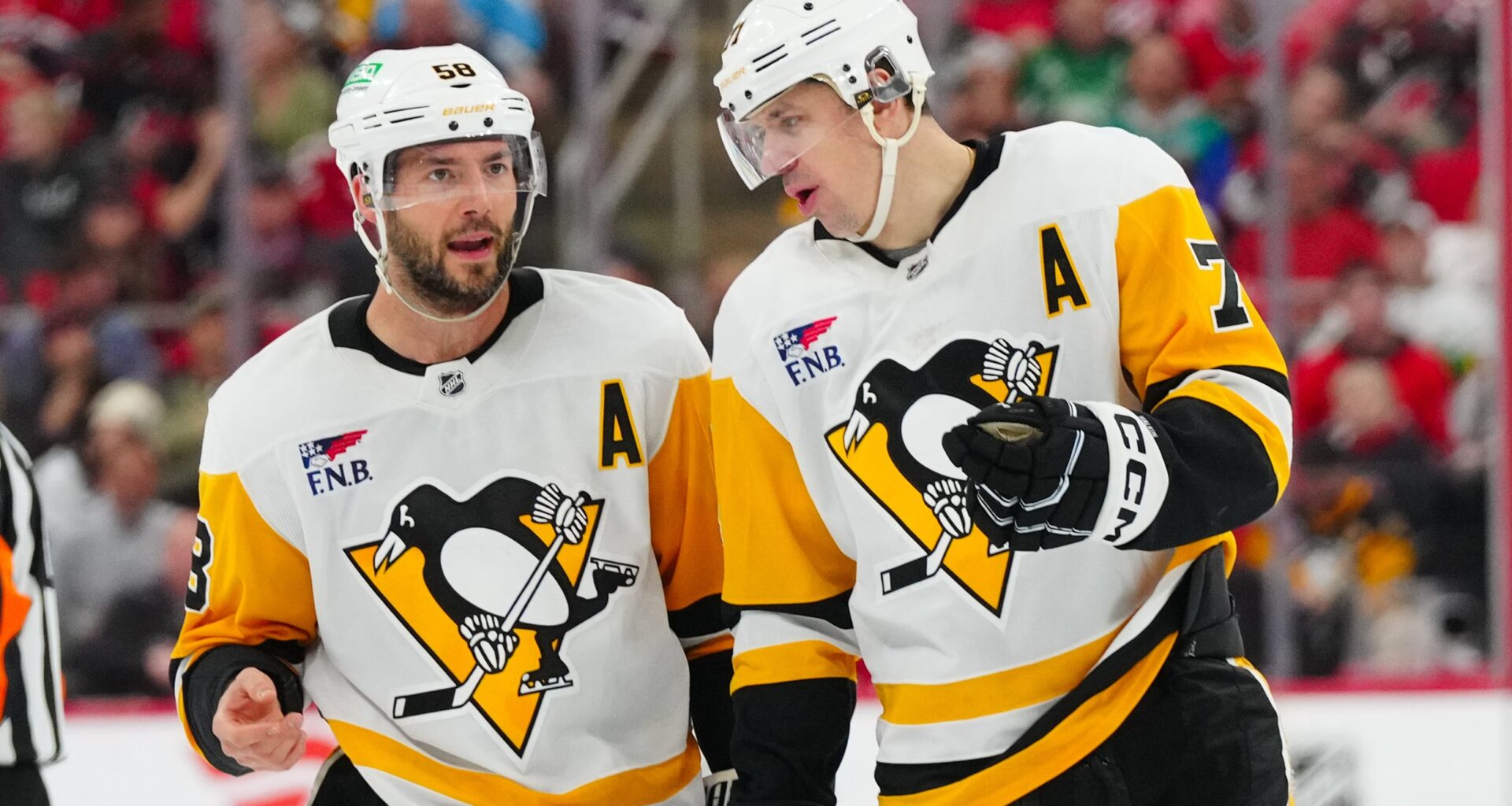
LAS VEGAS — Fears over a further crippling drop in the Pittsburgh Penguins’ offensive production following the NHL’s five-game suspension of Evgeni Malkin may have been overblown.
The team is certainly struggling to fill the void left by Sidney Crosby at the top of the lineup, as the team’s faceoff percentage has varied wildly, Rickard Rakell has struggled to produce offensive in the middle, and rookie Ben Kindel has engaged the difficulties of playing a higher level of competition while also being needed to score.
But in the three games without Malkin, the team has scored four, five, and four goals, respectively.
On ordinary nights, those totals should have been enough to win at least two of the games. Instead, the Penguins have a dubious three-game points streak but only one win, a 5-4 overtime victory over the Boston Bruins Sunday.
The Penguins are struggling to contain top lines and win those battles, but the middle six is putting the puck in the net. Tommy Novak has risen to the challenge at both ends of the rink. He has three points (2-1-3) and is a plus-4.
Anthony Mantha has also submitted his best for the falling production and has three goals and is a plus-2.
However, the biggest contributor has been Egor Chinakhov, who has five points, including four goals in the three Malkin-less games.
No, the Penguins were not particularly good against the Carolina Hurricanes, and once the emotion of the two-goal comeback subsides, the tape will show they were over-matched.
But the uphill war waged against Carolina and prior games exiting the Olympic break offer a very clear glimpse into the Penguins’ future, and one that is not necessarily good for the championship core-three.
First, the team still badly needs Crosby. The effort to create a team that can carry Crosby rather than the unfortunate contrariwise, is still a work in progress.
The games since the break have also shown that the team can indeed move on without Malkin.
But the run of competition since the Olympics has also demonstrated how much defenseman Kris Letang has slipped as this season has dragged along and included more travel than every other NHL team.
The 19 or so games in which Letang played with now-traded Brett Kulak were easily the best of Letang’s season. Before Kulak’s arrival, Letang’s offensive numbers were notably subdued, as was his game. Sometimes his game was a largely unspoken problem.
With Kulak, Letang’s numbers jumped to well above 50% in Corsi, xGF, and scoring chances. The eye tests confirmed the positive statistics.
However, in the aftermath of the Kulak trade to the Colorado Avalanche in exchange for left-handed defenseman Sam Girard, Letang was a problem. Despite above 50% advanced analytics, there was a spate of turnovers, missed assignments, and a lack of breakouts. The troubles meant the team was playing in the wrong direction, and Girard-Letang were on the ice for three goals against over five games, while seeing just one goal for.
Bringing the issue full circle, the game against Carolina showed Letang’s current status. There just weren’t the singular breakouts in which Letang could take the puck and … just go. Erik Karlsson did it several times. Ryan Shea did, too. However, the rest of the blue line spent more time defending than creating an attack, including Letang.
As Penguins general manager Kyle Dubas tries to hold his cards close to his chest, his hand becomes clearer.
Malkin and Letang have been through hell. Several times. Injuries have savaged both, and Letang has the additional burden of health issues, too. As they approach 40, Malkin is having a moment in the sun, while Letang is getting burned.
But they are approaching 40.
Dubas won’t find a better player on the free agent market than Malkin, but as the emotions subside on that matter, just as they settle following the Carolina game, perhaps finding a better player in the immediate isn’t the crux of the issue. Perhaps it’s opening that spot to find a player who will be with the Penguins beyond the immediate.
Kris Letang
The core-three have thrilled fans for two decades, and they sacrificed greater fame and fortune elsewhere to remain loyal to the organization. In a perfect world, that counts for a lot.
Their championships and place in team history make any interference with their playing futures a touch subject, as evidenced by the vociferous support Malkin has received.
No, that perfect world of repaying loyalty doesn’t exist, and the passage of time only creates the need for new. And it seems Letang is increasingly struggling, making the uncomfortable seem increasingly inevitable.
Letang’s contractual status is diametric to Malkin’s. While Malkin will be a free agent with absolutely no control, Letang has a 35+ contract both a no-movement clause and, beginning on July 1, a 12-team approved trade list (currently, it’s a 10-team approved list).
The 35+ stipulations became reality when former GM Ron Hextall included signing bonuses, thereby front-loading the contract. As a result, the contractual clauses and 35+-stipulation prevent Letang from being traded to 20 teams, and the team cannot waive him or assign him to the AHL without his permission.
The 38-year-old Letang’s contract has two more seasons with a $6.1 million salary cap hit. If he were to retire, there would be 0% salary cap savings, and 100% of his salary could count against the cap for each of the remaining two seasons.
There are no indications that Letang has considered or will consider retirement.
However, there is one weapon at Dubas’s disposal that would save real-world money and push the Penguins’ roster forward. If the Penguins buy out Letang when the window opens in June, like a retirement, they would receive 0% cap savings over the next two seasons, but would only pay the player two-thirds his salary spread over the next four seasons.
For cap math and confirmed to us by the cap wizard at PuckPedia.com, Letang’s salary over the next two seasons is $3.8 million in each season. The Penguins would owe him two-thirds of that ($5.06 million) and the entirety of his $1 million signing bonus owed in each of the next two seasons, totalling $7.06 million paid, instead of $9.6 million.
The benefits are easy to see. A buyout would save the Penguins’ new ownership group just under $2.6 million, while spreading the $5.06 million over four years and furthering Dubas’s ability to reshape the roster.
Of course, one problem in a Letang buyout would be the lack of viable options in the organization to play on the right side. Harrison Brunicke, 19, did not fare well this season and probably needs a season or two with the Wilkes-Barre/Scranton Penguins, beginning next season.
There are no other RHD prospects within shouting distance of the NHL, so the need would have to be filled via free agency, which would essentially mean the team is paying two players for that specific roster spot.
In the thick of the playoff chase, it seems the Penguins’ future is also coming into focus. Some of it will be for the good, and some will be a venture into the unknown. Perhaps through attrition, or through managerial force, there will be roster turnover following this season. There simply has to be.
But the great turnover won’t happen yet, at least not without one more good playoff fight.
Tags: Evgeni Malkin Kris Letang kyle dubas Pittsburgh Penguins
Categorized:Penguins Analysis