
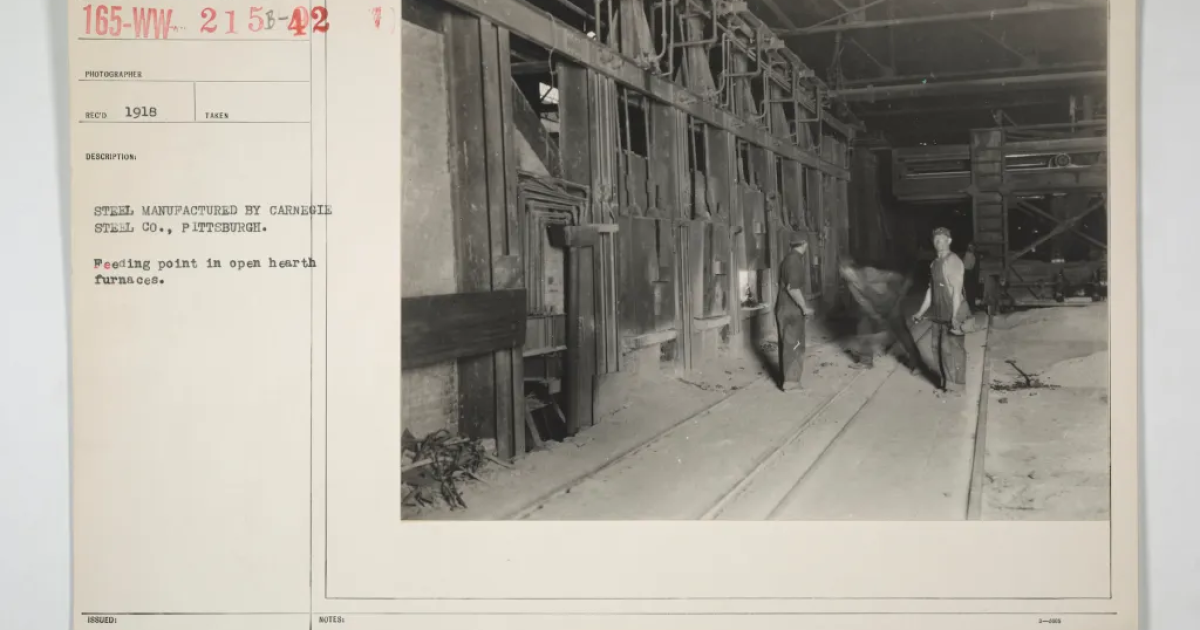
A new book from Chris Briem, regional economist at the University of Pittsburgh, untangles Pittsburgh’s industrial history. “Beyond Steel: Pittsburgh and the Economics of Transformation” looks behind the factory floor to a time when steel reigned, and follows the region through its reinvention that pulled on varied sectors — health care, university research and technology.
This interview transcript has been edited for clarity.
Julia Fraser: There’s been a number of books about Pittsburgh’s history. What did you see that was missing from that canon? Why write this book?
Chris Briem: There are a lot of great books on the history of Pittsburgh, especially [on] the aftermath of and the impact of the decline of steel here. And there’s also a lot of great books on the national steel industry [that ask] “Why did the American steel industry lose its competitiveness against other producers in the world?
I think a lot of folks just put those two stories together. They conflate them: “Why did steel decline in Pittsburgh? It’s just because of the trends of what happened to the national steel industry.”
And one of the main things I argue is that’s not really true. I think there’s a unique story about why steel declined in Pittsburgh specifically — even if there were not difficult times in the national steel industry, our regional steel industry probably would’ve gone into decline.
Steel has been central to the region’s identity, even though it’s been a while since it was the dominant industry. Going back in time, can you give me a sense of what once was? Just how big was steel?
Peak manufacturing, which is really the peak of steel production in Pittsburgh, [occurred] probably in the 1950s. We probably had about 380,000 or 400,000 manufacturing jobs here in Southwestern Pennsylvania.
Most of those jobs were directly or indirectly here because of the steel industry. That made up about 40% of all jobs. If you really add in all the jobs created by the wages that workers spent — that money in the economy and other stuff — it’s an even bigger chunk. We had been a steel region at that time for almost a century.
It [took] a long time to build up this mature concentration of heavy industry here in the region.
There’s a narrative that looks at the collapse of steel that began in the late 1970s, and that’s a turning point for the region’s economy. But in your book, you talk about how that decline began much earlier and was much more complicated. What’s the arc in the story of Pittsburgh’s steel-centric economy?
I argue pretty strongly that the peak of competitiveness of the regional steel industry wasn’t just 50 or 60 years ago, but now, almost a century ago. I think, from the first couple decades of the 20th century, you saw the first warnings that steel would not be so central to the regional economies.
The question is — as I go into in the book — why did it last so long? There’s a flip side of this. We did remain a steel region well into the 1970s. The collapse that we all remember, I say, really didn’t begin until the very first part of the 1980s, but we weren’t competitive long before that.
We’re not a single industry town anymore. How did that change?
This was a very diverse economy before steel came. The oil refining industry started here. We had shipbuilding here, iron and glass, and I could go into many other industries.
What happened is that steel displaced all that economic diversity, or much of it. And only after steel went away was there the opportunity for many other industries to grow and bloom.
People ask me often — what has replaced the steel industry in Pittsburgh? And my general answer is that nothing has replaced the steel industry in Pittsburgh.
What has happened is slow but steady growth in a lot of other industries. It is true that, if you look at job creation, it has come from health care and education and research related to that — eds and meds, finance, and of late technology outside of the university. A lot of technology is embedded in university research here. But none of those things will ever fill the role of steel in the region.
Something I found really interesting in your book is the trajectory of working women in Pittsburgh. In Pittsburgh, for a long time, women weren’t a significant part of the labor force. Why was that the case, and how did that shape the region’s workforce?
Heavy industry, particularly the steel industry, was very male dominated. But that doesn’t quite explain why we had such low, what we call female labor force participation. And part of that has to do with the nature of shift work in the steel industry. If the primary wage earner was shifting between daytime and afternoon or nighttime work, it made it almost impossible for a second wage earner to take on employment that matched that.
So any household that had dependents probably was not going to be able to find work, and that got embedded in our culture. For a while — many decades — U.S. Steel wouldn’t hire female workers except in certain circumstances, maybe widows or [spouses of] disabled former steel workers, if that was their husband.
And it really extended. We had low female labor force participation here into the 1980s. I mean by that, lower than elsewhere, lower than other major regions. And that was a challenge as we tried to rebuild prosperity once steel left because we needed workers across the board. And by that time, women were a large part of the workforce [elsewhere] and they weren’t really part of the workforce here.
Where is Pittsburgh’s economy today? And what are you following to see where it’s headed?
Look, I think the Pittsburgh region is doing well — or at least better than some people think — at attracting new investment and growth. That message gets confused because we are a region that saw so many young people leave in the past. We are an older region today. If you focus just on top-line population or employment growth, we might not compare well compared to places that are growing fast.
But that often is the reflection of demographic trends baked in 40 or 50 years ago. It’s not reflecting current trends or current competitiveness. So it depends. I think we have the firms that are growing and competing well nationally. But again, you’ve gotta get beyond the simple way of looking at it as just — are we growing in population? Are we growing in employment?
We may not be for awhile, but I think we are a place that is certainly increasing the quality of life and a place where people do want to live and work.
What’s the one takeaway you would want readers to get from your book? What is the thing that, for you, most stands out?
I’ll just go back to one thing — the decline of steel in Pittsburgh was well forecasted.
It might’ve been a surprise to many people on the ground, but many predecessors of mine or other folks looking at it saw this coming. The challenge was — and why the 1980s were so cataclysmic here — was that those messages weren’t just ignored, but in many cases actively suppressed.
You have to realize that change is coming. Steel looked like everything for Pittsburgh, and it had for a long time. Nothing is going to be fixed like that. In the future, the things that look like they’re the most prosperous or most successful industries or policies now will probably not be the same in the coming decades.
And you want to be able to adapt and change in ways that maybe weren’t necessary for much of Pittsburgh’s modern economic history.