
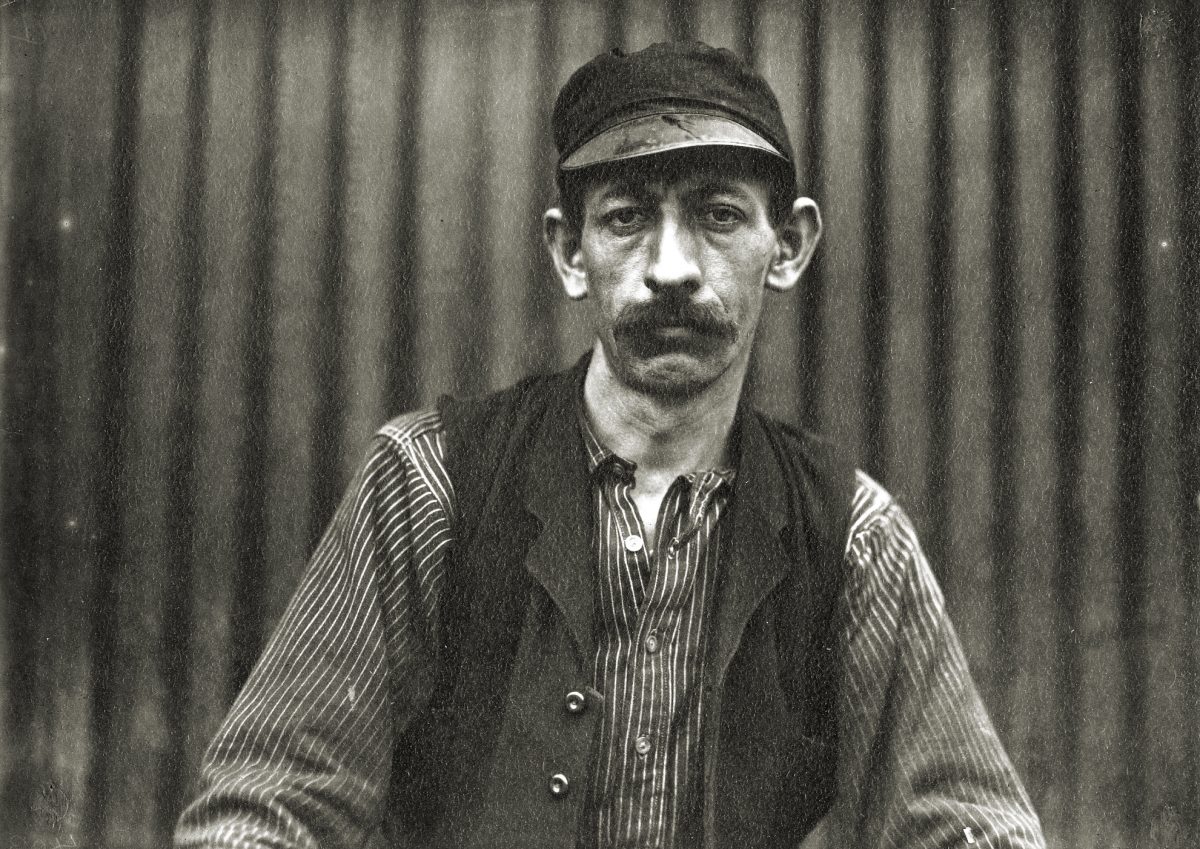
A German steelworker in Pittsburgh in 1908. It’s included in the exhibit “Lewis Hine: Pictures of America.”
As the nation marks the 250th anniversary of the signing of the Declaration of Independence this year, it is important not only to understand where we are and what brought us here, but also to consider from whence we came.
That perspective informs The Frick Pittsburgh’s decision to present “Lewis Hine: Pictures of America.”
“It’s the intersection of art and history that makes it authentic to the Frick,” said Dawn Bream, chief curator and director of collections.
The traveling exhibition, on view through May 17, features more than 70 photographs, including Hine’s images of newly arrived immigrants at Ellis Island, working children, steel industry laborers and workers constructing the Empire State Building.
Driving change
Born during the Gilded Age in 1874, Hine began seriously working as a photographer in the early 1900s. His career spanned decades marked by rapid industrialization, waves of immigration, urban poverty and the rise of factory labor.
His work on the Pittsburgh Survey in 1907 and 1908 documented industrial life in the city, and became one of the first large-scale investigations of an American industrial center. Organized by reformers and published through the Russell Sage Foundation, the survey examined working conditions in cigar factories, as well as the steel and glass industries.
“It was a comprehensive sociological study that drove change,” Bream said, noting that many visitors may recognize elements of their own family histories in the images.
Hine, who worked as a sociologist and educator, taught at New York’s Ethical Culture school. He took his students to Ellis Island, putting human faces on the “huddled masses yearning to breathe free.”
“He never defined himself as an artist and picked up photography as a teaching tool, knowing how to frame images to drive social change by representing reality,” Bream said. Ultimately, Hine is responsible for some of the most iconic images of the 20th century.
A pioneer of documentary photography, Hine often went to great lengths to expose exploitative labor conditions. While working for the National Child Labor Committee, he posed as a Bible salesman, fire inspector and postcard vendor — whatever was necessary to gain access. These disguises allowed him to photograph children working in mills, mines, canneries and factories.
His images helped build public pressure that contributed to major child-labor reforms and, ultimately, the Fair Labor Standards Act, which established a federal minimum wage, overtime rules and restrictions on many forms of child labor.
The Frick exhibition
Roughly 70 images are included in the exhibition and “the ones with the children are the most difficult to view,” Bream said.
Bream also credits Lauryn Smith, assistant curator at the Frick, with tailoring and rewriting exhibition signage to resonate with regional audiences.
Modern reproductions have been added to broaden representation within the exhibit. “The exhibition didn’t have images of breaker boys (who worked in the mines), so we added them as well,” Bream said.
The exhibition is complemented by tours of Clayton, the home of industrialist and art collector Henry Clay Frick. The award-winning “Gilded, Not Golden” tour underscores the stark divide between extreme wealth and working-class hardship during the era Hine documented.
More than a century later, Hine’s photography endures as a powerful educational tool and historical record. His work stands apart for its empathy.
“He humanized the people he photographed and represented them with dignity and care that’s very present in the images,” Bream said.