
PITTSBURGH — At 4 p.m. ET on Wednesday, a new NFL league year officially opened — and with it yet another Aaron Rodgers Watch began.
Last offseason, the Pittsburgh Steelers were willing to remain patient, waiting all the way until mandatory minicamp in June for the four-time MVP and future Hall of Fame quarterback to commit. While general manager Omar Khan said at the NFL Scouting Combine that he doesn’t anticipate the indecision will drag out “like it did last year,” and the prevailing sentiment from inside the organization is that the team believes an answer will come sometime this month, the Steelers ended Wednesday as one of the NFL’s few teams without a clear QB1 in place or an obvious path to land one.
That said, while the Steelers don’t have a signature on a dotted line, the moves they made suggest they’re trying to win in this 42-year-old QB’s window.
That started even before the floodgates opened on Monday’s two-day negotiating period, when the Steelers traded for Colts receiver Michael Pittman Jr. Anyone who follows the Steelers knows that wideout was the most glaring hole on the roster — it has been for really two years. But beyond simply adding a player capable of filling the WR2 role, it’s the type of receiver the Steelers targeted that also fits.
Rodgers is meticulous about how receivers run their routes. In one of the defining moments of the season, Rodgers broke his wrist in Week 11. Even before he went to the sideline for attention or the locker room for X-rays, he ran up to second-year receiver Roman Wilson to tell him, quite loudly, what he did wrong.
Then in Week 14, the Steelers made Wilson a healthy scratch and activated 31-year-old Marquez Valdes-Scantling and 35-year-old Adam Thielen for the first time. After a season-altering win in Baltimore, Rodgers said, “I’m not a big believer in coincidences. I’ve got to think that just Marquez and Adam made a difference from a professionalism standpoint.” Never mind the fact that Thielen had one catch for 4 yards and Valdes-Scantling had nothing.
By signing Pittman, who will turn 29 in October, the Steelers presumably are adding what Rodgers has shown — through his words and actions — he prefers: a veteran who understands the nuances of route running, who can interpret disguised coverages on the fly and who knows how to approach a week of preparation. Pittman, who agreed to terms on a new three-year, $59 million deal shortly after the trade, is a hard-working receiver known for playing through injuries and blocking hard for teammates. He was once effective enough to be a WR1 but is now willing to serve as a complement to DK Metcalf as a WR2.
Stylistically, Pittman also fits the West Coast offense that Mike McCarthy runs and Rodgers has thrived in. Pittman ran the 10th-most hitch routes in the NFL last year, according to TruMedia, a staple route in the WCO. He’s also been productive with a high volume of crossing routes, digs and other in-breaking routes that target the parts of the field where Rodgers would want to throw.
Elsewhere on offense, the Steelers rounded out their running back room by agreeing to a two-year, $12.25 million deal with Rico Dowdle. It’s a reunion for the 27-year-old running back, who played his first four years under McCarthy in Dallas.
Meanwhile, on the defensive side of the ball, the Steelers addressed the most obvious hole by handing cornerback Jamel Dean a three-year, $36.75 million contract. They also secured some depth behind him by re-signing Asante Samuel Jr. While Rodgers bounced back from a poor 2024 season with the Jets, no one thinks he’s going to be at his MVP best as he approaches his 43rd birthday in December. For the Steelers to reach any type of ceiling, they need a well-built defense to play up to its collective salary-cap hit. By filling a critical position with an impact player (who will be 30 in October), the Steelers are attempting to round out the defense in a way that would support the quarterback — and do so with an immediate answer rather than relying on a developmental player.
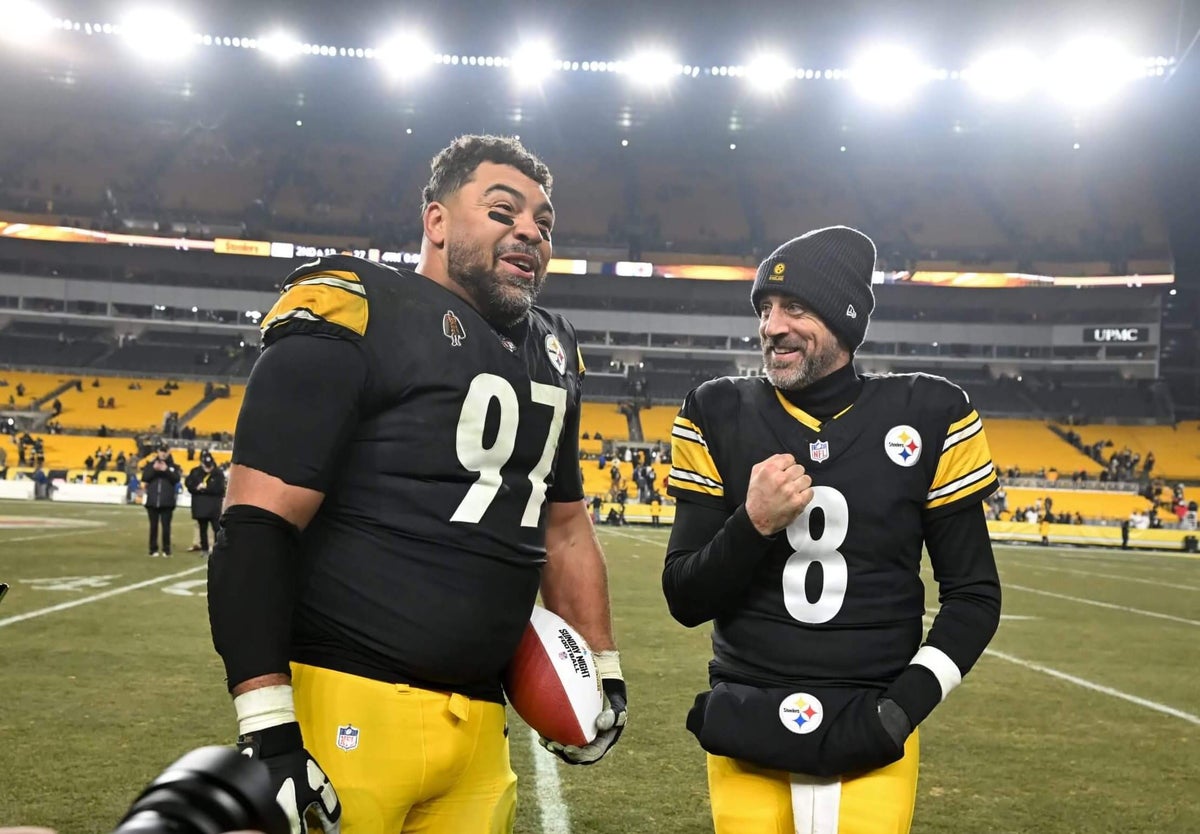
Finally, the Steelers signed 36-year-old defensive tackle Cameron Heyward to a new two-year deal that became official shortly after the league year began. The extension ties Heyward to Pittsburgh through the 2027 season and frees up more than $5 million in salary-cap space, which could be used to continue to add.
That move, maybe more than any other, reinforces the Steelers’ vision. Beginning with Heyward in 2011, the Steelers rebuilt the defense by using first-round picks in nine of 10 years. They’ve since paid several members of that core handsomely and supplemented it with others in free agency. That group came together just in time to give Ben Roethlisberger one more chance to make a run. Now, in the years since Roethlisberger’s retirement, the Steelers have given several other veteran QBs that same chance to take a highly compensated defense and elevate it — first Russell Wilson and now Rodgers.
When coach Mike Tomlin stunned his team by stepping down in January, it could have been an opportunity to step back and reevaluate that process. The coaching change could have provided an opportunity to turn over the roster and get younger, even if it meant sacrificing something in 2026. But the day after Tomlin’s resignation, team president and owner Art Rooney II made it clear that his hand wasn’t anywhere near a reset button.
“I’m not sure why you waste a year of your life not trying to contend,” Rooney said. “Sometimes you have the horses, sometimes you don’t. But I think you try every year.”
Right or wrong, the Steelers have chosen to continue along the same trajectory, trying to address their weaknesses and put together the best possible team they can in 2026, even if that means doing so with a 29-year-old receiver, soon-to-be 30-year-old corner and nearly 37-year-old defensive tackle.
Only time will tell if a 42-year-old quarterback joins that group and, more importantly, if his performance will justify the commitment to the current window.