
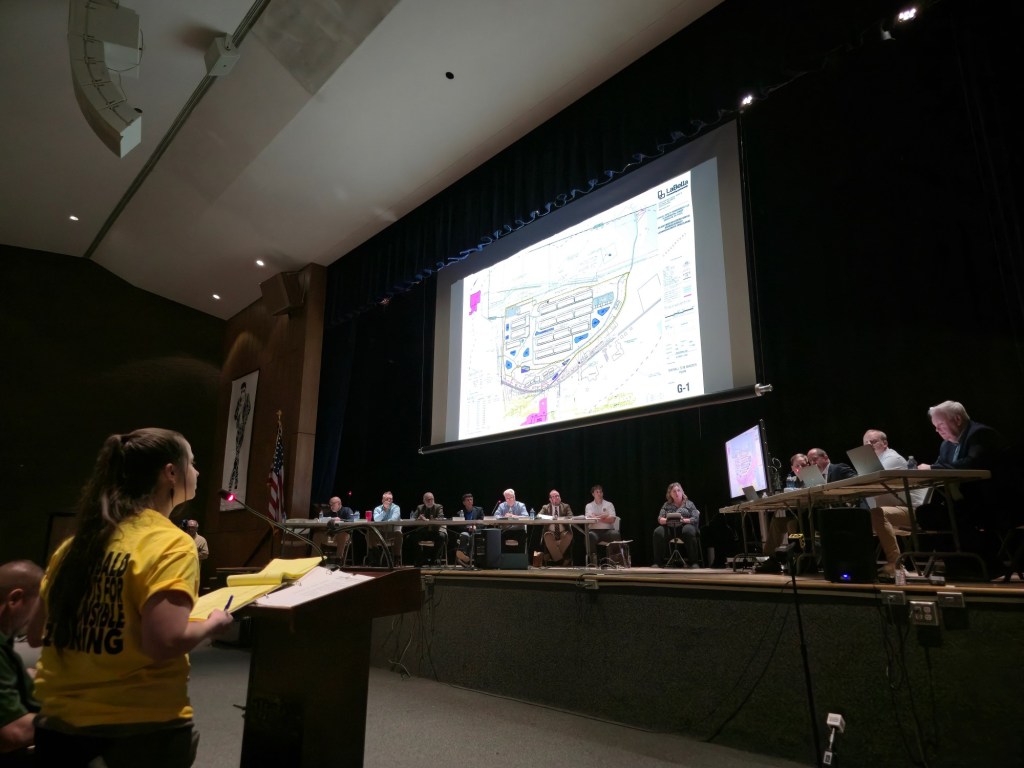
ARCHBALD — A raucous crowd drowned out testimony from data center representatives Tuesday night, vocalizing their opposition to more than a dozen data centers along Business Route 6 and Route 247.
The borough held its second public hearing on the Wildcat Ridge Data Center Campus as representatives for the project touted new technologies and financial incentives to make the case for developing one of Northeast Pennsylvania’s largest data center campuses above Archbald’s Eynon and Sturges sections.
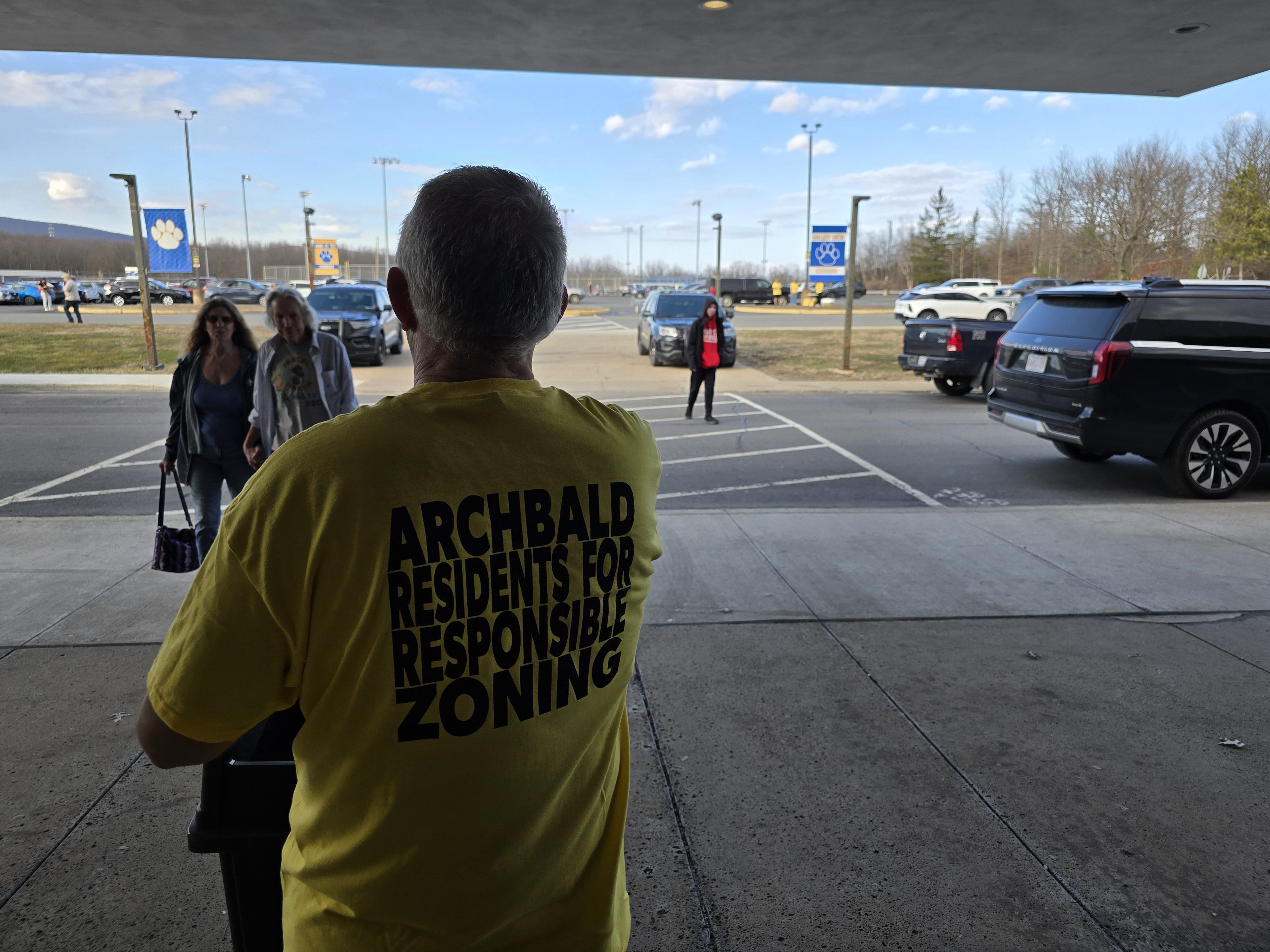
Their pitch faced a hostile reception from 400-plus vociferous community members packing the Valley View High School auditorium. Many of those in attendance wore bright yellow T-shirts with “Stop Data Centers Protect NEPA” on the front and “Archbald residents for responsible zoning” printed across the back in large black lettering. Some held up matching yellow-and-black “NO DATA CENTERS” signs throughout the night.
Shouts of “Go home!” and other jeers from the animated crowd prompted borough officials to step in multiple times to regain order, with council President Dave Moran at one point threatening to postpone the meeting due to the interruptions.
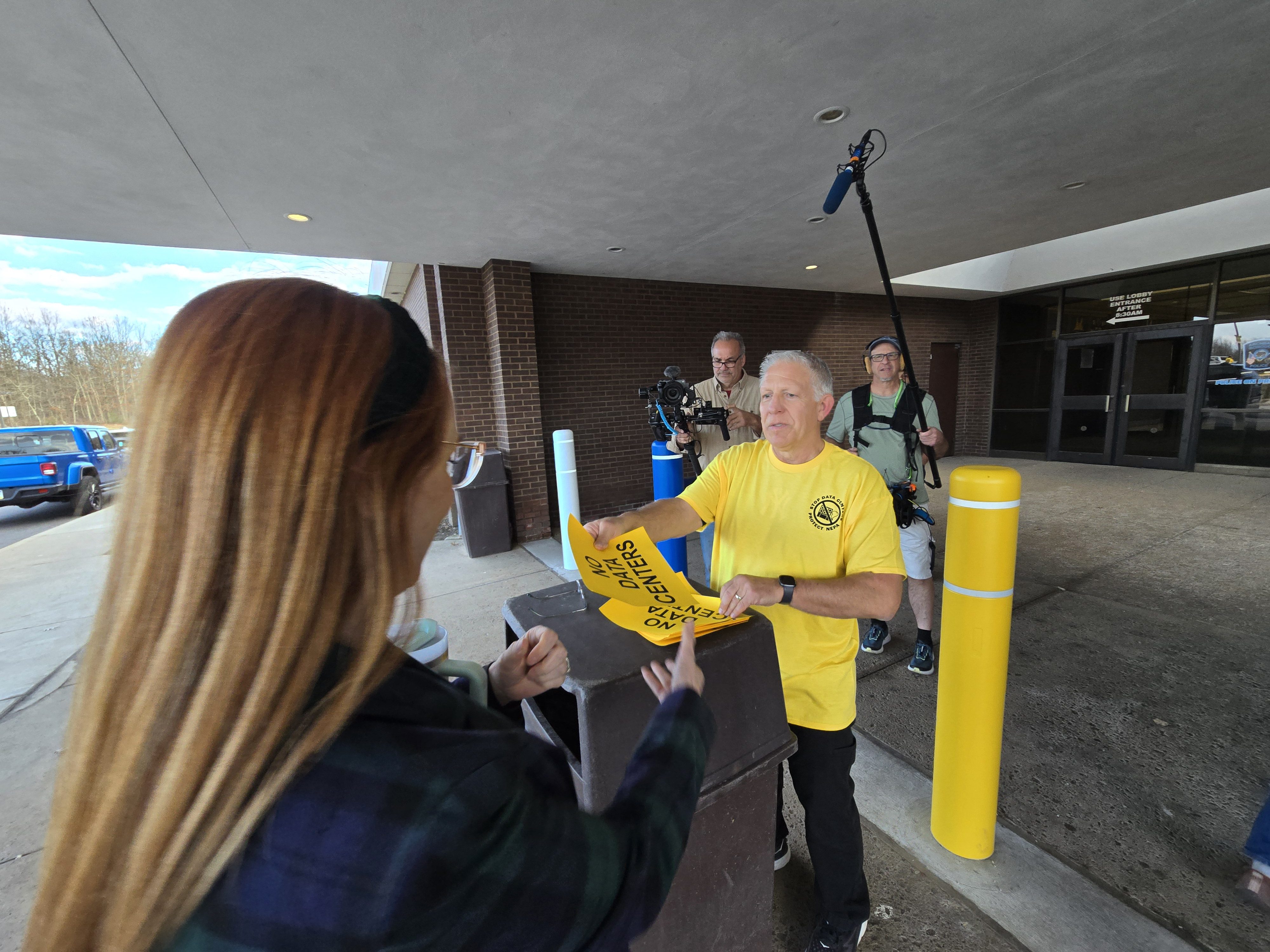
Archbald resident David Polansky hands out “NO DATA CENTER” signs outside the Valley View High School in Archbald on Tuesday, March 10, 2026. Polansky said he was handing out his third batch of 500 signs.
(FRANK WILKES LESNEFSKY / STAFF PHOTO)
Archbald resident David Polansky hands out “NO DATA CENTER” signs outside the Valley View High School in Archbald on Tuesday, March 10, 2026. Polansky said he was handing out his third batch of 500 signs. (FRANK WILKES LESNEFSKY / STAFF PHOTO)
Show Caption
1 of 2
Archbald resident David Polansky hands out “NO DATA CENTER” signs outside the Valley View High School in Archbald on Tuesday, March 10, 2026. Polansky said he was handing out his third batch of 500 signs.
(FRANK WILKES LESNEFSKY / STAFF PHOTO)
Brooklyn-based Cornell Realty Management LLC seeks approval from borough council to build 14 two-story data centers, each up to 80 feet tall with a 202,340-square-foot footprint, across 574.2 mountainside acres on Business Route 6 and extending up Route 247, or Wildcat Road. Cornell Realty Management also proposes to build 316,000 square feet of commercial space, though to the chagrin of some council members, officials from Cornell noted that while they are actively looking to develop it, the commercial space is not mandatory.
Wildcat Ridge became Lackawanna County’s first data center campus proposal in January 2025. Just over one year later, it is one of six campuses proposed in Archbald and one of at least 12 proposed throughout the county, including in Clifton and Covington townships, Dickson City, Jessup, Olyphant and Ransom Twp.
Archbald held its initial public hearing for the project on Jan. 28 but adjourned after about two hours.
On Tuesday, an even larger crowd turned out for the second, four-hour-long hearing, where two witnesses testifying on behalf of Wildcat Ridge discussed the project’s water and electricity needs, cooling technologies, backup generators, emergency plans, job creation and tax revenue. They faced scrutiny from an attorney and residents during cross examination.
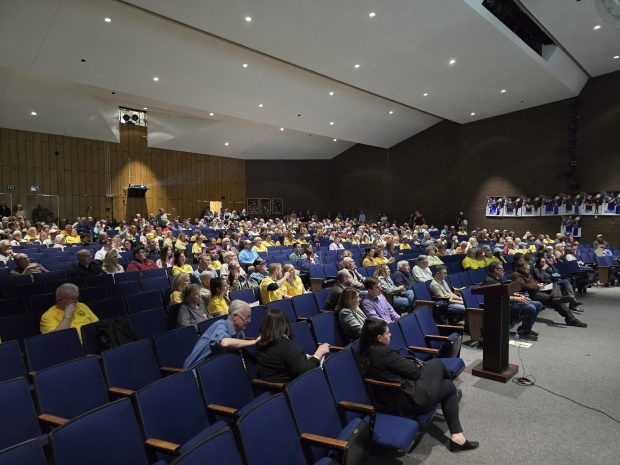 Residents filled the Valley View High School auditorium in Archbald for a public hearing on the Wildcat Ridge Data Center Campus on Tuesday, March 10, 2026. (FRANK WILKES LESNEFSKY / STAFF PHOTO)
Concerns about the project extended beyond the crowd, with council members also pressing the developer.
In an attempt to calm the crowd at one point, Councilman Louis Rapoch emphasized the borough has to allow data centers under state law.
“We know you don’t want it. We probably don’t want it, but we have to listen to that,” he said. “This is something that we have to allow one way or the other.”
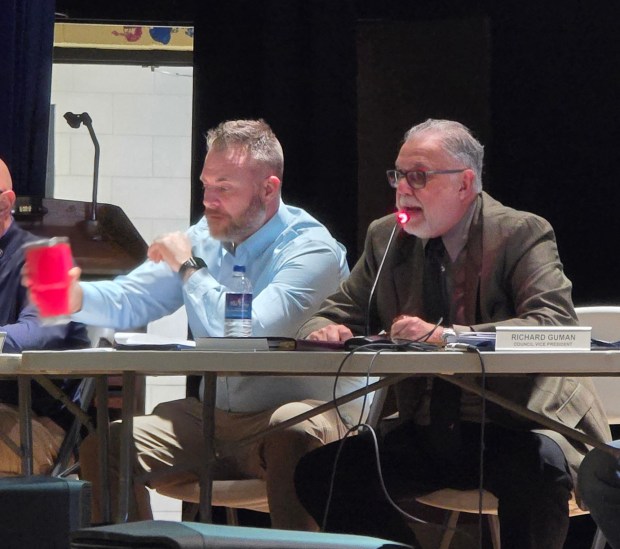 Councilman Louis Rapoch, right, speaks during a public hearing at the Valley View High School in Archbald on Tuesday, March 10, 2026. (FRANK WILKES LESNEFSKY / STAFF PHOTO)
When Archbald Borough Council voted in November to amend its zoning to regulate data centers, it created multiple “data center overlay” districts — including the proposed site of Wildcat Ridge — that permit data centers as conditional uses, meaning council must approve each individual project following a public hearing while requiring developers adhere to a slew of conditions established in the legislation.
Sustaining 14 data centers
While data center campuses face widespread opposition throughout Northeast Pennsylvania, Wildcat Ridge has been especially controversial due to its water and electricity needs, which it documented in a 777-page conditional use application submitted to Archbald on Dec. 15.
The campus seeks to use just over 3.3 million gallons of water per day during the hottest summer weather while requiring 1,600 megawatts, or 1.6 gigawatts, of power to operate.
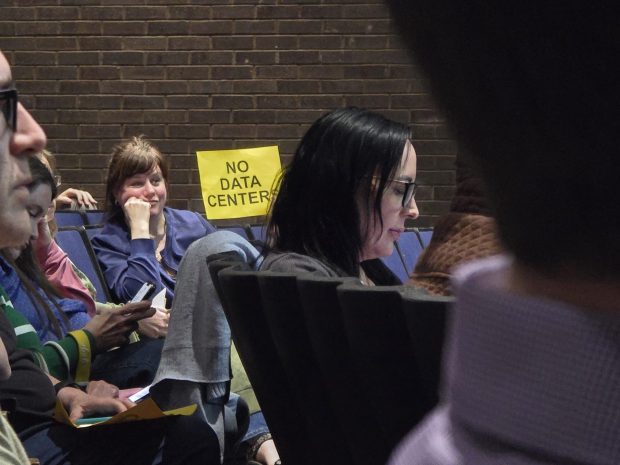 A woman holds up a “NO DATA CENTERS” sign during a public hearing on the Wildcat Ridge Data Center Campus at the Valley View High School in Archbald on Tuesday, March 10, 2026. (FRANK WILKES LESNEFSKY / STAFF PHOTO)
Data center consultant and adviser Ben Mitten testified Tuesday that they designed an “adiabatic cooling system” for the campus that would use both air and water to cool the computer hardware inside the data centers. Rather than implement an open-loop system that relies on evaporating water, which would use an estimated 21 million gallons per day, Wildcat Ridge’s adiabatic system would be a closed-loop system with air-cooled chillers that would then use water during peak summer months, according to Mitten. The project is also exploring tapping water from the mines below, though that unprecedented method would require significant permitting and studies.
Mitten is the founder and CEO of Nuclei Data, which offers “fully integrated development services for data centers and energy infrastructure,” according to its website.
Through testimony guided by questions from project Attorney Edmund J. Campbell Jr., Mitten said the data centers could function without using water in the event of a drought or other water disruption, though the adiabatic system would need to use more power.
“It can work completely without the use of water if required,” Mitten said.
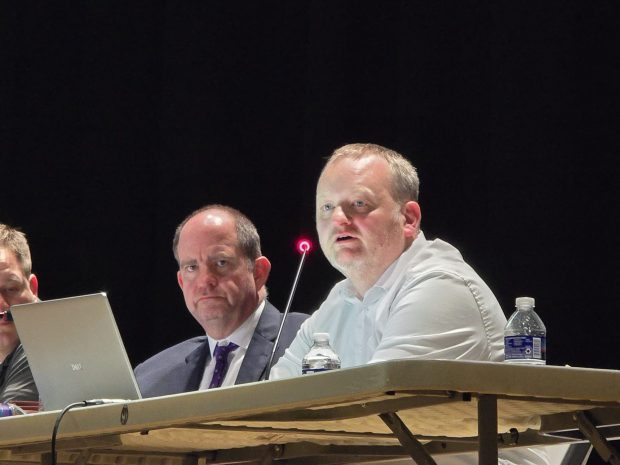 Cornell Realty Management Attorney Edmund J. Campbell Jr., left, looks on as data center consultant Ben Mitten speaks during a public hearing on the Wildcat Ridge Data Center Campus on Tuesday, March 10, 2026, at the Valley View High School in Archbald. (FRANK WILKES LESNEFSKY / STAFF PHOTO)
The system would initially need several million gallons of water, but they could truck it in via tankers rather than using the domestic water system, he said.
To ensure reliability during power outages, Mitten testified each data center would have as many as 41 backup generators, totaling 574 diesel generators across 14 buildings. Each 3-megawatt generator would have its own 2,000-gallon diesel fuel tank, Mitten said, explaining they need the capacity to run 24 hours. That translates to 1,148,000 gallons of diesel fuel stored on site across 574 2,000-gallon tanks.
Councilman Tom Aniska, who joined council this year after winning a seat in November, pointed out 574 generators would equal 1,722 megawatts.
“Invenergy in Jessup produces 1,485 megawatts of energy … so on that property, not an industrial property, you’re going to bring in more megawatts of power than is produced by the Jessup Invenergy plant?” Aniska asked.
“That is a possibility,” Mitten replied.
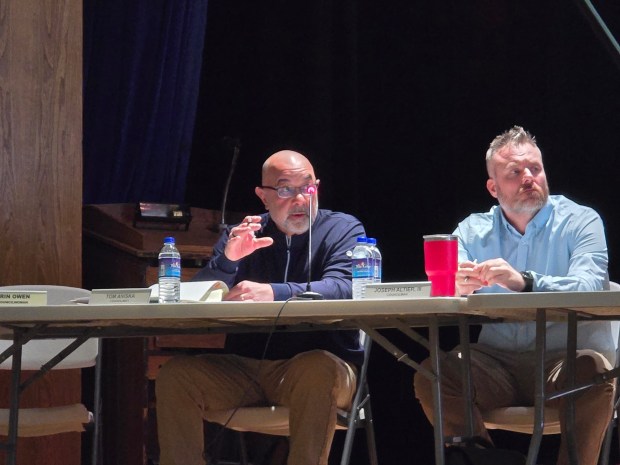 Councilman Tom Aniska, left, speaks during a public hearing at the Valley View High School in Archbald on Tuesday, March 10, 2026.(FRANK WILKES LESNEFSKY / STAFF PHOTO)
However, the 41 generators per building are a “worst-case condition” in case the end-user is something like a hospital system, critical infrastructure component or social media platform, Mitten said. New data center designs are drastically reducing the need for on-site generation, eliminating 80% to 90% of generators because of the power reliability that the electric utility can bring to the property, he said.
Each generator would need to run four hours every three months for maintenance, and Mitten said he traditionally sees one 24-hour power outage per year requiring the use of backup generators, though it depends on the weather. Campbell told council his client would accept borough approval of the testing schedule as a condition to their land development.
Questioning the developer
As conditions for approval, Archbald’s data center zoning requires “will-serve” letters from utility companies showing they have the capacity to serve a data center, and if a project uses nonpublic sources of water, like mine water, it requires a water feasibility study.
During cross-examination of Mitten, attorney Justin Richards, who represents a group of borough residents challenging Archbald’s data center zoning, pointed out the lack of a water feasibility study, “which would render the application incomplete or premature” if it moves forward with that plan, he said, eliciting loud applause from the crowd. Richards also cited the project’s letter of authorization with PPL Electric Utilities, pointing out it was sent from Cornell Realty to PPL, despite Archbald’s ordinance mandating that applicants must submit a letter from PPL.
Mitten said PPL does not issue letters of authorization.
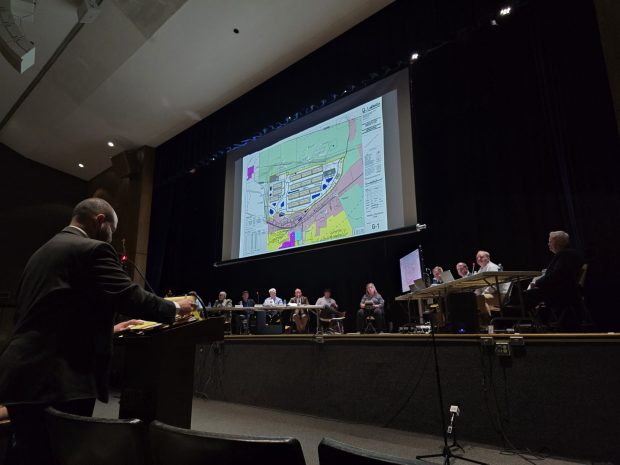 Attorney Justin Richards, who represents a group of borough residents opposing data centers, cross-examines witnesses from the Wildcat Ridge Data Center Campus during a public hearing at the Valley View High School in Archbald on Tuesday, March 10, 2026. (FRANK WILKES LESNEFSKY / STAFF PHOTO)
Aniska also asked about an apparent missed deadline, with PPL requiring a letter signed by June 20, but the application showing it was dated July 7.
Campbell responded they will supplement the record and confirm it’s in place; they wouldn’t be there if it wasn’t still valid, he said.
“You are asking us to make decisions based on information that is just not here,” Aniska replied, telling the developer, “You weren’t very well prepared.”
“I’m looking at words like ‘is expected,’ ‘we expect,’” Aniska continued. “I can’t work on ‘we expect.’”
Resident Tamara Misewicz-Healey questioned Mitten about false alarms that could strain the borough’s volunteer Fire Department, testing schedules for the generators and emissions from nearly 600 diesel generators.
Misewicz-Healey, who founded the 5,000-member Stop Archbald Data Centers Facebook group with her husband, Justin, also raised concerns about the amount of diesel fuel stored on site.
“I just looked up how much a very busy truck stop carries, and it’s around 100,000 gallons of diesel fuel,” she said. “This facility is looking at over a million — that’s 11 times the amount of fuel on top of a coal mountain. Are you familiar with Centralia, Pennsylvania?”
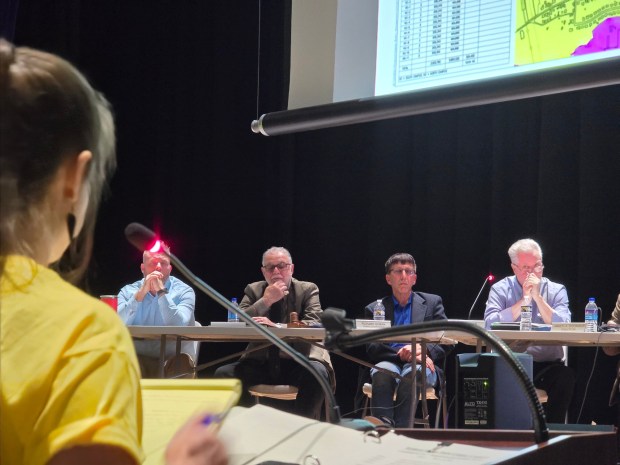 Archbald council members look on as Archbald resident Tamara Misewicz-Healey cross-examines representatives from the Wildcat Ridge Data Center Campus during a public hearing at the Valley View High School in Archbald on Tuesday, March 10, 2026. (FRANK WILKES LESNEFSKY / STAFF PHOTO)
Centralia is a Columbia County town that was almost entirely abandoned by residents due to a long-burning, underground coal fire.
As the project’s second witness on Tuesday, planning consultant Thomas Shepstone of Honesdale-based Shepstone Management Company presented a slideshow overview of a community impact analysis he compiled on Wildcat Ridge that estimated it would create 1,280 jobs while generating annual net revenues of about $7 million for Archbald, $15.2 million for Lackawanna County and nearly $21.9 million for the Valley View School District.
Shepstone, who recently worked with Dickson City to develop zoning standards that prohibited data centers on the same mountainside about 2.5 miles southwest of Wildcat Ridge, concluded the campus would not have a negative impact on the character of surrounding residential neighborhoods.
“I believe it’s a good location for this,” he said, prompting shouts from the crowd.
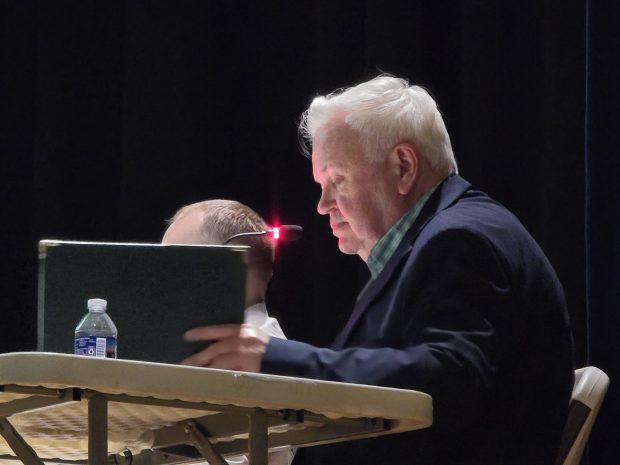 Planning consultant Thomas Shepstone testifies on behalf of the Wildcat Ridge Data Center Campus during a public hearing at the Valley View High School in Archbald on Tuesday, March 10, 2026. (FRANK WILKES LESNEFSKY / STAFF PHOTO)
In Dickson City, as the borough’s planner, Shepstone defended the decision during a Feb. 13 hearing not to allow data centers on the mountain above Business Route 6, saying, “It may not please some of the developers, but it’s something we feel is going to accomplish the objectives of the borough council, which are to protect the interests of the community.”
During cross-examination, Richards questioned Shepstone’s sourcing in his analysis, pointing out that while his presentation on Tuesday provided a list of 15 sources, his 22-page analysis attached to the conditional use application did not have that list.
“We thought about it afterwards,” Shepstone said. “We thought it’d be a good idea to provide it.”
Richards further questioned a five-page slideshow about data centers in Stafford County, Virginia, and an artificial intelligence search engine, Perplexity, that Shepstone cited as the basis for his employment projections, which estimated 688 data center jobs, plus an additional 593 office and retail jobs, including 255 “office building” roles with an annual salary of $90,000.
“You have confirmed here tonight that some of this data is based on this high school-style PowerPoint presentation that this borough council is supposed to rely upon to believe that this is reliable data for income that should be coming to the borough of Archbald, the county of Lackawanna and the commonwealth of Pennsylvania,” Richards said.
Shepstone stood by his figures.
As the hearing progressed, Rapoch, who began his first term on council in January, delivered one of the hearing’s sharpest criticisms.
“You people came in here like this is the Garden of Eden,” he said. “And you are the devil tempting us.”
The next Wildcat Ridge hearing will be April 13 at 5 p.m. in the Valley View High School auditorium, 1 Columbus Drive, Archbald.