
Photo by Eliza Boylan for The Lafayette
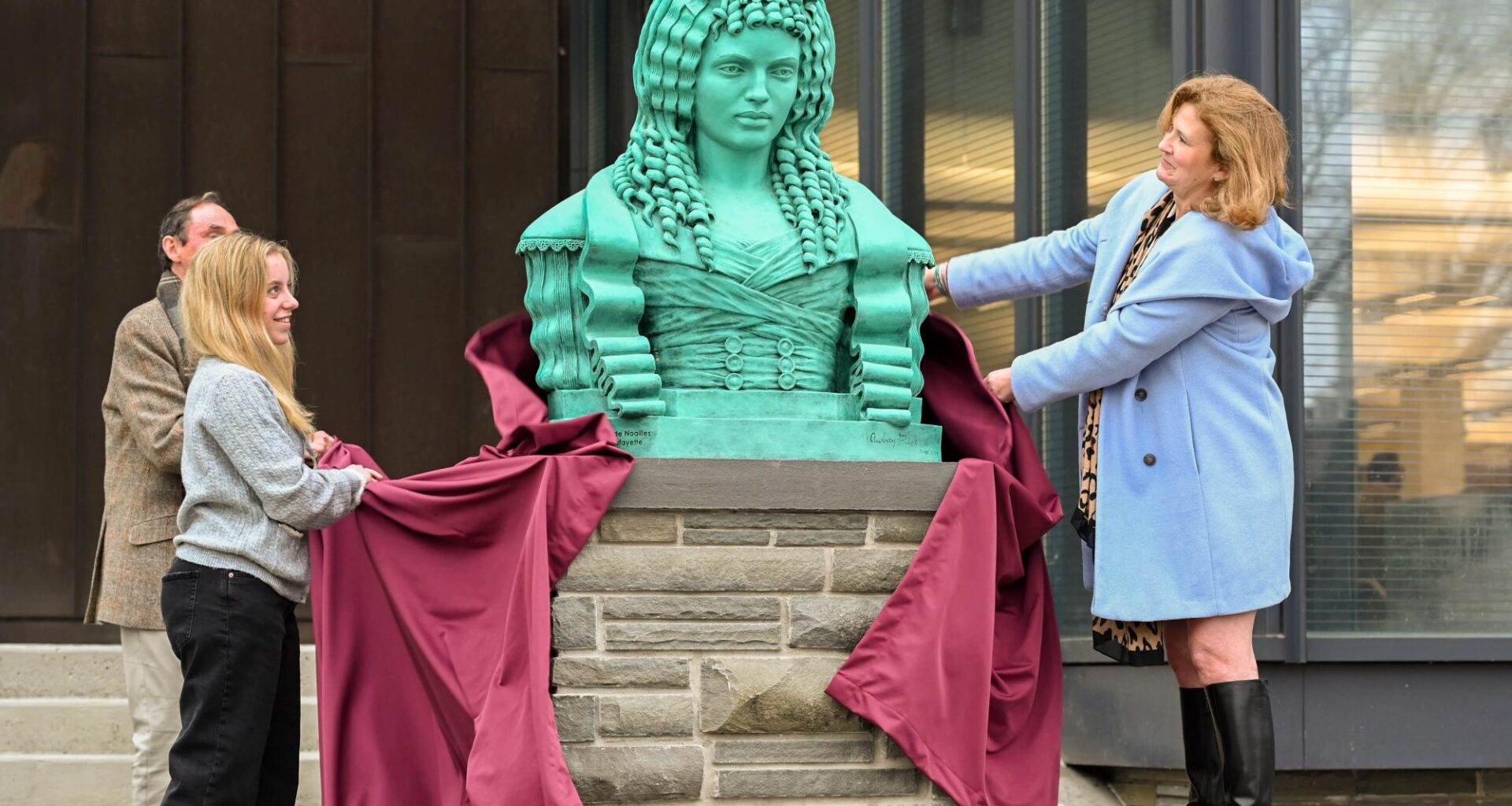
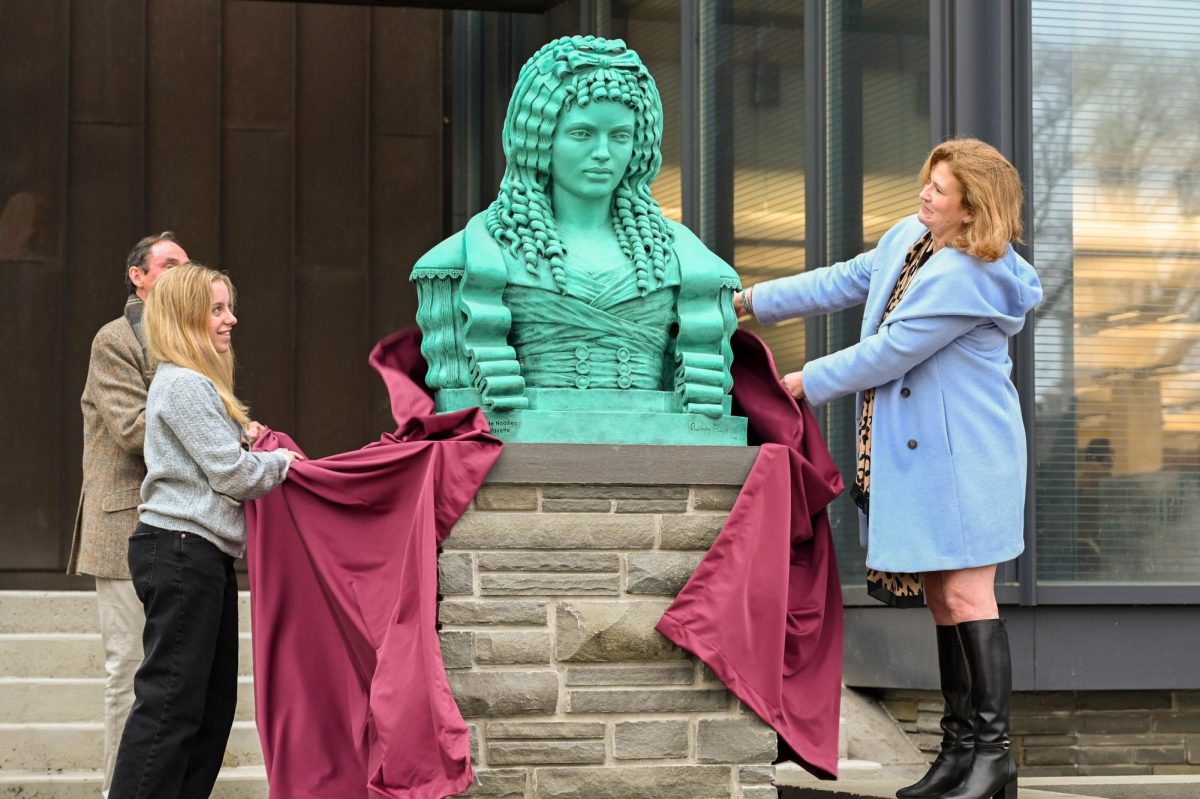
The Marquise de Lafayette is the first permanent statue of a woman on the college’s campus.
Audrey Flack knew her sculpture of Adrienne de Noailles would be her last.
The project was all-consuming: de Noailles, the wife of the Marquis de Lafayette, would wake her up in the middle of the night, demanding shoulders. Flack scrutinized materials from the Lafayette College archives, weighing how to best capture the contours of the French noblewoman’s face. Over time, she grew to identify with her.
Flack, a renowned painter and sculptor, died in 2024 before the sculpture was completed. She was 93. Her final work — the bronze bust of the Marquise de Lafayette — was installed Saturday on the steps of Skillman Library, capping the year’s annual Council of Lafayette Women Conference.
Depicted waist-up in a shocking turquoise, the Marquise’s expression is calm and placid. Her hair falls in loose coils around her neck, and a length of fabric waterfalls off her shoulders, dipping toward a blocky plinth made of stones from Skillman’s original facade.
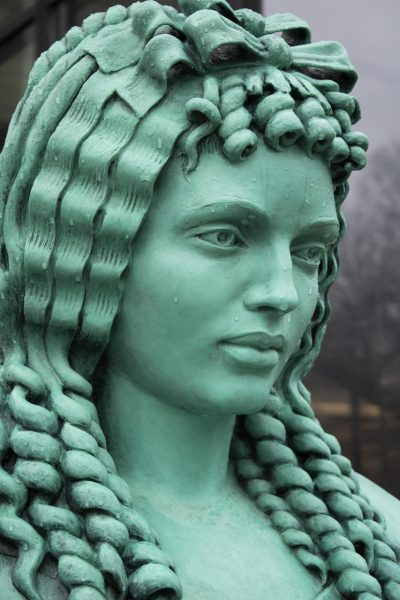 The bust’s bright green hue is expected to darken and deepen over time. (Photo by Elisabeth Seidel)
In some ways, said emeritus art professor Robert Mattison, the statue is “all women.”
The bust stemmed from a visit Flack made to campus in 2015, when she noticed a lack of art depicting women — “What about the woman behind the man?” Mattison, a long-time friend of Flack, recalled her asking.
After a visit to the archives, Flack soon became entranced by the Marquise, though the chance to bring her to life would not come until 2023, when the college began exploring art commissions to mark its bicentennial.
“I have such immense respect for her as a feminist, groundbreaking artist,” college President Nicole Hurd said about Flack. “And I have so much respect for Adrienne as the Marquis’ partner, and someone who, frankly, he wouldn’t have been able to do what he did without her.”
“She had her own voice,” Hurd said of the Marquise. “It’s beautiful to celebrate that.”
The Marquise joins three campus sculptures depicting men, including two of her husband. One-hundred and twenty yards away, on the opposite side of Colton Chapel, a youthful depiction of the Marquis stands with one hand on his sword, facing Easton’s downtown. Early conversations about the bust included whether she should be placed near him.
“She can hold her own,” said sculptor Brian Booth Craig, Flack’s longtime assistant, who completed the piece after her death.
Craig first met Flack as an undergraduate and worked closely with her on numerous projects. The role of the artist’s assistant, he said, is to make the “whole thing run seamlessly” before going off “into the shadows.”
Finishing the piece was not all that different from their usual collaboration: Flack sculpted the original at a smaller size, and Craig was charged with scaling it up.
“My job is to get in tune with what the artist’s intentions are, and in a lot of ways, Audrey had already done all that communing with Adrienne,” Craig said. “Then it was just for me to be like, ‘OK, Audrey, I’m going to do it. I’m going to make it the way you designed it.’”
The timing carried its own symbolism. As Craig executed Flack’s final work — the pair’s last project together — he was also preparing for the unveiling of his first public commission this fall.
“The bittersweet thing is that Audrey won’t be there to see it,” he said.
Why the Marquise?
By all accounts, Adrienne de Noailles was a devoted wife and mother. She supported her husband’s liberal ideals and assisted him in his efforts to promote human rights.
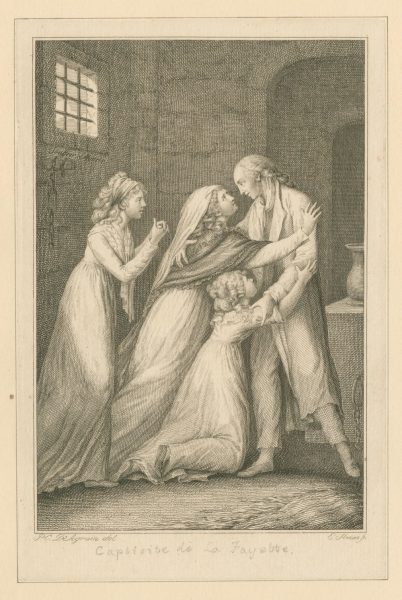 The Marquis and Marquise de Lafayette were 16 and 14 years old, respectively, at the time of their marriage. (Photo courtesy of Lafayette College Archives)
Born into one of France’s wealthiest noble families, the Marquise narrowly avoided the guillotine during the French Revolution’s Reign of Terror. Her sister, mother and grandmother were not so fortunate. Later, she helped establish the Cimetière de Picpus, a private cemetery reserved for victims of the guillotine and their descendants.
At 35, after failing to persuade Austrian leaders to release her imprisoned husband, she volunteered to incarcerate herself and her two youngest daughters alongside him for two years.
Diane Shaw, the college’s former archivist and one of the leading historians on the Marquise’s life, called the decision a “remarkable act of self-sacrifice,” and one that contributed to her early death at 48.
“Lafayette was in solitary confinement when she got to him,” Shaw wrote in an email. “One scholar has credited her with saving his life.”
Hurd, who bonded with Flack over a shared interest in the divine feminine (Hurd’s doctoral thesis was on female saints), called the addition of the Marquise one of the “big moments” of the college’s bicentennial celebration.
“There are so many ways to bring female voice into the world, and this feels like an important moment to do it,” said Hurd, who first saw the statue during the reveal when she, Craig, Mattison and Student Government President Allie Waxman ‘28 ceremoniously pulled away the maroon fabric draped over it.
“Sometimes female voice comes from places that people don’t expect it,” she added.
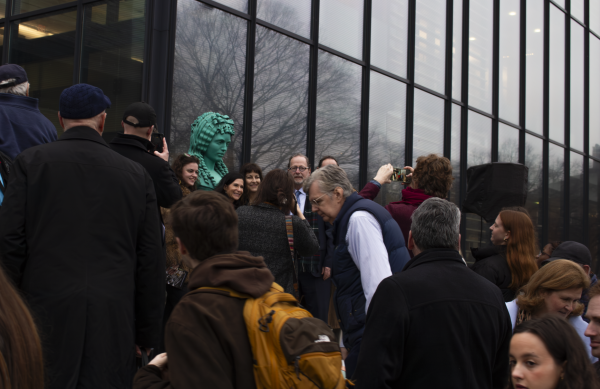 Attendees of the sculpture’s dedication swarm the Marquise shortly after her reveal. (Photo by Elisabeth Seidel)
Campus reaction to the bust was mixed. The color of the Marquise, which Hurd dubbed “Tiffany Blue,” has been a common topic of discussion.
“It’s beautiful, and shockingly green,” said Noa Stahlberg ‘28, a student in attendance at the reveal. “Two things can be true at the same time.”
The bust’s bright hue isn’t permanent, however; the patina is expected to darken and deepen over time.
On Wednesday, several students enjoying the first turn of spring on the Quad said they had noticed the library’s new addition, but didn’t know who she was.
“My fault for not going to the ceremony, but I’m hoping that there was a good reason for her being there,” Lauren Haber ‘29 said.
“I hope that with all the information that they continue to send out about it, people start to understand the story more,” Maddie Miniutti ‘26 said. “History has this way of erasing women from history, and so I think making efforts in order to show how important women are — it’s a big deal.”
Others are not sure that the life of the Marquise measures up to the weight the sculpture has been given by the college administration.
“It is not a bad thing to have more representations of women in Lafayette’s public spaces but real impact only happens when the community is invested and people understand the purpose,” wrote Mary Armstrong, the head of the Women’s, Gender & Sexuality Studies department, in an email.
Armstrong noted the lack of broad community input on the subject of the sculpture; the bust received review and approval from the college’s bicentennial committee, roughly 50 college constituents.
“The beauty of this bicentennial is that there were ideas that came from the community, there are ideas that came from students,” Hurd said. “It’s come from all different directions.”
“Regardless of whether you find the statue itself inspiring or dreadful, I think the administration missed some important opportunities,” Armstrong wrote.