
Welcome to the Lehigh Valley Landmarks with Leon podcast series, celebrating 250 years of independence. I’m your host, Rachel Leon. Since being elected in 2022 and serving as Vice President of Bethlehem City Council, I’m humbled by the opportunity to serve the diverse communities that make up our great city. But to understand where we’re going, we need to understand our past. Each week, I’ll share a short feature with a big story about the 250 years that made the Lehigh Valley and Bethlehem, Pennsylvania, known as the Christmas City, as we explore historic landmarks.
I have one passion: it is Jesus, Jesus only” – was the sentiment said by Count Nicolaus von Zinzendorf, founder of the Renewed Moravian Church. He expressed his passion for mission work through a focus on the “wounds” of Christ and to bring the message that God loved them and died for their salvation.
During a religious service on Christmas Eve in 1741 Count Von Zinzendorf officially named the town Bethlehem.
Earlier in the year, 500 acres were purchased for the Moravians by Henry Antes from William Allen. Shortly after the purchase, Bishop David Nitschmann and his followers established the area as a communal religious settlement.
All members lived and worked without wages to support global missionary efforts and spiritual outreach to Native Americans.
The relationship was built on a “covenant” of friendship, sealed with wampum. This approach allowed them to connect deeply.
Moravians often adopted native dress and customs. In turn, they introduced European farming techniques and livestock. They also developed dictionaries for Native languages.
In the winter of 1741 a thousand acres adjacent to the Burnside Plantation that belonged to the wealthy Quaker Benezat family was selected. Work began on Nain, named after the village in the Bible where Christ raised a young man from the dead.
This effort did not go without questioning. Brother Martin Mack who had worked with the Native Americans for years argued, “Zinzendorf’s plan showed no awareness of the cultural needs of native people – to have good hunting grounds close to their settlements.”
Native Americans worked beside whites on the buildings. Work progressed rapidly by the summer of 1762 – 14 houses had been erected.
Life was copacetic in Bethlehem between the Moravians and the Native Americas.
The French and Indian War ended in 1759 with a British victory in Quebec. But it had not ended in the hearts and minds of white settlers outside of the Moravian settlement.
In December of 1763 a largely Scots-Irish group known as the Paxton Boys brutally murdered the peaceable Susquehannock Indians living on Conestoga Manor, land given to them by the Penn family.
It was suspected that the Paxton Boys wanted to wipe out Nain village first, but it was too well protected.
Nonetheless, Nain Indians were taken to Philadelphia. They were placed on an island in a “pest house” where nearly half of them died from small-pox and other diseases.
Moravian leaders concluded that Nain could no longer be continued without making Bethlehem a target of attacks. In 1764 it was decided to dismantle Nain and sell off its houses.
The survivors from Philadelphia came by and collected their remaining goods and went to another Moravian Indian village further west. Today some of their descendants live in Canada.
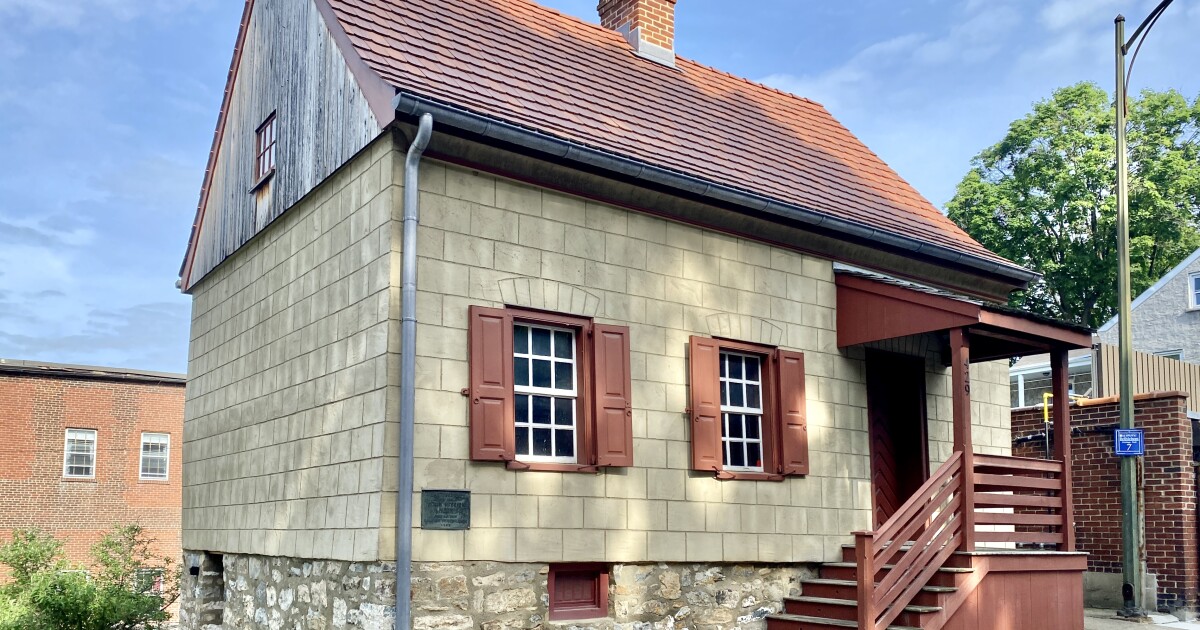
The Nain log structure of today was removed piece by piece in 1765 and rebuilt one mile from its original location by Andreas Schober, a mason, at the corner of Heckewelder Place and Market Street.
It was moved to its current location at Heckewelder Place in 1905 and restored in 2012 and 2013.
Today it is the only standing 18th century building built and lived in by Native Americans in eastern Pennsylvania.
Information for this episode was provided by local historian Frank Whelan’s transcript Bethlehem’s Nain-Schober House tells a tragic story of Native American, white relations and the Historic Bethlehem Museum and Sites.