
ARCHBALD — The region has enough water to supply data centers, but electric utility officials acknowledged the potential for power shortages and said electric infrastructure could be built at ratepayers’ expense.
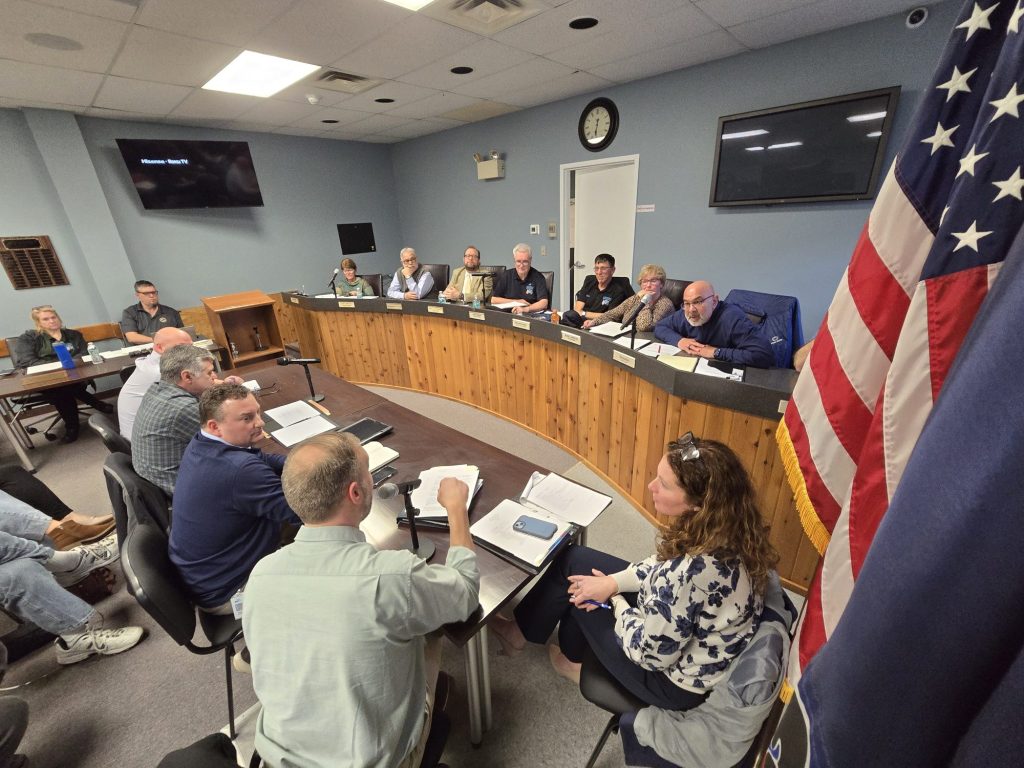
Archbald Borough Council assembled representatives from PPL Electric Utilities, Pennsylvania American Water and the Lackawanna River Basin Sewer Authority at its work session Wednesday to discuss the utility demands of data centers.
Six campuses are proposed in Archbald — the highest concentration in Northeast Pennsylvania — adding up to 51 individual data center buildings. There are at least 12 data center projects in Lackawanna County, with others proposed in Clifton and Covington townships, Dickson City, Jessup, Olyphant and Ransom Twp. Some projects are tied up in legal challenges.
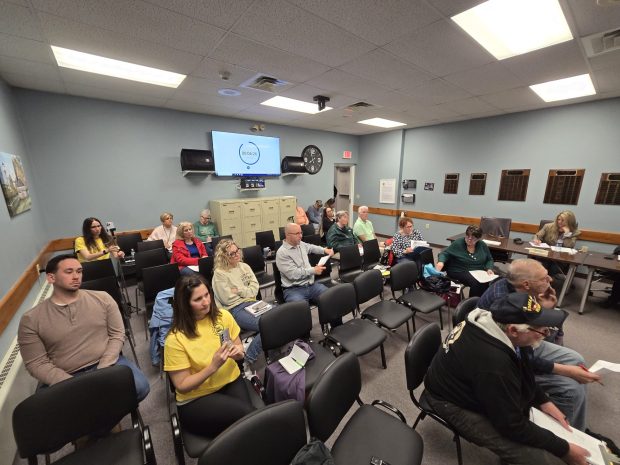 Residents listen to comments from representatives with PPL Electric Utilities, Pennsylvania American Water and the Lackawanna River Basin Sewer Authority during an Archbald Borough Council work session in the Borough Building on Wednesday, March 11, 2026. (FRANK WILKES LESNEFSKY / STAFF PHOTO)
Archbald received Lackawanna County’s first data center proposal in January 2025 for Wildcat Ridge Data Center Campus, which seeks to build 14 data centers across 574.2 acres along Business Route 6 and extending up Route 247. It has the county’s largest water and electricity demands. If approved, the campus wants to use just over 3.3 million gallons per day during the hottest summer weather while requiring 1,600 megawatts, or 1.6 gigawatts, of electricity.
Data centers often require large amounts of water and electricity to cool and power computer hardware. Their potential impact on utilities has been a core concern among residents and elected officials.
Publicly regulated utilities cannot deny data centers’ requests for water or electricity, though they can require developers to pay for infrastructure upgrades. When electric infrastructure benefits the grid overall, ratepayers will fund some of it, including buying land from data center developers if PPL operates infrastructure on their property.
Electricity demands
PPL serves 1.5 million customers across 29 counties in Pennsylvania. It has invested heavily in its transmission system over the last decade, said Doug Grossman, PPL’s manager of transmission siting.
“A lot of the infrastructure that’s needed to support these data centers has already been put in throughout our service territory,” Grossman said. “We’re very well positioned for this type of growth.”
PPL does not generate power. It buys electricity in bulk and passes it on to customers without markup, he said.
Pennsylvania currently has an excess capacity of power, but PPL is “cognizant that there may be a shortage in the future,” Grossman said. PPL is working with lawmakers in Harrisburg to pass legislation addressing that, he said.
Shelby Linton-Keddie, PPL’s senior director of public and external affairs, pointed to identical pieces of legislation, state House Bill 1272 and Senate Bill 897, as possible solutions.
Known as the “Power PA Act,” the House Bill was introduced last year by state Rep. Perry A. Stambaugh, R-86, whose district encompasses Perry County and most of Juniata County just north of Harrisburg. According to Perry’s sponsorship memo, the legislation would allow electric distribution companies to invest in and potentially own their own power generation sources. It would also require the companies to pass on the net revenues to their customers.
“Allowing EDC investment in electric generation would guarantee new power plants being constructed in Pennsylvania, letting our Commonwealth secure its electric future,” Perry wrote in the memo.
PPL looks to get as much capacity as it can out of its existing infrastructure, Linton-Keddie said. She believes large-load customers, like data centers, generating their own power will be part of the solution.
During his Feb. 24 State of the Union, President Donald Trump said the government is “telling the major tech companies that they have the obligation to provide for their own power needs,” according to an Associated Press transcript.
“They can build their own power plants as part of their factory, so that no one’s prices will go up,” Trump said.
Earlier this month, the White House announced a Ratepayer Protection Pledge where major data center companies, including Google, Microsoft, Meta, OpenAI and Amazon, agreed to “build, bring or buy new generation resources and cover the cost of all power delivery infrastructure upgrades required for their data centers, ensuring such expenses are not passed to American households.”
Pennsylvania generates 50 to 60 gigawatts of energy on a typical day and exports between 9 and 12 gigawatts of it, Grossman said.
For PPL, a typical daily load in Pennsylvania is about 6 to 6.5 gigawatts, rising to 7.5 gigawatts on a heavy day, he said.
That means a single data center project like Wildcat Ridge, which requested 1.6 gigawatts, would be equal to as much as 26.7% of PPL’s entire existing load across 1.5 million customers on a typical day.
Impact on electricity bills
PPL’s first step when it receives a service request is to evaluate what improvements are needed to ensure they don’t impact reliability for existing customers, Grossman said.
The utility would look at the improvements and facilities needed for the large-load customer, which could be a direct transmission path, substation or switchyard, he said.
A load analysis will determine a cost estimate, and any improvements that solely benefit the data center will be on their dime, Grossman said.
Any costs that help reinforce the general transmission grid “do get subsidized throughout our ratepayers,” he said.
“But, the overall majority of the improvements are directly paid for by the large-load customers,” he said.
Grossman compared the 230-kilovolt and 500-kilovolt power lines strung across the valley to a superhighway without exit ramps. Developers have followed the power lines to determine where they will build data centers.
Tapping into those lines to serve data centers provides an exit for the electricity for other customers, giving PPL a control point to restore outages or direct electricity, he said.
“There are direct benefits to the reliability of our customers in this area as well,” he said.
Whether PPL or a data center owns the infrastructure is unique to every project, Grossman said. If a facility will benefit the grid, PPL will own it; if it’s to the sole benefit of the data center, like a step-down substation that converts high voltages to a lower voltage usable by the data centers, Grossman said the data center will own it.
“We evaluate that, and we negotiate with the developer to make sure that our ratepayers are only paying the part that’s appropriate, and that all the costs that are solely benefiting the (data center), they pay,” he said. “We go through that very closely.”
PPL prefers to own the property its infrastructure is on, though there are rare times where they do long-term leases, Grossman said.
For Wildcat Ridge, Grossman said he would have to confirm, but he believed it will sell PPL land for a substation.
If ratepayers subsidize the cost of infrastructure, it would be spread across all customers, not just the customers in a community hosting a data center, such as Archbald, Grossman said.
“If the improvements that we’re building improve the operation of the overall network grid, then yes, they would get subsidized amongst all 1.5 million customers,” he said.
The average residential electricity bill is about $192, with transmission costs accounting for just over $33, Linton-Keddie said.
Transmission costs will go down as data centers come online, Grossman said. PPL projects that transmission rates on electric bills will drop 10% when the first gigawatt of electricity goes online at a data center, further decreasing with every added gigawatt, he said.
“It’s the first gigawatt that has the most improvement, but it’ll decrease the more we add to the system,” he said. “Transmission rates will go down by these large-load customers.”
For the average customer, the first gigawatt would equate to a reduction of just over $3.30, or about 1.7% off their total monthly bill.
PPL has no influence on power generation costs.
Water availability
Concerns about data centers tapping Lake Scranton for water have extended beyond Archbald. At a Scranton City Council meeting, city officials questioned how it could affect residents.
Dan Rickard, PAW’s director of engineering, pointed to a large capacity available to sustain data centers, describing the utility as “well positioned to support data center development.”
“The large water demands that you hear publicized with these data centers are true to some degree, but they’re really actually very limited to certain times of year that they’re used for cooling,” he said.
He noted that although they’ve had inquiries, there are no agreements in place, nor do they have firm numbers on water usage from local data centers.
The six proposed in Archbald are all “developers and speculators” with no users, he said.
“They’re not sure how much water they’re actually going to use,” Rickard said. “It seems to vary almost daily, if not weekly, every time we talk to them.”
The high water demands are limited to the hottest times of year — July and August — and could only be for a couple weeks at a time, Rickard said.
“Otherwise, they really use a very reasonable amount of water, especially during the cooler months,” he said. “Actually almost nothing.”
When the utility receives a service request, it looks at three parameters: source of supply (reservoirs and watersheds), treatment capacity and distribution capacity, Rickard said.
PAW has nine treatment plants in the Scranton/Wilkes-Barre area, he said.
Archbald uses Lake Scranton’s treatment plant to its south and three treatment plants to the north, drawing from the Brownell, Fallbrook and Forest City plants, he said.
The utility is permitted to use up to 125 million gallons of water per day in the region. Its nine treatment plants can treat up to 95 million gallons of water per day. The average demand across the nine plants is 50 million gallons per day, Rickard said, which leaves 45 million gallons in available capacity. During a drought, based on their worst drought on record, PAW would still have access to 80 million gallons a day, known as the safe yield, Rickard said.
Industrial customers, like data centers, and commercial customers are the first to have their water use limited during a drought, Rickard said.
Water is on a first-come, first-served basis, and once PAW gets to around 80% of its maximum available capacity, it will require developers to pay for improvements to increase capacity, whether it’s building reservoirs, drilling wells or developing treatment plants, Rickard said.
“The later they come to the table, the more they’re probably going to end up having to pay,” he said. It could mean a data center pays hundreds of millions of dollars just for its water supply.
Other than Wildcat Ridge’s 3.3 million gallons per day maximum, no other data center is over 1 million gallons, Rickard said. The only other development in Pennsylvania using more than 1 million gallons per day is the Cleveland-Cliffs steel plant in the Pittsburgh area, he said.
Water infrastructure challenges
The challenge is moving water to sites. Locally proposed data centers are not in industrial parks. Archbald and other areas where they’re proposed lack the infrastructure needed to move the necessary water.
“That is where the bottleneck is with almost all the data centers we’re dealing with that have requested service,” Rickard said.
Going from low water demands from data centers during the winter to very high demands in the summer is another problem, he said.
Developers will be fully responsible to pay for all capital improvements needed to serve their sites, Rickard said.
Data centers in Archbald would have to pay for infrastructure to transport water from the Lake Scranton plant, including pump stations, storage tanks and road paving, Rickard said. He expects Wildcat Ridge alone would need to pay for at least a 24-inch water main.
“We make them aware of that, that this is going to be a substantial cost,” he said. “Usually their response is, ‘Well, their site is B with billions, and we’re talking M with millions, so keep it in perspective’ is what they tell us.”
Infrastructure would not be solely used by data centers, though, he said. PAW would tie the water mains in along the way, ensuring water isn’t sitting in the pipes stagnant when data center demands are low in the winter.
“Our customers reap the benefits of having additional reliability, newer infrastructure serving the area,” he said.
Sewer usage and infrastructure
Data centers’ sewer needs are lower than their water demands, but infrastructure is a challenge.
Across the six proposals in Archbald, the LRBSA has seen preliminary numbers totaling about 500,000 gallons discharged to them per day, Executive Director Mike Matechak said.
Of those 500,000 gallons, they would direct 400,000 gallons to their Archbald treatment plant and 100,000 gallons to their Throop treatment plant, he said. The Archbald plant is on the northern end of the borough along the Lackawanna River across from North Main Street, and the Throop plant is on Boulevard Avenue.
Most of Archbald’s wastewaster goes to Throop for treatment, Matechak said.
“That’s why it makes development problematic up in this area, because since we’re so far from our treatment plant, the lines are the smallest,” he said.
If there is a high-volume user, the LRBSA doesn’t have the capacity in its existing lines to move the wastewater to Throop without substantial upgrades, Matechak said. Instead, where feasible, they have been informing data center developers that they will need to get their wastewater to flow up to the Archbald plant, which has about 1.1 million gallons per day in available capacity.
If the LRBSA identifies areas in its system with limitations, whether it’s the treatment or collection systems, they put the onus on the developer to provide all necessary upgrades, Matechak said.
The LRBSA looks at three elements: the capacity of its treatment plants, the conveyance system and the local collector lines, which are the lines located in the streets with the most restrictive capacity, he said.
They also look at three criteria from developers: average wastewater flow, the quality of wastewater and the discharge characteristics, Matechak said. Discharge characteristics pertain to how much wastewater is actually discharged at a time. Discharging 100,000 gallons over 24 hours versus discharging 100,000 gallons over three hours will have significantly different impacts on their system, he said.
So far, the LRBSA has approved capacity for two of Archbald’s data center projects, Project Boson and Project Gravity, Matechak said.
Project Boson, which looks to build a large data center with a nearly 620,000-square-foot footprint at the site of the Highway Auto Parts junkyard on the Eynon Jermyn Road would discharge 3,250 gallons per day, equivalent to a restaurant, Matehcak said. Project Gravity, which plans to build seven data centers, each with a 138,000-square-foot footprint, between Eynon Jermyn Road and Business Route 6 would discharge 14,000 gallons per day, which is similar to a large warehouse complex, he said.
Although he did not identify them by name, Matechak referenced data center proposals from Archbald I LLC. Those two campuses plan to run their own line directly to the treatment plant, bypassing the collection system entirely, he said. The projects, known as Project Scott and Project North, would build up to 22 data centers between Business Route 6 and Eynon Jermyn Road, surrounding Project Gravity. Project Scott encompasses as many as 18 data centers, each up to 90 feet tall with a 154,850-square-foot footprint, that would border Staback Park and Archbald Pothole State Park, adjacent to Project Gravity. Just north of Project Gravity near the Jermyn border, Project North would build four data centers with similar footprints as Project Scott.
Dallas, Texas-based Provident Data Centers is the developer behind Archbald I LLC.
Project Green, which also proposes seven 138,000-square-foot buildings off the Casey Highway at the site of the Stavola Quarry, and Wildcat Ridge plan to discharge wastewater to the Throop plant, which would have minimal impact on the Archbald system, Matechak said.
Upcoming data center meetings
Archbald has three public hearings scheduled for data centers over the next month, all inside the Valley View High School auditorium, 1 Columbus Drive, Archbald, with other data center hearings scheduled in Jessup and Olyphant.
Council will hold its next public hearing Thursday at 5 p.m. to consider a conditional use application from Project Green, according to public notices published March 3 and 10 in The Times-Tribune.
A second hearing on Project Scott will follow March 23 at 5 p.m., and the borough will hold its third hearing on Wildcat Ridge on April 13.
The Jessup Zoning Hearing Board will hold a public hearing March 23 at 6 p.m. at the Jessup Municipal Building, 395 Lane St., to consider an application from Sunnyside Road Associates LLC for a 40-foot height variance to build a 90-foot-tall, approximately 487,000-square-foot data center, according to a public notice published March 8 in The Sunday Times. The data center would be next to the Lackawanna Energy Center natural gas-fired power plant.
Olyphant will hold a public hearing March 31 at 6:30 p.m. in the Olyphant Borough Municipal Building, 113 Willow Ave., to listen to testimony on a zoning ordinance to regulate data centers, according to public notices published March 3 and 10 in The Times-Tribune.