
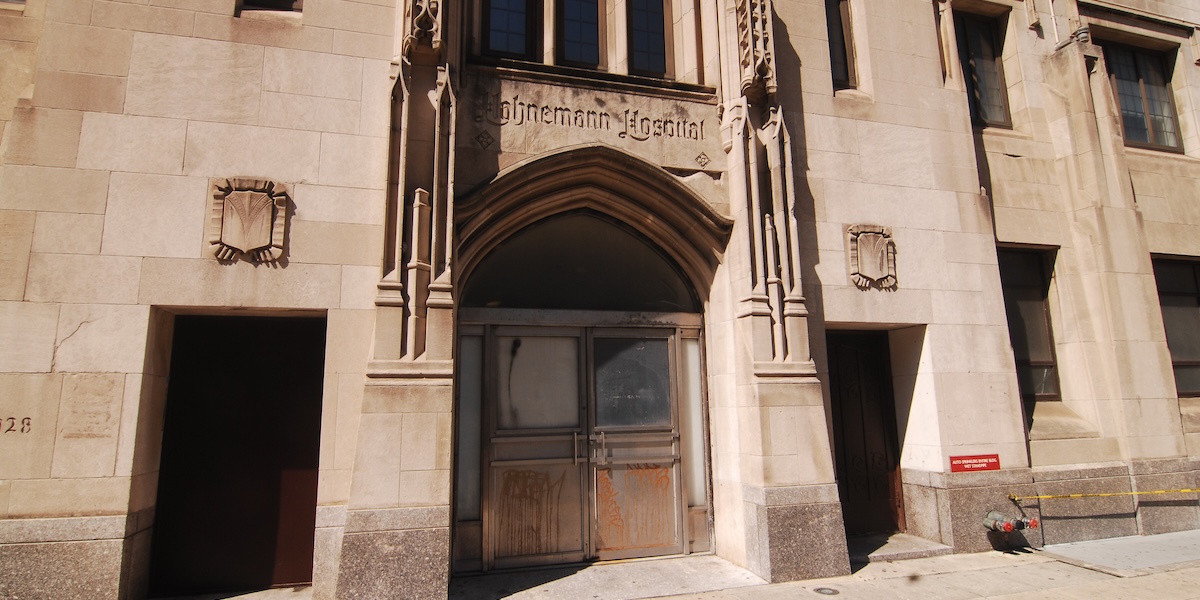
Does City Council really want to encourage more economic investment in Philadelphia? Or are members more interested in ensuring they get what they want out of proposed development?
Those are the key questions for a new piece of legislation from City Councilmember Jeffrey Young, which would shorten the period of time that developers have to complete construction on a building for which they have secured zoning permits.
Young’s bill (#260133) is the latest volley in his public feud with the developers trying to convert the closed Hahnemann University Hospital into a residential apartment building. He argues that the Hahnemann building and other properties in the area should be preserved for future office or institutional use rather than converted to housing. He also wants the City to discourage developers from pulling zoning permits without any intention to build imminently.
 District 5 City Councilmember Jeffrey Young Jr. Photo courtesy of Philadelphia City Council.
Young first proposed a bill late last year banning residential uses across multiple blocks near Hahnemann, which would have had the effect of blocking developers from turning Hahnemann into housing rather than offices.
While that bill sat in committee over the holiday break, the developers moved quickly, filing for permits before the first bill could take effect. Because their project follows existing zoning rules, they don’t need special permission from Young or the Zoning Board of Adjustment — the city’s zoning appeals board — to move forward.
As the Inquirer reported last week, several other property owners in the targeted district followed suit, filing for zoning permits totaling 824 units before the start of the new year. In just a few weeks, the threat of the first bill passing led to significant new housing proposals at a time when Mayor Parker and members of Council say their goal is to build more housing. That area just south of Vine Street has such a gratuitous expanse of surface parking, and is one of the more logical places for more Center City high-rise development to expand into as the city hopefully achieves Mayor Parker’s goals, so it would be a shame to take it out of the mix for new residential development.
But just when it looked like the developers had found a way to do their projects, Young returned last week with a new bill that would drastically shorten the period of time they would have to build out the properties — from three years down to just six months. The politics involved in this fight — Young vs. the Hahnemann developers — might make this seem like it’s targeted at Center City, but really, the effect is citywide.
Under Young’s bill, a developer would have just six months from the day they receive a zoning permit to complete their entire project — not just start it, but finish it and receive final city sign-off. That final sign-off, called a Certificate of Occupancy (CO), is the last step in a process that typically takes years.
The bill’s language makes it sound targeted to Center City, but it would impact almost every development project in the city because the technical trigger Young chose — whether a permit includes construction documents — almost never applies at the zoning stage. Construction documents come later, with building permits. So the six-month clock would start ticking for virtually everyone.
Some have argued the bill is unnecessary, that permits like the ones pulled near Hahnemann are already supposed to lapse after six months under existing rules. But the city doesn’t actually enforce it that way. Philadelphia’s own licensing department has a written policy confirming the six-month rule only kicks in when someone changes a property’s use without doing any construction at all — think a business moving into an empty storefront without making structural changes. The moment renovation is involved, developers get three years. Multiple zoning attorneys confirmed this is how it works in practice.
I was curious how many projects of different kinds would be able to comply with a six-month timeline, so I used Claude Code to look at the relevant city permits using the city’s open data. The city’s data conveniently has timestamps for the issuance of zoning permits and the issuance of Certificates of Occupancy, so it’s possible to reconstruct the permitting timeline to capture the exact date range that’s relevant under Young’s bill.
Not even close to enough time
Between 2010 and 2025, only 8 percent of all projects received a Certificate of Occupancy within six months, and for most projects it wasn’t even close.
The median length of time for city review (zoning permit to building permit) is 96 days, which eats up 3.2 months right off the bat — over half the amount of time Young’s bill would allow for full construction and inspections to be completed. The median length of time between the issuance of a building permit to the completion of a project is 304 days — another 10 months.

So the typical project comes nowhere close to completion within the 6-month window. This chart shows the percentage of different kinds of development projects that would’ve been extinguished had the bill been in effect during the 15-year window of analysis.

The results are staggering: 92 percent of all development projects in the city would’ve been blocked if CM Young’s bill had been in effect over this period. And it’s not just the 97 percent of residential development to worry about. One hundred percent of construction projects undertaken by houses of worship and non-profit community centers, and 99 percent of salons and barber shops would’ve failed to meet the bill’s six-month deadline too.
Development projects come in all shapes and sizes though, so it’s helpful to decompose this by project size. The Hahnemann redevelopment and the other proposals in the area are larger buildings that obviously couldn’t be completed in six months. But what about single-family homes?

Even a single-family home takes a median of 869 days to get from zoning permit to CO. Interestingly, the median two- to four-unit building takes less time, at 819 days. A project the size of Hahnemann is looking at closer to 1,320 days. The overwhelming majority of projects of any size, though, all take much longer than six months.
An important caveat: the city’s open data records Certificate of Occupancy dates on only about 3 percent of all building permits, so this analysis is based on the roughly 17,000 zoning permits that could be matched to COs. That’s a meaningful sample size, and consistent with a clear pattern: construction projects almost never complete within 6 months of receiving zoning permission.
Bill 260133 isn’t like other Councilmanic Prerogative zoning bills that only affect one district. As the bill impacts general L+I procedures, it would apply citywide. There isn’t a legal mechanism to restrict it only to one district, or only the Hahnemann zone. With that being the case, the other 16 City Council members get a say, and should evaluate this proposal on the merits.
Do they think it’s a good idea to revoke zoning permits from home builders, or churches, or would-be barber shop owners who can’t get their construction projects completed within six months?
Notably, the six-month rule isn’t working well even in its current limited form. Among the narrow category of projects already subject to the 6-month deadline under existing law, roughly 32 percent fail to meet it. Young’s bill would expand a rule that already fails nearly one in three projects to cover virtually every development project in the city.
The consequences of passing this bill extend far beyond one council member’s dispute with a single developer — it would create absolute chaos for the city’s housing and commercial development sectors, with small corridor businesses hardest hit.
It’s time to take the win — the initial bad bill did a good thing, laying the groundwork for almost 1,000 new housing units in an underbuilt part of Center City. Instead of inventing innovative new ways to make housing production riskier and more unpredictable in Philadelphia, Council should get back to work on passing Mayor Parker’s ambitious H.O.M.E. agenda.
 MORE ON THE HOUSING STRUGGLE IN PHILLY