
It was early on the cold morning of January 9, 1963, and President John F. Kennedy knew he had a full schedule. According to the History Central website, he and family had just returned from several days sailing on the Honey Fitz at Palm Beach.
Now there was a meeting with the Democratic leaders of the House and Senate. Soviet Ambassador Anatoly Dobrynin was to come by, as were advisors Walt Rostow, McGeorge Bundy and Walter Heller for consultations and an early evening confab with brother and Attorney General Robert Kennedy was planned. The Boston Celtics were also scheduled for a photo op. That evening he and his wife Jacqueline had dinner planned at the home of Secretary of the Treasury C. Douglas Dillion.
But before most of this Kennedy had an official duty to perform: the swearing-in of Kathryn O’Hay Granahan of Easton as Treasurer of the United States. According to the Morning Call she would receive a salary of $17,000 a year. Among those on hand were her brother-law, Lee J. Kennedy of Easton, and her niece Nancy Lee Kennedy of Easton.
President Kennedy gave her a certificate of appointment. The actual swearing-in was done by Herbert Miller, assistant executive of the White House. She would be the fourth woman to occupy this post and had already served as a member of Congress following the death in 1956 of her husband, builder William T. Granahan.
According to Granahan’s New York Times obituary, Kennedy asked her to write her signature as she would like it to look on the new currency. Apparently, the president was a little surprised when she wrote it out, in a rather florid hand “Kathryn O’ Hay Granahan.” Seeing a little look cross Kennedy’s face she replied, “It’s a good Irish name.” JFK could hardly object. He quickly agreed.

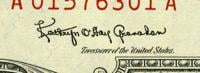
Signature of Kathryn O’Hay Granahan, which appeared on U.S. currency.
As did Kennedy, O’Hay Granahan took her Irish heritage very seriously. Born in Easton on December 7, 1894 (some sources say 1895), she was the daughter of James B. O’Hay (1867-1942) and Julia Theresa Reilly (1867-1918). Kathryn also had a sister, Anne Julia.
According to information provided by the Easton Public Library’s website, James O’Hay in his younger days owned a saloon and café. Later he owned the United Furniture Store and had an automobile dealership and sold real estate. He was also very active in local and state Democratic party politics, attending as a delegate at state and national conventions. His wife died in 1918, perhaps during that year’s flu epidemic.
They were part of an Irish community that grew up first in Easton with the building of Josiah White and Eriskine Hazard’s Lehigh Canal in the 1820s. It had begun with the building of the Erie Canal in New York several years earlier.
Even before the potato famine in the 1840s things were troubled in Ireland and it has been estimated that there more people per square mile in Ireland than there were in China. Anne Royall, the great travel writer of the period, had this to say when passing through the Lehigh Valley region in the 1820s:
“The poor fellows, fleeing from oppression to be free…make a short life and a merry one of it…in many instances, on some of the canals, they die so fast they are thrown into the ground from four to six together without coffins.”
Many of those Irish were coming from the County of Meath, which boasted a population of 183,000 in 1841 that would be reduced to 67,000 by 1900.
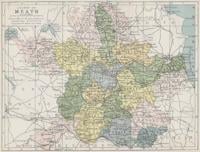
County of Meath, Ireland
Library Ireland
According to the Delaware Lehigh National Heritage Corridor website, it led to huge changes nationally and locally:
“The Irish famine years of the 1840s triggered the third wave of Irish immigration. One and a half million Irish, more than half of them women, came to the United States between 1845 and 1856. By 1850 Irish immigrants made up of more than half of the foreign residents of Pennsylvania.
The massive waves of Catholics lowered the percentage of the U.S. Protestant population from 97% to just under 90% in only a decade. But for the devout Irish Catholics, this meant the pool of marriageable mates was limited to other Irish Catholics, a situation that prolonged the traditional links of clan, kinship, and regional ties for one or two more generations.
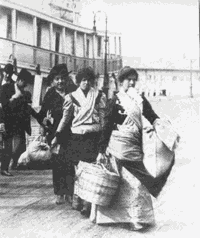
Early Irish immigrants
The Irish quickly adopted English, but most remained among the ranks of unskilled labor in mines, factories and domestic work until the last quarter of the 19th century. By the 1880s both public and Catholic schools had been widely established. Education and assimilation that came from it allowed the descendants of the original Irish immigrants to gain upward mobility in the rapidly industrializing United States.”
Kathryn O’Hay Granahan graduated from Easton Area High School and attended Mt. Saint Joseph’s College (now Chestnut Hill College) in Philadelphia where she studied sociology. On graduation she entered state government as supervisor of public assistance in the auditor general’s office.
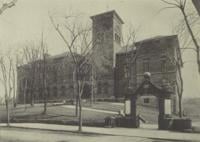
Easton High School, 1912
In 1943 she left state government to marry William Granahan, a builder who three years later was elected to the first of five terms to the House of Representatives from Philadelphia. After her husband’s death in 1956 she was elected to his seat and was the first woman to be elected to Congress from Philadelphia from the Second Congressional District. She was also a delegate to the 1960 Democratic Convention that nominated Kennedy.
After the 1960 census the Second Congressional District was merged with the Third District of Robert Nix, and Kennedy decided to name her to the post of Treasurer of the United States in September of 1962. It was confirmed a month later.
While she was in Congress O’Hay had served on the committee that dealt with the post office and worked closely with the Eisenhower administration’s Postmaster General Arthur Summerfield to block the distribution of pornography through the mail. Some of what Summerfield regarded as pornographic are regarded as classics of modern literature like novels by D.H. Lawrence and James Joyce.
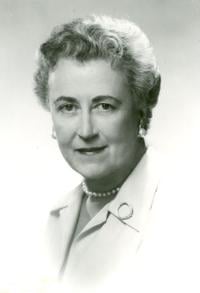
Congresswoman and United States Treasurer Kathryn Granahan, circa 1947
“There are many things we don’t let our juveniles do,” she said in an address to a woman’s club. “We don’t allow them to drive, we don’t allow them to drink, and we don’t allow them to carry firearms. So why should they allow these filth merchants to sell this to youngsters to lead them to juvenile delinquency?“
Although she was active in politics she apparently felt there was only so far a woman should go. “I wouldn’t vote for a woman president,” she told a Philadelphia woman’s group. “There are too many un-lady-like things a president has to do. A man can get right down to brass tacks. It’s a little less dignified for a woman to do that.”
Granahan’s whole life was not all official business. On March 3, 1963, she appeared as the mystery guest on the quiz show What’s My Line. On November 11, that same year she was in the same role on Bud Collyer’s quiz show To Tell the Truth. No word if panel member Kitty Carlisle Hart was able to ferret her out.
In August 1964 Granahan was getting ready to appear on television in Washington when she slipped and fell on the slippery studio floor, injuring her head with a blood clot on her brain. By 1966 she was forced to resign.
Granahan was to spend many years thereafter at the Leader Nursing Home in Norristown, dying on July 12, 1979. She is buried in Gethsemane Cemetery, Palmer Township.
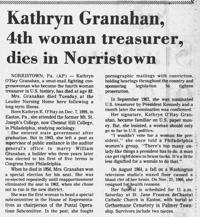
Kathryn Granahan obituary
According to Pete Smith’s American Numismatic Biographies, Granahan’s signature appears on the Silver Certificates series of 1935-H, 1953-C, and 1957-B; and the Federal Reserve Notes series of 1950-D, 1950, 1963, 1963-A and 1963-B.