
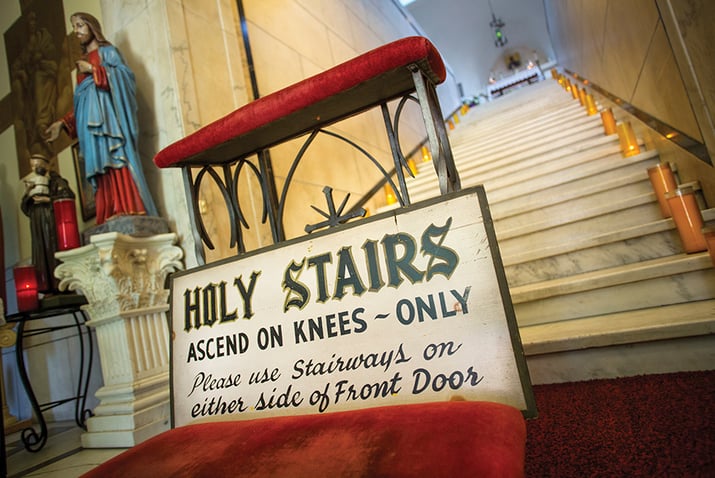
Each year, more than half a million pilgrims travel to Rome to climb the ancient steps known as the Scala Sancta. Located across from the Basilica of St. John the Lateran, the 28 marble steps are venerated by the faithful as those Jesus Christ ascended when he appeared for judgment before Pontius Pilate.
According to longstanding Catholic tradition, the Holy Stairs were brought from Jerusalem to Rome in the fourth century by St. Helena, mother of Constantine the Great. For centuries, pilgrims have ascended not on foot but on their knees, praying in meditation on the Passion of Christ.
While such a pilgrimage may seem distant for most Catholics, the faithful in western Pennsylvania can encounter a similar devotion much closer to home.
Within Pittsburgh’s historic Strip District, Old St. Patrick’s Church, today part of St. Patrick-St. Stanislaus Kostka Parish, houses a replica of the Holy Stairs that invites visitors to undertake the same prayerful ascent.
Upon entering the church, visitors immediately encounter the marble staircase, which leads up to a small chapel. Pamphlets line the stairs with prayers and meditations on Christ’s Passion for each step. While visitors may not walk up the stairs on foot — following the tradition of ascending on their knees — they may enter the chapel through smaller staircases on either side.
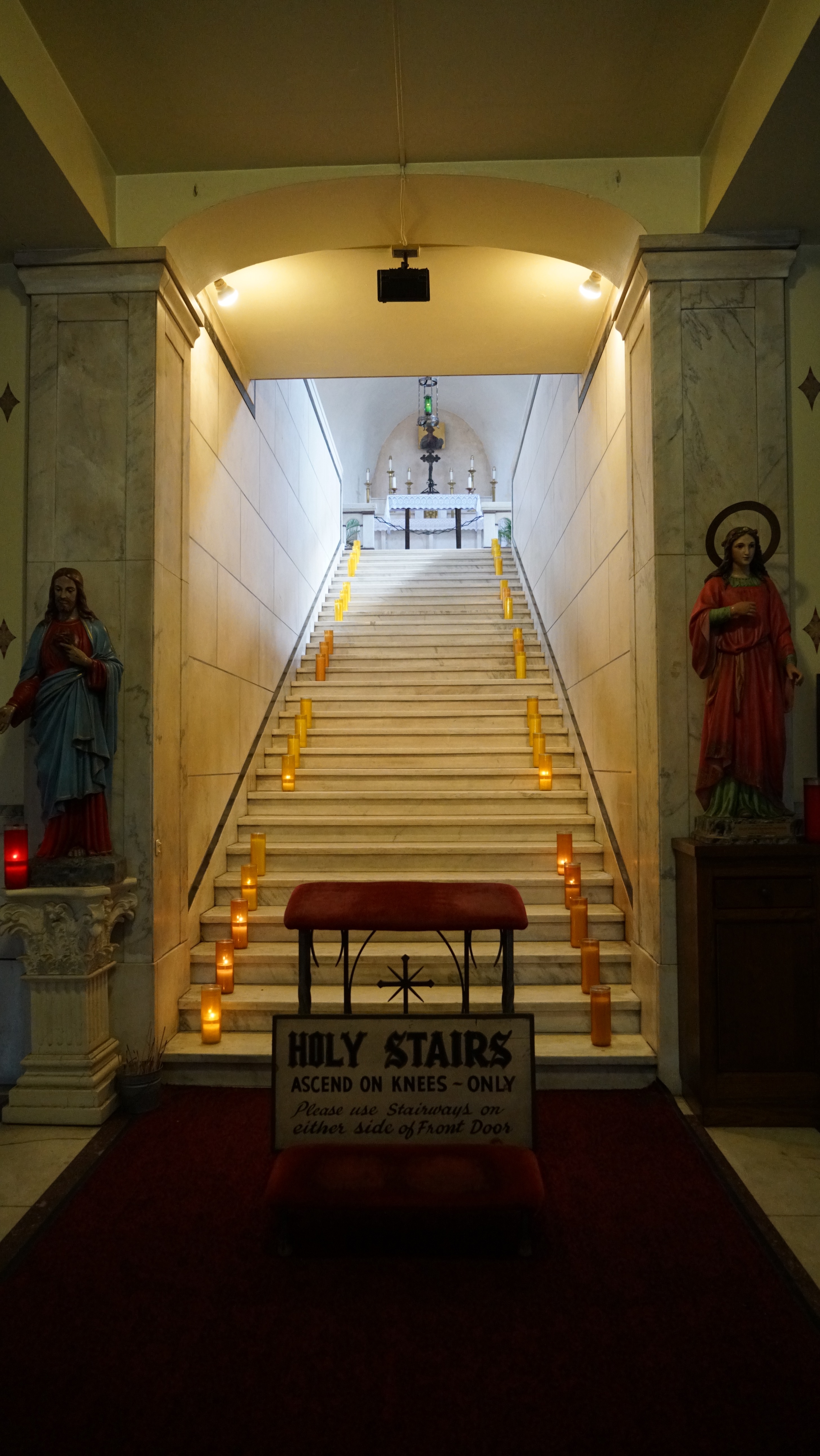 When visitors first enter St. Patrick’s, they encounter the Holy Stairs replica. (Photo: Courtesy of Father Nicholas Vaskov)
Whether climbing them in prayer or scrubbing the marble in service, parishioner Dan Yates — who assists with maintaining the church — describes the devotion as a means of “humility” amid a “day and age that rejects mortification, that worships pleasure and comfort instead.”
“You invoke the passion of the Lord,” he told the Register. “You open up a whole other world.”
The presence of the Holy Stairs in Pittsburgh is closely tied to the history of St. Patrick’s itself. Established in 1808 to serve a small Catholic community, the parish grew alongside the rapidly expanding city.
By the early 20th century, however, the surrounding Strip District had become increasingly commercialized. Many parishioners had moved elsewhere, leaving only a few dozen families behind and casting uncertainty over the parish’s future.
That changed dramatically in 1923 with the arrival of a new pastor, Father James Cox.
Born in Pittsburgh’s Lawrenceville neighborhood in 1886, Cox grew up in a working-class family and understood firsthand the struggles of the poor. As a young man he suffered from an eye ailment, and later credited water from the Sanctuary of Our Lady of Lourdes with restoring his sight — an experience that fostered a lifelong devotion to the Blessed Mother.
Ordained in 1911 and later serving as a military chaplain in France during World War I, Father Cox arrived at St. Patrick’s determined to revitalize the parish. In 1924, he dedicated the church as the “American Shrine to Our Lady of Lourdes,” constructing a grotto and gardens on the church grounds.
When the Great Depression struck, St. Patrick’s became a center of relief for Pittsburgh’s unemployed and poor. Through soup kitchens and charitable programs organized by Father Cox, the parish distributed countless baskets of food, clothing and fuel to those in need. His tireless advocacy for workers would earn him national attention and the nickname “Pastor of the Poor.”
Bringing the Universal Church to Pittsburgh
At the same time, Father Cox encouraged devotional practices that allowed ordinary Catholics to experience traditions associated with the Church’s great pilgrimage sites. Among these was the installation of the Holy Stairs in 1936, offering the faithful a local opportunity to meditate on Christ’s suffering in the same way pilgrims had done for centuries in Rome.
“He had a great devotion to the Passion of Jesus,” Father Nicholas Vaskov, pastor of St. Patrick-St. Stanislaus Kostka Parish, told the Register. “Because his parishioners were mostly poor and many of them couldn’t afford to go on these pilgrimages he would take, he thought, ‘Let’s bring those experiences to them here.’”
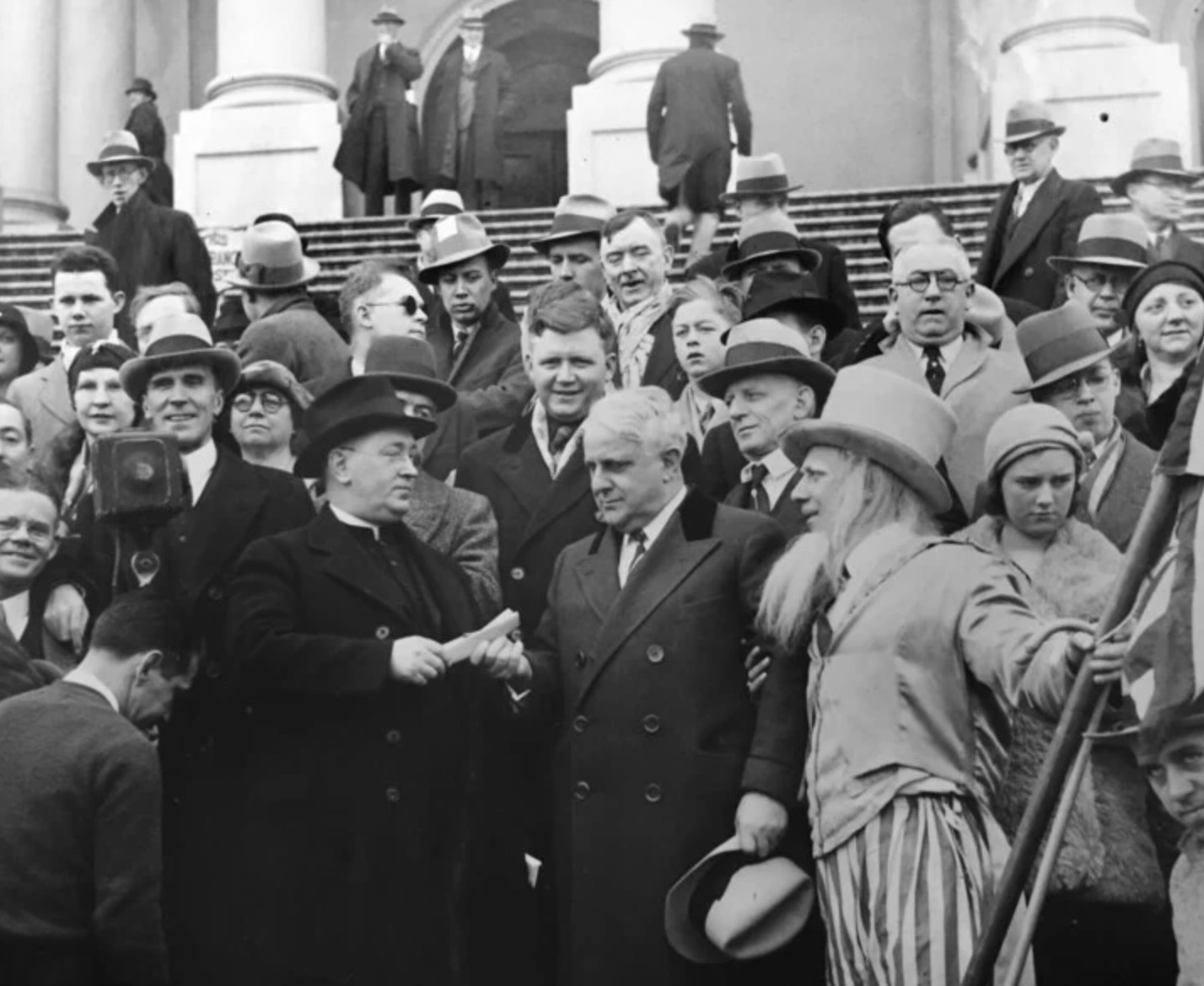 Father James Cox (front left), an advocate for the poor and unemployed in Pittsburgh, leads a 25,000 person demonstration in Washington, D.C., in 1932, demanding Congress provide unemployment relief. (Photo: Courtesy of Father Nicholas Vaskov)
Born and raised in Pittsburgh, Father Vaskov now serves as pastor of what the diocese designated in 2019 as the Shrines of Pittsburgh: a group of historic churches that includes St. Anthony’s Chapel, Immaculate Heart of Mary Church, St. Nicholas Croatian Catholic Church, Most Holy Name of Jesus Parish, and St. Patrick-St. Stanislaus Kostka Parish.
He recalled first encountering the Holy Stairs replica as a child after shopping with his family in the Strip District and stopping inside St. Patrick’s to pray.
“When we walked in, there was a kneeler and sign that said, ‘Holy Stairs, ascend on your knees,’” he said. “As a little child, I was fascinated by it.”
“To draw us closer to experiences in the life of Christ, I remember being very moved by that,” Father Vaskov said. “And to now … be the steward of [the stairs] is just a wonderful gift. It heightens people’s devotion to Christ.”
Though relatively rare, several other churches in North America contain similar replicas of the Holy Stairs, including the Shrine of the Little Flower in Burrillville, Rhode Island; Cross in the Woods Catholic Shrine in Indian River, Michigan; St. Lucy’s Church in the Bronx, New York; and the Basilica of Sainte-Anne-de-Beaupré in Quebec, Canada.
At St. Patrick’s, that devotion has been experienced by parishioners and visitors alike. Yates, who began attending St. Patrick’s in the late 1980s, recalled not knowing what to do when he first encountered the Holy Stairs.
“I had never heard of [the devotion] before,” he said. “The Holy Stairs were very unique to me, but then they just became part of my life.”
A ‘Beautiful Little Oasis’
According to Yates, the Holy Stairs have been the setting for numerous stories of answered prayers.
In one instance, he recalled a man whose wife had been declared brain dead at a nearby hospital. The man rushed to St. Patrick’s, climbed the steps on his knees and promised God he would continue the devotion each week if his wife survived. When he returned to the hospital, he found her awake and sitting upright in bed.
Patty Shelley, another longtime parishioner who discovered St. Patrick’s more than 25 years ago, said she has encountered many visitors who believe their prayers were answered in “miracles” after climbing the Holy Stairs.
In one case, a woman who had prayed on the stairs returned days later to report that her nephew — who had waited two years in dire need of a kidney transplant — had received a call that a donor organ was available.
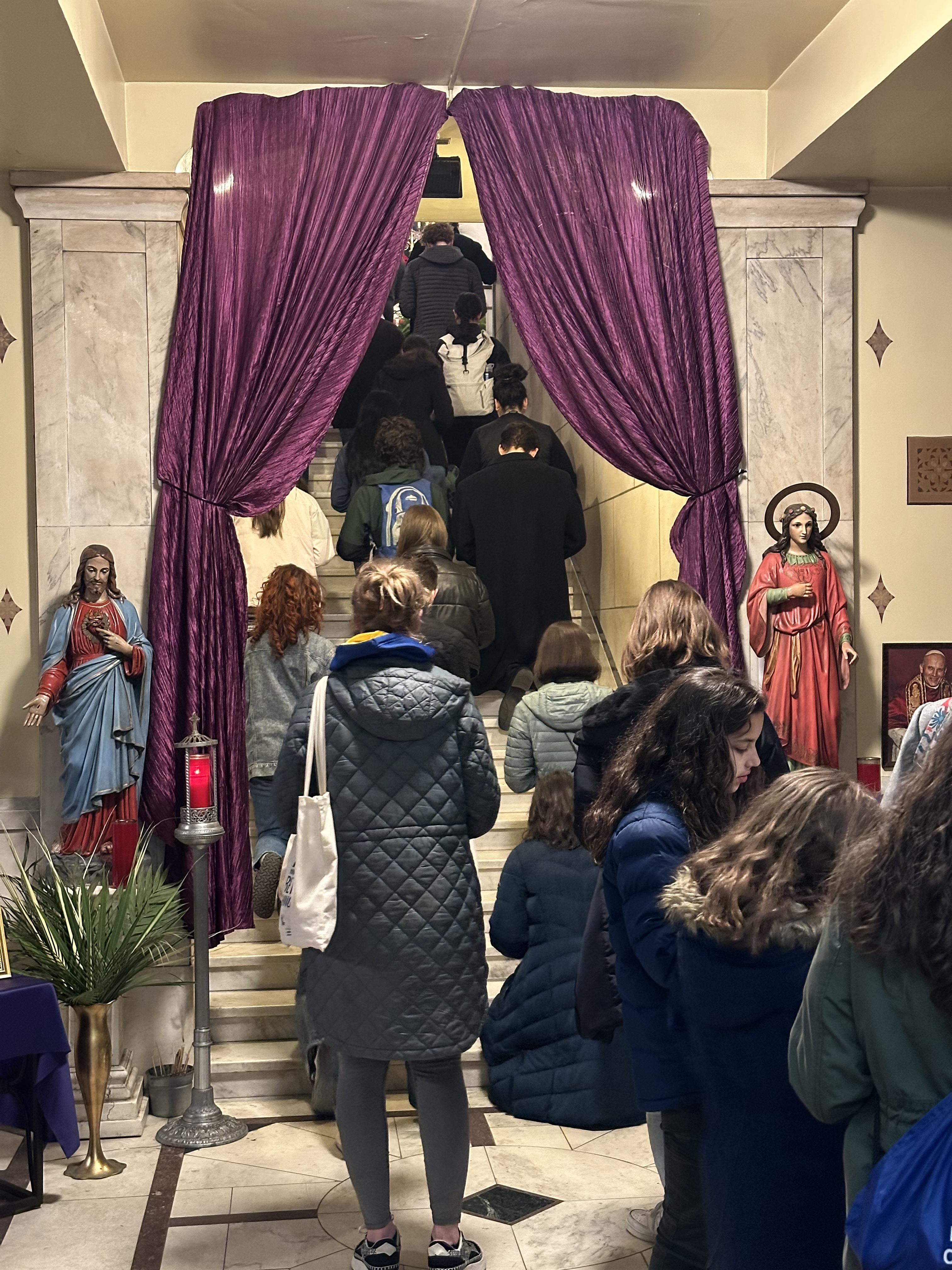 Visitors ascend the Holy Stairs replica on their knees at St. Patrick’s Church in Pittsburgh, Pennsylvania. (Photo: Courtesy of Father Nicholas Vaskov)
Another young woman shared that she and her husband had been struggling to conceive a child for years. Following Shelley’s suggestion, she began coming to the church more regularly to pray on the Holy Stairs. Several months later, on Holy Thursday, Shelley received a message from the woman letting her know she was pregnant.
“She was certain it was because she had done the Holy Stairs,” Shelley recalled. “I know [people] go off those steps, and there are many miracles and graces that are answered.”
The church, she added, has become a “beautiful little oasis in the middle of a hectic Pittsburgh city.”
“When you go up the stairs, you feel so connected to Jesus because you’re actually doing what he did,” Shelley said. “Then to get to the top and to be looking at the tabernacle while saying your prayers — it’s very moving.”
A Tangible Sign of the Faith
While St. Patrick’s sees visitors throughout the year, the church is especially busy during the Lenten season — particularly on Holy Thursday, when many Catholics participate in the tradition of visiting seven churches.
Families and pilgrims line the streets around the church, Shelley said, eager to climb the Holy Stairs and feel “closer to what Our Lord suffered on Good Friday.”
For Father Vaskov, that devotion points to the importance of tangible expressions of faith.
“There’s a physical aspect to devotion, whether it’s rosary beads or the sacramentals of the Church,” he said. “Sometimes, [it’s] just the physical pain of kneeling your way up 28 marble stairs that I think inserts us even more into Jesus’ experience of his passion.”
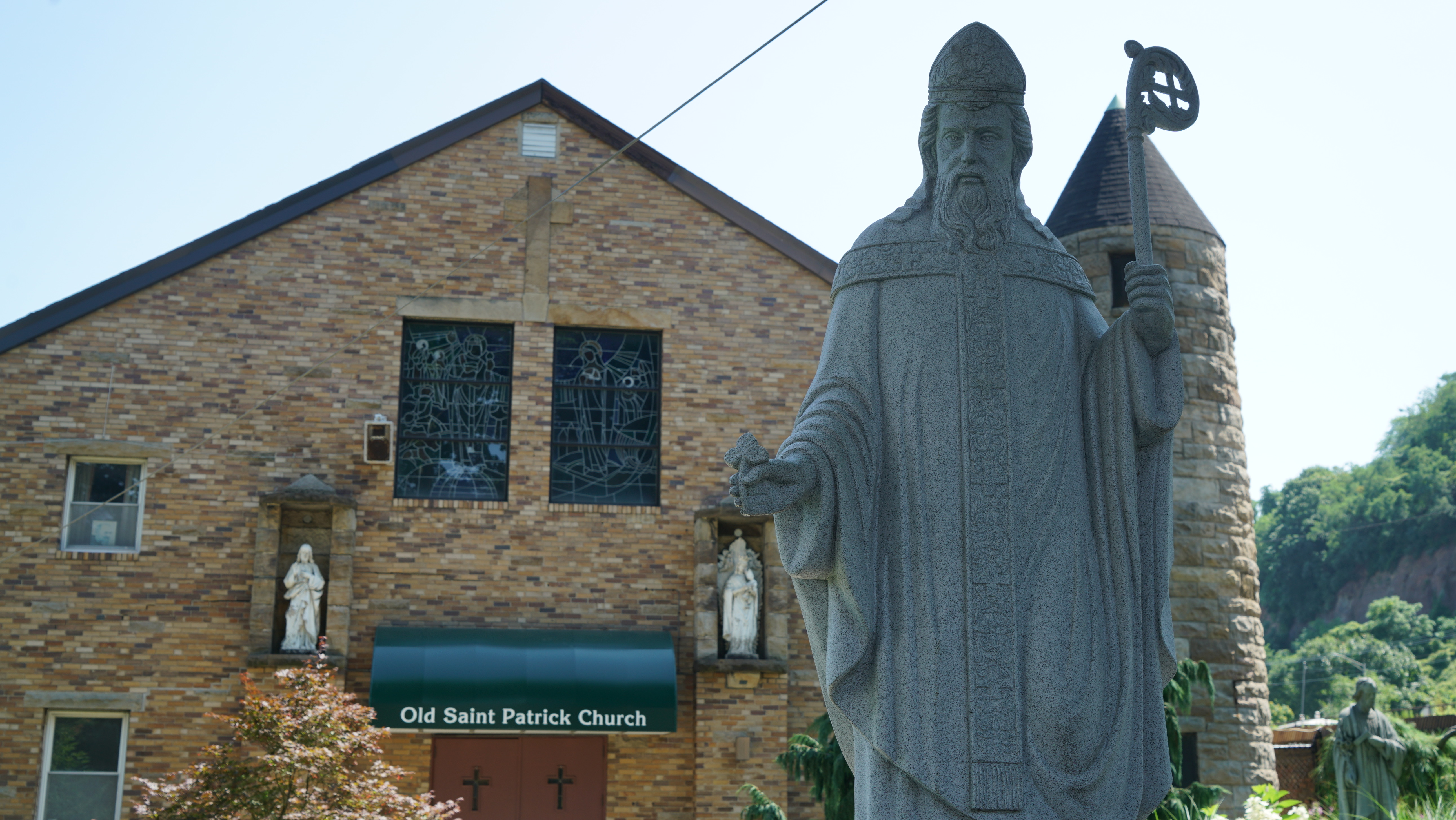 Founded in 1808, St. Patrick’s Church in the Strip District was the first Catholic parish established in the city of Pittsburgh. (Photo: Courtesy of Father Nicholas Vaskov)
That physical action, he explained, becomes an “action of the heart.” People come to St. Patrick’s carrying a wide variety of burdens — family problems, poverty, unemployment — all of which connect back to Father Cox, who sought to serve those facing “difficult times.”
Step by step, prayer by prayer, pilgrims ascend the marble stairs at St. Patrick’s just as pilgrims have done for centuries in Rome. At the top, the small chapel opens before the tabernacle, offering a moment of quiet reflection and encounter with Christ.
“People just come needing to pour out their hearts,” Father Vaskov added. “When you’re kneeling up the stairs, the tabernacle is right in front of you the whole time. I think this really fixes our gaze on Jesus to say, ‘Lord, I can entrust everything to you.’”