
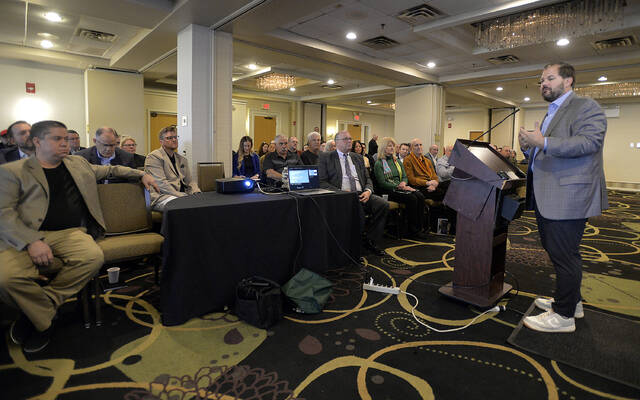
WILKES-BARRE — Numerous data centers are being proposed in the region, and on Friday, more than 150 people heard from experts across all aspects of the burgeoning sector to learn firsthand what to expect in 2026.
John Augustine, president/CEO at Penn’s Northeast, hosted the morning-long seminar at the Doubletree by Hilton that covered everything from local zoning issues, construction of new facilities, energy requirements, economic impact, and public perception.
What Augustine termed “Data Center 101”, the seminar featured Amazon Web Services and a consultant from Data Center Alley in Virginia, in addition to utility representatives and education and workforce experts.
First, let’s define data centers:
“Data centers are specialized, secure facilities that house thousands of servers, storage systems, and networking equipment to store, process, and distribute massive amounts of digital information. They act as the physical backbone of the internet, cloud computing, and AI, providing 24/7 power, cooling, and security to run websites, apps, streaming services, and data processing.
“One of the key components of data centers are the servers — the computers that process and store information.”
Augustine said Pennsylvania has already secured significant data center investment, reinforcing its position in the rapidly expanding digital infrastructure sector. He said NEPA has 29 data centers on the planning map, though he qualified that number, saying he expected 15 to be completed.
“With AI adoption and cloud expansion accelerating nationwide, the region must ensure that infrastructure, utilities, workforce development, and public policy are aligned to support continued growth,” Augustine said during his opening remarks. “This forum will highlight NEPA’s ongoing momentum, showcase regional coordination efforts, and provide insights on sustaining the area’s participation in the evolving digital economy.”
Augustine said NEPA is a desired site for data centers because the region is a top producer of electricity, natural gas, and nuclear energy. He also said the economic impact for the area would be significant, creating more high-paying jobs than the region has ever experienced.
“Northeastern Pennsylvania is a strategic northeast location,” Augustine said. “We have a skilled workforce, strong infrastructure, and a world-class educational system.”
Economic impact
Augustine said the data center industry contributed $2.1 trillion to the U.S. GDP (2017–2021). In Pennsylvania, he said data centers added $14.4 billion to the state’s economy in 2023.
Augustine said more than 900 construction jobs were created or are projected, and each of those direct data center jobs supports an additional 6 jobs across the regional economy.
Augustine and the panelists offered a wealth of facts about the scale of the need for data centers to power the devices people use every day. He said in today’s technological world, the average household has 21 connected devices — more than double the amount of a few years ago. He said there are 5.5 billion people online around the world today. This usage, Augustine said, is why data centers are popping up at such a rapid pace.
The first panel featured Curry Roberts of Parkway Strategies LLC, Fredericksburg, Va., and Merle Madrid, representing Amazon Web Services (AWS).
Roberts urged the NEPA crowd to set clear ground rules now, including where data centers can be located, how close they can be to neighborhoods, and the standards they must meet.
Madrid said the focus should be on approving the right projects and setting the right rules for how they are built. He said Pennsylvania is well-positioned to attract data centers.
Representatives from regional utilities, including Comcast, Pennsylvania American Water, PPL, UGI, and Susquehanna River Basin Commission, addressed energy capacity, grid reliability, fiber connectivity, and coordinated infrastructure planning.
Leaders from Luzerne County Community College, IBEW, LIUNA, and Northeast PA Building Trades discussed training pipelines, apprenticeship programs, and long-term workforce sustainability.
Issues addressed ranged from concerns raised by residents living in areas where data centers are planned, such as water usage, power demand, excessive noise, and more.
Also discussed were zoning rules and regulations, and public input being part of the approval process.
Workforce development
John Yudichak, president of Luzerne County Community College, said the seminar was an informative, fact-based discussion on the “once-in-a-generation” economic opportunity presented by the responsible construction and operation of AI Data Center campuses in NEPA.
“The $10 billion Amazon Web Services AI Data Center campus being constructed in Luzerne County is currently employing thousands of skilled trade workers and will generate millions of new tax revenue for state and local governments,” Yudichak said. “By 2030, Pennsylvania will need 300,000 skilled trade workers across critical industry sectors of technology, energy, manufacturing, and healthcare.”
Yudichak said LCCC is leading a new, statewide workforce strategy with the Pennsylvania Commission for Community Colleges — known as PA Works! — that will build a first in the nation workforce pipeline of skilled trade workers beginning in the career and technical high schools and progressing through Pennsylvania’s 15 community colleges.
He said the pillars of PA Works! include collaborative, innovative partnerships with community colleges and career and technical high schools through Career & Technology Academies, with community colleges and industry partners through Micro-credential Academies, and with community colleges and Pennsylvania’s Building & Construction Unions through Pre-Apprenticeship Building & Construction Trade Academies.
“There is no sector of higher education better to ally with to respond to the changing workforce development demand of the technological revolution that is driving historic economic growth than Pennsylvania’s community colleges,” Yudichak said.
George Stark, of the Pennsylvania Energy & Innovation Institute, moderated the Workforce Development and State & Local Policy Regulations panels. One thing he brought up during the latter discussion is how important it is for communities to set proper zoning regulations, noise ordinances, and other parameters in place in case a data center proposal comes to town.
“If you’re coming, you need to do it our way,” said Stark about what it means to plan ahead and set up these regulations and guidelines before a proposal is even submitted.
Stark also noted that Pennsylvania law prohibits municipalities from banning data centers and that somewhere within zoning ordinances needs to accommodate them.
Growth?
Augustine said our digital demand is no longer just about convenience — it’s a constant, high-volume requirement of modern life.
To put this in perspective, Augustine said 98% of Americans now carry a smartphone — and we collectively stream more than 200 million hours of content on Netflix every single day.
Reach Bill O’Boyle at 570-991-6118 or on Twitter @TLBillOBoyle.