
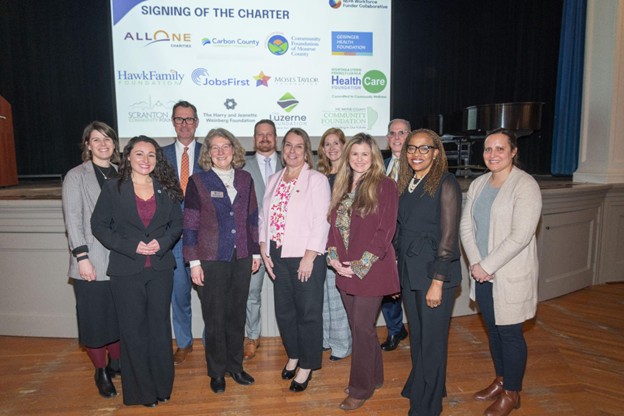
A dozen founding members of a local organization hope their joint effort bolsters the region’s workforce pipeline.
The NEPA Workforce Funder Collaborative — launched March 3 — will support projects that align education, workforce and industry partners around shared career pathways to ensure resources are coordinated across Lackawanna, Luzerne, Wayne, Carbon and Monroe counties, rather than concentrated in specific communities, officials said.
Lindsay Landis, community impact director for the Luzerne Foundation in Wilkes-Barre, views the collaborative as a positive step forward for the region.
“Achieving equitable access to education, skills training, and sustainable wage careers requires coordinated investment and shared strategy beyond the capacity of any single organization,” she said. “By partnering with other funders, we can reduce systemic barriers, align resources, and create scalable workforce pathways that meaningfully enhance the lives of Luzerne County residents.”
Different groups began brainstorming different potential solutions several years ago and developed a list of 10 recommendations, said Laura Ducceschi, president and CEO of the Scranton Area Community Foundation and co-chair of the collaborative.
“Around 2019, the Harry and Jeanette Weinberg Foundation convened a large group of community leaders to start to get a handle on how we can tackle some major workforce challenges,” she said. “Then, they started to convene a smaller group that decided they needed a permanent home, or a collaborative, that wants to cut across a lot of the silos in terms of some of the disconnects within the workforce ecosystem, because it was fragmented.”
The Scranton Area Community Foundation started an initiative to look at how we could collectively address these issues and build a better workforce, Ducceschi said.
“We tackled about four of the 10 (recommendations),” she added. “A big one was making sure there was a funder’s collaborative looking at how we can pool resources to really start moving the needle. Working together is important, but when we pair that with distinct funding to help catalyze this I think that’s where we really start to see momentum. Workforce is one of the most important issues in our region to really build and grow a thriving region in so many ways, and many of the funders represent a variety of these geographical areas where they would put their money. It’s focused on making sure each county is heard.”
The partners gathered for several quarterly meetings leading up to the launch, with another scheduled for late March.
“We plan to formalize a lot of the strategies, a lot of the policies and a lot of the plans,” Ducceschi said. “From there, we’ll be able to put out calls for funding.”
Danielle Breslin, president and CEO of Moses Taylor Foundation and co-chair of the collaborative, highlighted the need to fill a variety of health care positions — from medical assistants to nurses to physicians. She credits the Anchors for Equity program led by The Institute, along with the Federal Reserve Bank of Philadelphia, for providing a blueprint for the group to follow.
“They brought together the educational institutions and health care institutions in the community to identify the most high-need positions and places where we can start to make an impact,” she said. “In some cases, people may come in and start doing some work getting a credential. Then, while they’re working, they can take some additional classes and maybe move into being a nurse’s aide or medical assistant. We’re really trying to help people make their way through the health care pipeline.”
The collaborative consists of AllOne Charities, the Carbon County Community Foundation, the Community Foundation of Monroe County, Geisinger Health Foundation, the Harry and Jeanette Weinberg Foundation, the Hawk Family Foundation, JobsFirstNYC, the Luzerne Foundation, Moses Taylor Foundation, NEPA Health Care Foundation, Scranton Area Community Foundation and the Wayne County Community Foundation.
“As we’re starting to come together and pool our resources and focus together, that creates a lot more opportunity and likelihood that we’re going to be able to bring in funding from outside the region,” Ducceschi said.
Breslin added it will be critical to attract financial support from both regional and national sources for the initiative to reach its full potential.
“We know it’s going to take more than the money we have here in the community today,” she said. “We’re sending a message to other funders from outside the area that we’re an area that is ripe for investment if you care about workforce issues, and particularly workforce issues in health care.”
John Cosgrove, CEO of AllOne Foundation & Charities, believes strength in numbers makes a difference when trying to generate the biggest impact.
“Whenever one or more of us, from the philanthropic sector, come together to leverage our collective resources it’s a good thing,” he said. “As far as this effort is concerned, focusing on the workforce solutions in Northeastern Pennsylvania, we consider that to be an excellent investment because one of our most valuable commodities as a region is our workforce — it’s our neighbors and family and friends. We have to pool our resources and we have to be much more strategic about where the investments go in order to get the best solutions.”
Cosgrove also feels the mix of partners should help spur constructive discussions and positive changes.
“You have large foundations, corporate entities and community foundations, of all shapes and sizes, coming together to share what they’re seeing and hearing on the front lines of their own community about where the needs are and how we can best utilize our collective resources,” he said. “For many generations, the work ethic of the people of Northeastern and North-Central Pennsylvania has been our strength. It’s in our heritage and it’s very much alive today. The purpose of this collaborative is to shine as bright a light on that, and remove some barriers that are holding back those ethics from being fully realized.”