
Gov. Josh Shapiro’s administration plans to move ahead with two multimillion-dollar projects to make it easier for disabled persons with mobility issues to access the Capitol Complex in Harrisburg. But the projects won’t address a longer list of needed fixes listed in a recent study assessing the Capitol’s accessibility challenges.
The Department of General Services released the 158-page study to the public Monday.
It evaluates access to the 45-acre Capitol Complex — including outdoor routes, entrances, restrooms, elevators, signage and indoor paths — and proposes dozens of construction projects to improve accessibility in response to an executive order signed by Shapiro in May 2024. Costs for each individual improvement range from hundreds to millions of dollars.
It would cost about $71 million to tackle every accessibility improvement proposed in the study, according to a DGS spokesperson.
The Capitol Complex is held to a lower standard for accessibility than newer buildings. That’s because the Americans with Disabilities Act has looser guidelines for historic properties, even if they’re as well-visited as the state Capitol.
The study, put together by Philadelphia-based Voith & Mactavish Architects, was initially scheduled to wrap up by spring 2025. But field work and adding an extra meeting with stakeholders, including disability advocates and Capitol staff, caused months of delays, according to Greg Kirk, DGS’ deputy secretary for capital programs.
Kirk said the two meetings with stakeholders had more than 40 participants each, though he did not confirm how many were disability advocates.
DGS has yet to inform stakeholders of how their input was used for the final draft and which of the dozens of potential accessibility improvements will get picked up.
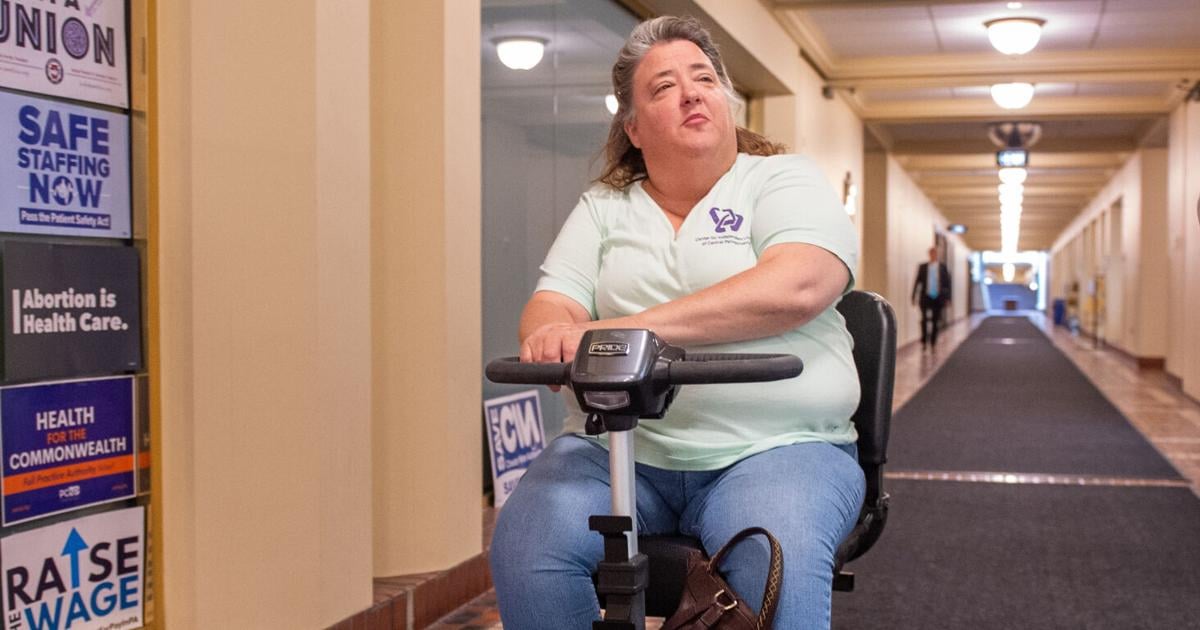
Pam Auer, a nursing home transition coordinator for Thrive Center for Independent Living who lives with spina bifida, has long advocated for communities with disabilities in Harrisburg. Auer uses a motorized scooter to get around the Capitol Complex.
“I still haven’t heard anything,” Auer said. “We even told them when things happen, let us know so we can celebrate with them.”
Upcoming projects
The two projects DGS is moving forward on have a $16.5 million price tag, with the money coming from state public improvement project dollars authorized by the General Assembly, a DGS spokesperson said via email. The projects are financed through bond funding administered by the Office of the Budget via the Capital Facilities Fund.
“For accessibility work specifically, authorization was provided under Act 36 of 2020,” a DGS spokesperson said by email.
That act designated $25 million to DGS to fund “improvements, infrastructure upgrades and land acquisition for ADA accessibility and code upgrades to DGS-owned buildings.”
One project, at $1.5 million, would install handrails to some staircases in the interior of the Capitol Complex and adjust thresholds at some doorways to make it easier for mobility aid users to get through.
Currently in the planning phase, construction is set to begin this summer and wrap up by the end of 2026.
Another project, valued at $15 million, seeks to improve navigation from parking spaces to the ADA-accessible East Wing entrance, adjust ramps along the north and south sides of the Main Capitol building, make improvements along Commonwealth Avenue and fix non-ADA compliant signage, Kirk said.
The top landing of the grand stairs at the front of the complex on North Third Street will also be made accessible, according to a DGS spokesperson, by making the Main Capitol parking lane ADA-compliant.
Those changes will not give mobility aid users an accessible path to any other level of the front steps, nor to the front entrance.
As it stands, mobility aid users have no way to access the top and can only use one of four public entrances in the entire complex available on weekdays.
“It’s very much our concern about what happens if there’s an emergency evacuation… There’s one way in and one way out. That’s it,” Auer said.
That project is in the design phase, with construction set to begin in late 2027 and conclude in mid-2029.
The front steps
The current plan would not give mobility aid users access to other levels of the front stairs or a ramp from North Third Street to the front entrance.
Press, community and cultural events are frequently held across all levels of the staircase.
“The work being done on this capital project is to provide an accessible route to the top landing of the main Capitol steps,” Kirk said, “so they won’t be fully accessible.”
There are currently seven events on the front steps scheduled for the remainder of March, including a “No Kings” protest, a Trans Day of Visibility rally, events on immigration advocacy and an elopement. Auer said people like her are typically left at the bottom of the 60-plus tiered steps.
In May 2024, months before the study began, nearly 150 Pennsylvanians with disabilities protested the state Capitol’s inaccessibility by abandoning their mobility aids at the base of the grand stairs and climbing as many steps as they could.
Voith & Mactavish proposed two options to add bronze handrails to the grand stairs leading to the front entrance, but the Capitol Preservation Committee, which leads projects to preserve the historical integrity of the complex, opposed them.
David Craig, the committee director, said the committee still opposes the handrails due to their alleged impact on the “historic fabric” of the property but is open to other options.
Plus, Craig said the East Wing should be the central focus for visitors.
“The ‘main’ entrance for visitors is the East Wing,” Craig said by email. “The study does incorporate accessible routes from the west side of the Capitol to the East Wing.”
That answer doesn’t satisfy Auer, who said she worries about the dangers of limiting entrances and exits for people with disabilities at the Capitol.
“They wanted to use old-looking handrails, that’s great. Make it look historic. What’s your problem?” Auer said. “History is great and important, but to be able to live your life and give access, you have to give a little.”
Rocco Iacullo, a staff attorney for Disability Rights Pennsylvania, said he doesn’t think installing handrails to the front entrance would cause harm, either, at least not according to the U.S. Department of Justice guidance.
“While the ADA would not require alterations that ‘threaten or destroy the historic significance of the building or facility,’ that exemption is intended to be construed narrowly,” Iacullo said via email.
Next steps
Iacullo last heard about the study when he was a stakeholder in January 2025, when Voith & Mactavish was on draft one of three. While the stakeholder meetings went smoothly, he said, communication about next steps has been nonexistent.
“If they’re just going to release a statement next week on what they decided on and not really allow for further input on that, that’s problematic,” Iacullo said. “Even with the main entrance issue, they’re really only talking about providing partial accessibility.”
Kirk said DGS is still working on a “communication plan” to inform stakeholders of upcoming accessibility projects and did not directly answer whether DGS will consult people with disabilities again as construction moves forward.
The future of remaining proposals — ranging from more accessible bathrooms to mobility aid-safe flooring to improved access to hearing rooms — is unclear. There are no concrete timelines yet for more accessibility projects based on the study.
“We are looking at additional phases to address some of the other findings of the study, on the interior of the building, but those will likely be after the initial phase project,” Kirk said.
In the meantime, DGS and the Capitol Preservation Committee have continued to make progress on accessibility projects outside the scope of the study. A new accessible bathroom, which includes the complex’s first adult changing room, opened to the public last week in the East Wing. A lower-level accessible restroom was recently completed in the Irvis Office building, and site work for a ramp from Capitol Park to the Main Capitol sidewalk near the Ryan Building is set to begin in May, according to a DGS spokesperson.
Auer, a longtime advocate for an adult changing table at the Capitol complex, said she was not informed about the ribbon cutting, or that the changing table was being added at all. She said she hopes DGS reaches out to disability advocates before moving forward on construction.
“I’m sure they have their ADA experts,” Auer said, “but consult with us, lived experts.”
MONTHS OF WAITING
LNP | LancasterOnline first asked the Department of General Services by email for a copy of the accessibility study in May 2025 and was told that the report would be finalized in the coming weeks and publicly released by early summer 2025.
Emailed follow-ups in August, September and November did not get clear answers, so LNP | LancasterOnline filed a Right-to-Know request at the end of November asking for digital copies of records related to DGS’ accessibility study.
DGS requested an extension until Jan. 2, then an additional one week extension, then an additional extension to Jan. 23 to finalize documents.
“After the study was received in August of 2025, we did go through a review and evaluation process of the study that did drive some updates in January of 2026 that were to finalize the report,” said Greg Kirk, deputy secretary for capital programs.
That deadline passed with no updates. On March 4, LNP | LancasterOnline received a copy of the 158-page accessibility report outside of the formal Right-to-Know request process. The report was then released to the public on March 9.
PAST COVERAGE

Success! An email has been sent to with a link to confirm list signup.
Error! There was an error processing your request.