
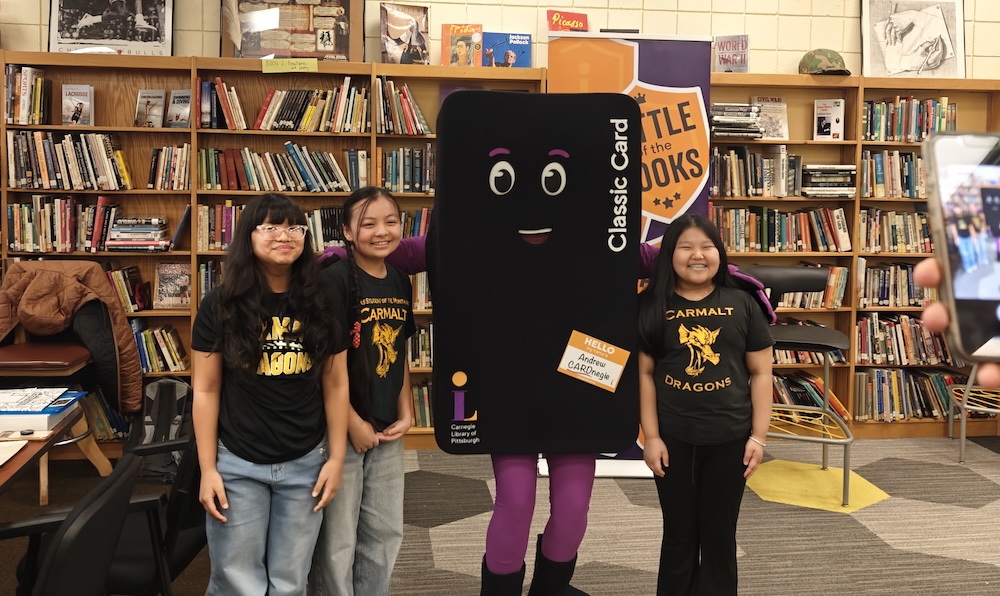
Inside the library at Brashear High School, groups of middle school students leaned toward one another, whispering last-second answers before scribbling them onto paper. Heads huddled together.
For a few hours, reading wasn’t a solitary activity. It was a team sport.
The students were competing in the Youth Battle of the Books, a long-running program organized by the Carnegie Library of Pittsburgh in partnership with Pittsburgh Public Schools. The districtwide event challenges teams to answer detailed questions about six books they’ve spent months preparing to read.
Dr. Ann Fillmore, executive director of literacy, communities and library services for Pittsburgh Public Schools, said programs like Youth Battle of the Books are part of a broader effort to strengthen reading across the district. Through its partnership with the Carnegie Library of Pittsburgh, the district works to expand students’ access to books and literacy resources both inside and outside the classroom.
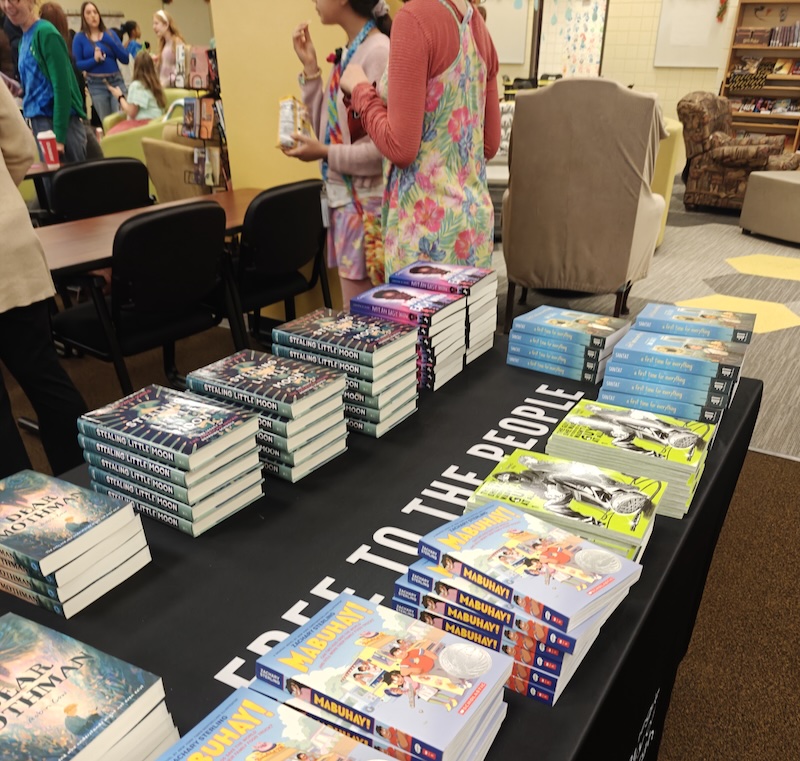 CLP Battle of the Books photo by Aakanksha Agarwal.
Fillmore noted that the district now ensures every PPS student has a Carnegie Library card, giving them access not only to books but also online tutoring and other learning resources through the library system.
About 40 students from schools including CAPA, South Brook, Carmalt and Sterrett gathered for this year’s middle school competition.
For many of them, the preparation began early in the year.
“We’ve been preparing since January,” said Amira, one of the students competing.
In the months leading up to the competition, teams met regularly with teachers and librarians, holding discussions about the books and staging mock trivia rounds to test their knowledge.
Teams approached the reading list strategically. Rather than everyone reading all six titles, students divided the books among themselves so the group could collectively cover the entire list.
“Each of us read two books,” Amira said. “One we focused on especially and one we still studied but a little less.”
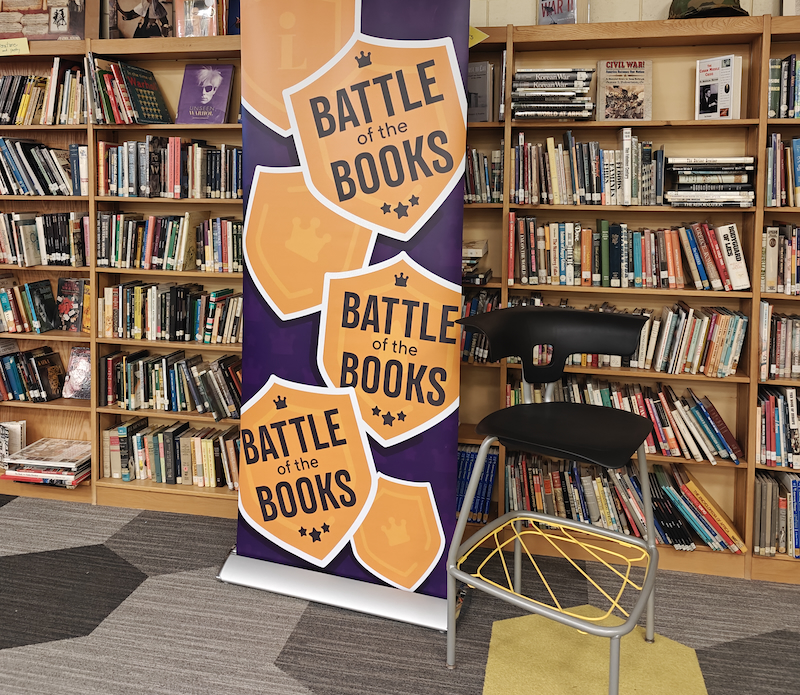 CLP Battle of the Books photo by Aakanksha Agarwal.
During practice sessions, teammates quizzed each other and revisited key scenes. For Owen, another competitor, the challenge came from remembering the smallest details.
“For my main book, I remembered a lot of the details,” she said. “But I still had to reread parts.”
The reading list also pushed some students into unfamiliar territory.
One of the titles, “The Guy She Was Interested in Wasn’t a Guy at All” by Sumiko Arai, is a Japanese manga — a format that reads from right to left rather than the left-to-right structure most American readers grow up with.
“At first it was confusing because you have to read it backwards,” Amira said. “But once you start to pick up on it, it gets easier.”
For Owen, the experience pushed her out of her comfort zone. “This made me read books I probably wouldn’t have picked up otherwise.”
That kind of curiosity is exactly what organizers hope to spark. The Youth Battle of the Books has been part of Pittsburgh’s literacy programming for years, though it paused during the pandemic. This year marked the first time the event returned to an in-person format in six years — something library staff say makes a huge difference.
“There’s really nothing like being together in person for it,” said Erin Rudegeair, library services supervisor for school partnerships at Carnegie Library of Pittsburgh.
The competition reflects a broader philosophy behind the library’s youth programs: reading works best when it’s social, joyful and connected to students’ interests. “It’s really in line with what we try to do at the library, create programs that bring the social aspect of reading to life and motivate kids through joy,” Rudegeair said.
The event is also part of the library’s Literacy Takes Flight initiative, which focuses on expanding literacy opportunities and building stronger connections between young readers and books.
Long before students arrived at the competition, librarians had spent months assembling the reading list.
A committee of 11 Carnegie Library staff members reviewed school reading lists, award-winning titles and staff favorites before narrowing the options to six books that would challenge students while remaining accessible to middle school readers.
The final list spans genres and perspectives, from the graphic memoir “A First Time for Everything,” by Dan Santat, to the novel “Dear Mothman,” by Robin Gow and the nonfiction history “Stealing Little Moon: The Legacy of the American Indian Boarding Schools,” by Dan SaSuWeh Jones.
Graphic novels and manga were included intentionally, Rudegeair said, because they reflect the formats many students already enjoy reading.
“We want the list to reflect what teens are actually interested in reading,” she said.
The selection process also prioritizes diverse authors and stories that allow students to encounter a wide range of identities, cultures and experiences.
Programs like Battle of the Books also help libraries reconnect with an age group that often begins drifting away from recreational reading.
“Middle school is actually an age where we tend to see less use of the library,” Rudegeair said. “So bringing back something fun and competitive like this helps reconnect students with books.”
At Sterrett School, librarian Kate Buick coached one of the teams preparing for the competition.
For Buick, the event is about far more than answering trivia questions. At its core, she said, reading programs work when students see books as both mirrors and windows.
“You want students to be able to look in a mirror and see themselves reflected in books,” Buick said. “But you also want them to look out a window and see other people’s lives and perspectives.”
The reading list offered both. Some stories transported students to entirely different places — from Appalachia to Japan — while others explored identity, friendship and history through voices students may not encounter in their daily lives.
Beyond reading comprehension, the competition also requires students to collaborate, debate answers and trust their teammates.
“The biggest skill they’re building is learning to work cooperatively,” Buick said. “And having the confidence to speak up.”
As the morning progressed, teams earned points for every correct answer about characters, settings and plot twists from the six books. By the end of the competition, one team had pulled ahead.
The CAPA group known as the “Sparkle Story Slayers” claimed the top spot after months of preparation, earning medals and plenty of bragging rights.
But for many of the educators watching from the sidelines, the real victory had little to do with the scoreboard. What mattered most was the sight of students arguing passionately about plot points, recalling details from chapters they read weeks earlier and discovering stories they might never have opened otherwise.
For Buick, that kind of excitement is exactly the outcome she hopes for.
“My goal,” she said, “is that they have a lifelong love of reading.”