
PLAINS TWP. — To start a conference, John Augustine displayed a map of 29 spots in Northeast Pennsylvania where developers want to open data centers.
Augustine, president of Penn’s Northeast, doesn’t think all of them will be built but said data centers still provide a “once-in-a-lifetime” opportunity.
Penn’s Northeast organized the conference for 150 people in business and government on March 13 at DoubleTree by Hilton to offer facts, Augustine said, not provide a commercial for them.
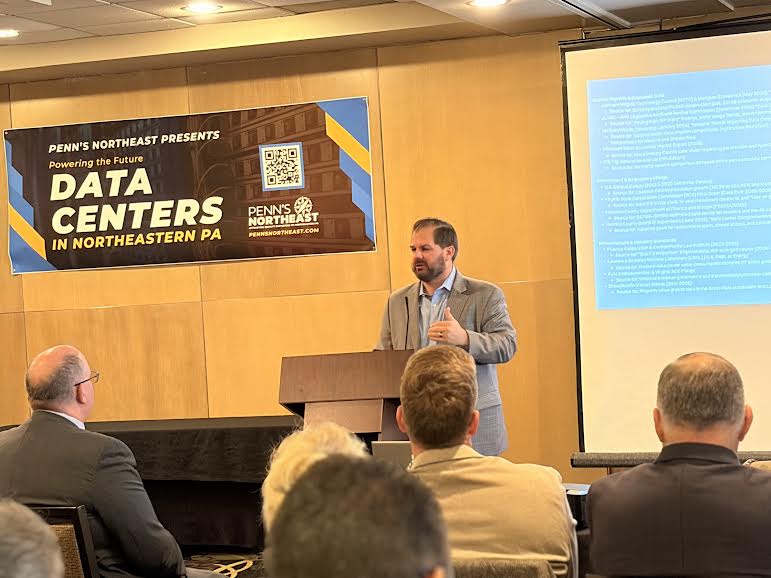
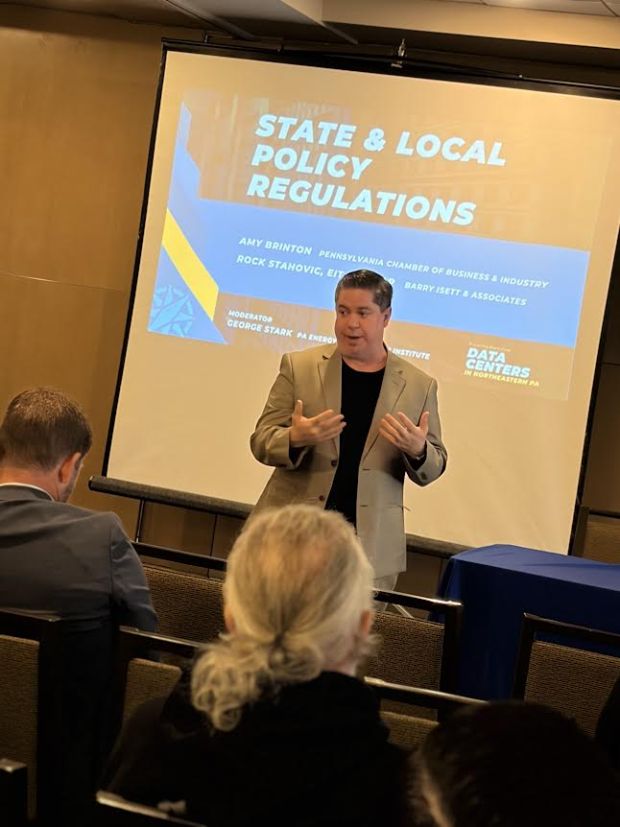 John Augustine, president of Penn’s Northeast, speaks during a conference about data centers in Northeast Pennsylvania sponsored by Penn’s Northeast at DoubleTree by Hilton in Plains Twp. on March 13, 2026. (Submitted Photo)
Speakers who followed him said data centers are drawn to Northeast Pennsylvania. The climate reduces cooling costs. Power, water and trained workers are available. But communities can set boundaries.
“What you do want to know is how much of your area do you want to dedicate to this industry,” Curry Roberts, a consultant from Virginia, said.
During the past dozen years in Virginia, Roberts watched data centers radiate southward from Loudoun County into Fredericksburg where he ran a regional business group.
The density of data centers in Loudoun County won’t be recreated anywhere, he thinks.
“The industry doesn’t want it. If Amazon goes somewhere, Google goes somewhere else,” Roberts said.
Virginia’s experience, he said, can inform Pennsylvania.
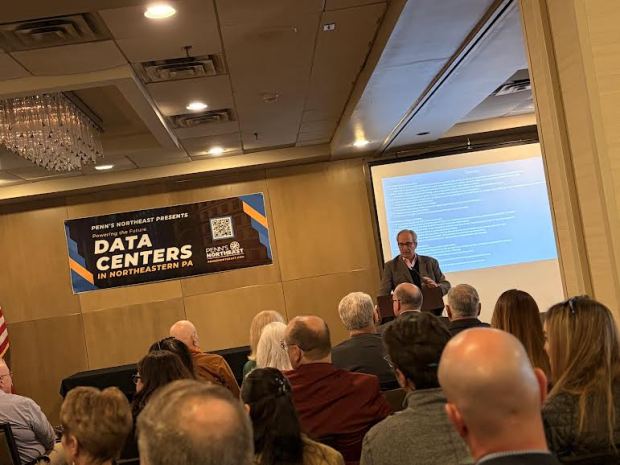 Curry Roberts of Parkway Strategies in Fredericksburg, Virginia speaks during a conference about data centers in Northeast Pennsylvania sponsored by Penn’s Northeast at DoubleTree by Hilton in Plains Twp. on March 13, 2026. (Submitted Photo)
Where Virginia communities allowed data centers in business and commercial zones, which often put them next to neighborhoods, Roberts said his group restricted them to 15 sites of at least 100 acres. He generally recommended keeping data center development 750 feet from homes but made allowances for effects of topography such how sound carries.
“You’ll hear it kills home values. It doesn’t,” he said while adding that data centers pay more in taxes than they require in services. The ratio is $13 to $1 in Prince William County where one data center spent millions identifying and reducing a source of noise.
Augustine, on a visit to Loudoun County, said, “Among the things we noticed, noise wasn’t one of them.”
Rock Stahovic of Barry Isett and Associates, an engineering firm for several municipalities in NEPA including Salem Twp. where Amazon Web Services is building a data center campus, said not all municipalities have huge areas to set aside for centers in industrial zones.
State law requires communities to allocate some land for data centers — as with all lawful uses — so Stahovic tells municipalities to be proactive.
“We urge them,” he said, “to see where the best fit is.”
That might be an agricultural or conservation area on which the municipality might overlay additional conditions for a data center, if a developer appears, Stahovic said. He also recommended adopting a communitywide noise ordinance, requirements for environmental impact and traffic studies and a comprehensive plan covering how an area transitions from what it is now to what it will become when development finishes.
George Stark of Pennsylvania Energy and Innovation Institute said adopting zoning rules and master plans doesn’t mean a community endorses data centers.
“Each project still needs to be reviewed. If you’re coming in, you’re meeting my standards. You now need to get a permit,” Stark said.
Gov. Josh Shapiro in February set standards for responsible developers of data centers, which he wants to supply their own power, conserve water, be transparent about plans and hire local workers.
Amazon Web Services is committed to working with the governor on those principals, Merle Madrid, senior manager of public policy for Amazon Web Services, said.
He said Amazon built two natural gas plants in Indiana that created more electricity than the company used and has a plan to recycle water and improve water works.
“Doing a development of this size, you’re not going to get everything perfect,” said Madrid, who encouraged “every local government to ensure the ordinances you put in place attract the projects you want.”
Amy Brinton of Pennsylvania Chamber of Business and Industry wants data center companies to be part of drafting any statewide model ordinances written for permitting them. Otherwise, the ordinance could add barriers to investment.
John Yudichak, president of Luzerne County Community College, said without the $20 billion that Amazon planned to invest in Pennsylvania, the county’s unemployment might rise as artificial intelligence reduces retailing, the second largest employment sector in Luzerne.
Instead just four data center projects could add $112 million in taxes to the county, which receives $128 million now Statewide, data centers are creating part of the demand for 300,000 tech jobs by 2030.
The college is trying to develop those workers by offering vocational students opportunities to earn certificates in welding and HVAC while in high school, microcredentials for workers who are displaced or want to advance in the tech boom and pre-apprenticeships.
Speakers from labor associations that offer apprenticeships said they supply the workers needed to build complex projects like data centers and didn’t describe construction jobs as short term.
“For 33 years, I’ve been doing these temporary construction jobs,” Warren Faust of Northeast PA Construction and Building Trades, said.
John Olejnik of the Third District of the International Brotherhood of Electrical Workers, said his father helped build the nuclear plant in Salem Twp. where his son now is working on the data centers. These jobs lead to good-paying careers that allow people to buy a home and raise a family in Northeast Pennsylvania, where they will move to other construction projects such as building schools and hospitals before they retire.
Augustine said about 1,100 workers are on the Amazon construction site in Salem Twp. where three buildings are open, two are being built and up to 17 are planned. He expects construction jobs will continue for 10 years.
After data centers open, Augstine said they will employ about 50 people for every 1 million square feet and supply 35 jobs through contracted services, according to current averages. Each employee hired directly at a center spins off six other jobs.
Shelby Linton-Keedie, senior director of government, regulatory and external affairs for PPL Electric Utilities, said her company is more bullish than Augustine on the number of data centers that will open, based on signed agreements for power supplies.
She displayed a chart showing power use in signed agreements for data centers rising from 10.9 gigawatts to 25.2 GW between the first and fourth quarters of 2025. One gigawatt, Linton-Keedie said, is almost the daily use in Pittsburgh.