
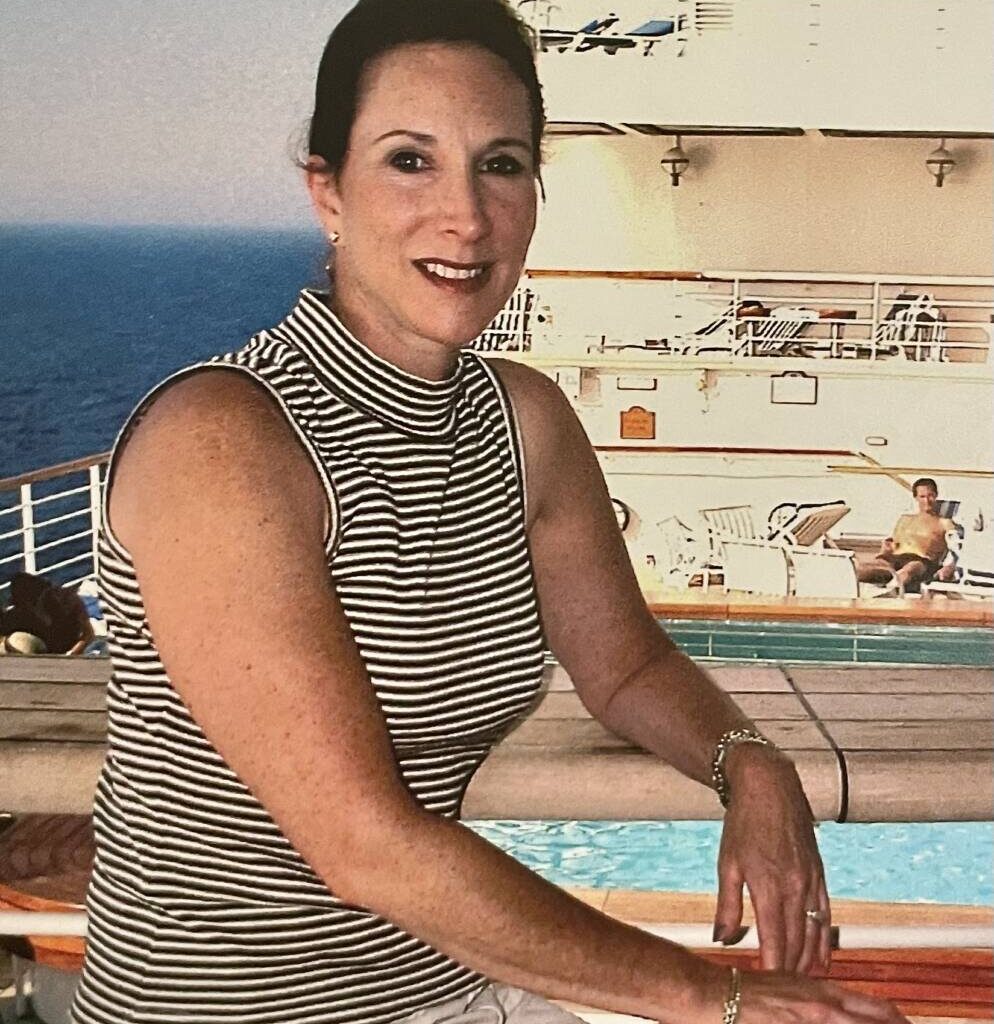
 Rhona Katz (Courtesy of Dana Katz)
Ellen Braunstein
Rhona Katz, a Philadelphia native who pursued Jewish learning as an adult, became active in the Soviet Jewry movement and opened her home generously to family and friends, died on Jan. 24 after a long illness. She was 78.
She was remembered by her daughter Dana Katz as elegant, deeply caring and determined — someone who valued beauty, fairness and Jewish community and who maintained strong friendships over decades.
Born on Aug. 27, 1947, in the Logan section of Philadelphia, Katz grew up in a home shaped by immigrant roots and traditional assumptions about gender. Her parents identified as observant, her daughter Dana Katz said, but in practice it was Rhona’s three brothers — not Rhona — who were sent for Jewish education.
That exclusion stayed with her.
“She was genuinely curious,” Dana Katz said. “She was jealous that they got to learn things that she didn’t.”
As an adult and a mother, Katz decided to change that. When she enrolled her own daughter in Hebrew school and saw women participating more fully in synagogue life, she realized how much she had never been taught. She began studying at Congregation Ohev Shalom in Richboro.
She enrolled in an adult bat mitzvah class at 35 and became a bat mitzvah at 37.
Her daughter said the learning itself was what mattered most.
“I don’t think she thought ‘I want to have an adult bat mitzvah,’” Dana Katz said. “I think she was so interested in learning that every time the rabbi assigned a book, she devoted herself to it. It was really the process that she enjoyed.”
Completing the milestone also allowed her to guide her two daughters through their own Jewish education with more knowledge than she had growing up.
Katz continued to deepen her Jewish involvement afterward. According to her family, she remained engaged in Jewish life through synagogue attendance and observance at home.
For Shabbat, she always lit candles and served a Shabbat dinner. She went to Friday evening services with her daughters.
She was also a devoted reader of Philadelphia Jewish Exponent.
“She read it front to back,” Dana Katz said. “It was probably the only newspaper in the kitchen.”
In the 1980s, Katz became active in the Soviet Jewry and Refusenik movement. Her daughter recalled petitions, marches and trips to Washington tied to that cause, as well as her mother’s support for bar and bat mitzvah twinning programs.
Dana Katz said her mother was drawn to the issue in part because she understood what it meant to be excluded from Jewish learning.
“The Jewish community was very important to her,” she said. “Jews have a right to be with each other in peace and to be able to practice and learn.”
Israel also held a lasting place in Katz’s life. According to her family, she first visited in 1987 and ultimately traveled there six times, including a volunteer mission about 20 years ago.
At home, Katz was known for her warmth and attentiveness. Dana Katz described her as deeply caring and focused both on immediate needs and on preparing her children for the future. Though she had not gone to college herself, she pushed her daughters to take education seriously.
“School is your job,” Dana Katz recalled her mother saying.
She helped with homework, encouraged curiosity and took pride in her daughters’ achievements, especially education.
Though remembered for her polished appearance, Katz was also practical and capable at home.
“She would tear drywall out and then paint,” Dana Katz said.
Her husband, Robert Katz, said her attention to detail showed up everywhere, from the way she dressed to the way she decorated their home.
“Anybody who knew her said everything about her appearance was always perfect,” Robert Katz said. “Even in the house, when we moved, the painter couldn’t believe she picked seven or eight different shades of white for different rooms.”
Friends remained central throughout her life. She kept relationships for decades and stayed in close touch with people she had known since childhood.
“That was from the time she was about 9 years old until the day she died,” Robert Katz said of one longtime friendship.
That warmth was paired with a strong sense of fairness. Her daughter recalled an incident at a Rite Aid when a cashier with Tourette syndrome was treated badly by another customer. Katz was sensitive to the cashier and the great job she was doing. She later spoke with the manager and wrote to the company to commend the employee.
“My mother was very compassionate and able to see strength in people,” Dana Katz said.
In her final years, Katz lived with Alzheimer’s disease, an illness that also debilitated her father. Symptoms became noticeable around 2012 and progressed over many years, her husband said.
“It’s a progressive disease,” Robert Katz said. “You don’t really notice it in the beginning, but it became more and more obvious.”
After her death, her daughter created a document called “Rhona’s Rules,” a collection of observations and lessons inspired by the way she lived. What began as something for the shiva house circulated widely among friends and family.
Looking back on their decades together, Robert Katz said his wife approached everything with the same determination.
“If she was going to do something,” he said, “she did it perfectly.”
Ellen Braunstein is a freelance writer.