
By SUSAN JONES
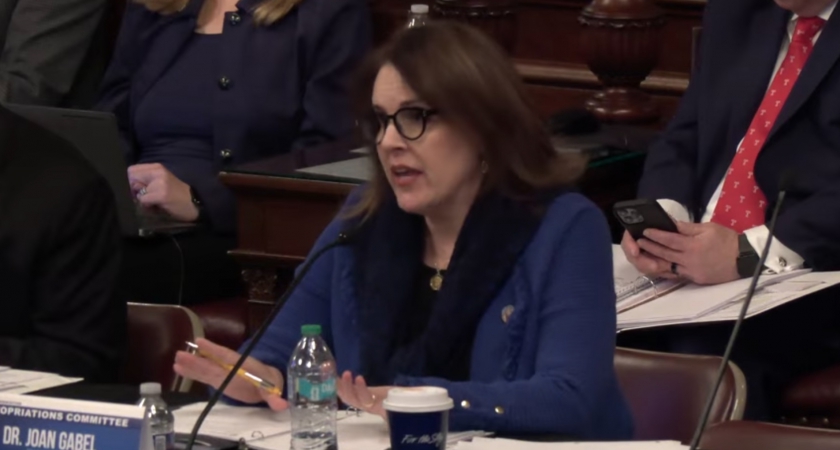
Pitt Chancellor Joan Gabel told the state House Appropriations Committee on March 10 that the University is proud to be working with the legislature to make Pitt “a great investment.”
The general funding Pitt gets from the state, which has been at $151.5 million annually since 2019, goes toward the discount in-state students get on tuition, and “makes higher education possible for thousands of Pennsylvania students who study at Pitt,” Gabel said.
Gov. Josh Shapiro’s 2026-27 budget proposal keeps funding flat for the state-related universities — Pitt, Penn State, Temple and Lincoln — but provides $30 million in performance-based funding for Pitt, Penn State and Temple. Lawmakers would have to approve that funding and determine what metrics would be used to determine its distribution. The leaders of the three larger universities all spoke favorably about the performance-based metrics.
In the fall, Pitt submitted its funding request to the state, which asked for a 3.7% increase.
“We believe that our 3.7% appropriation increase is tied to inflation, is responsible, allows us to focus on that partnership (with the legislature) and represent our commitments that you helped us craft through our strategic plan to provide affordable world class education to Pennsylvania students,” Gabel said at the budget hearing last week.
“We think this responsible increase request allows us to protect affordability for Pennsylvania students, maintain our excellence in ways that have yielded for the commonwealth, and in ways that we know make the future very bright for all of higher education and all of the constituencies that we serve,” she continued.
When asked what another year of flat funding would mean at Pitt, Gabel said that although the 2026-27 budget is still being developed, Pitt is anticipating a tuition increase.
“We’ve held increases below inflation for at least 10 years, which is resulting in a very heavy constraint on other strategic investments that we’re able to make,” she said. “The math is relatively clear, that when you hold appropriations flat in an inflationary environment, expenses continue to go up and we have to that figure out somehow. That has resulted in tuition increases.”
The leaders of the three other schools also said tuition increases are likely if state funding does not increase.
The more than two-hour hearing covered several topics. Here are just some of the responses from Gabel:
On the impact of the federal government reclassifying some degrees, such as nursing, as not professional, and what the universities have done to counteract that:
Gabel noted that the change has had a direct impact on the low-cost financial aid that students in those fields can get. Many of the fields that were left off of the “professional” list, including social workers, teachers and others in health care, are “high-demand, high-workforce, high-need, high-community-impact fields,” she said. “It was a list that would have looked quite different had it been consulted with representatives from higher education or from the professional associations or unions.”
Pitt is advocating for some changes to the list both individually and through professional higher ed organizations.
“In the meantime, we don’t want to see a dip in enrollment, because it’s very hard to dig back out once you see that valley hit in these fields,” Gabel said. “We’re working very closely on our own resources. We already award a lot of internal financial aid, and we’re looking at the strategic allocation of that financial aid. We’re working very closely philanthropically with individual donors, foundations, working in partnership with professional associations to make sure that we maintain enrollment in these programs.”
On all of the changes in the college athletics landscape:
“We have a student-centered philosophy for our 600 some odd student athletes, to ensure that they have an excellent educational experience and that we are competitive,” Gabel said. “That is part of our excellence too. We also do not use any of our appropriation to support the enterprise. But it is, as President Fry (of Temple) described, one of the most dizzying, rapidly changing, unsettled areas of ground that we are coping with.”
On making sure Jewish students feel safe:
“We have been working very closely, both with our Jewish students and Jewish community leadership, which is robust and heavily partnered in Pittsburgh, having had a very long history, and also very significant tragedies over the course of that history,” she said. “If there’s any silver lining to be found amidst tragedies, it often brings people together, and that has resulted in a very strong community approach to antisemitism, specifically, and on campus, the recent launch of an antisemitism task force that has faculty, staff, students and community members working specifically on the uptick in antisemitism.”
On the new Grow PA program, which provides grants of up to $5,000 per year for students going into in-demand occupations:
“I think it’s a fantastic program,” Gabel said, echoing the leaders of the other three schools. “I think it’s exactly how you put your money where your mouth is, so to speak, in terms of all the things we’ve talked about and attracting new talent, putting them in high demand areas, setting them up for professional success, creating the right incentives. “Operationally, as with any program, there’s some smoothing to do, … and then all of us together can do, I think, a lot in partnership to make sure students know that the opportunity is there.”
Find the full recording of the budget hearing on YouTube.
Susan Jones is editor of the University Times. Reach her at suejones@pitt.edu or 724-244-4042.
Have a story idea or news to share? Share it with the University Times.
Follow the University Times on Facebook.