
By SHANNON O. WELLS
The developing Health Sciences Master Plan for physical space in its six schools focuses mainly on future plans and projects, but some changes are already underway, particularly consolidation of space in Oakland.
Addressing questions in a presentation on the master plan before the Campus Utilization, Planning and Safety (CUPS) Committee at its March 3 meeting, Jaime Cerilli, associate vice chancellor for strategic space planning and management, health sciences, said consolidations that started last fall will continue into this spring and summer.
Noting that the Department of Medicine has one of the “biggest footprints” in Oakland, she said approximately 25,000 square feet of lab space in Scaife Hall was consolidated into spaces in the Biomedical Science Tower.
“We’re using that space in Scaife Hall to bring external leases back into Oakland. Because nobody ever left those rooms for 25 years, we’re doing the controls upgrades before people move in,” she said, noting that some spaces are awaiting air-handling system upgrades.
In June, the Drug Discovery Institute from Second Avenue will move in. “We’ve made a big dent without having the plan in full swing yet,” she said.
The master plan process started in April 2025 with a request for proposals that led to HOK, a global design, architecture, engineering and planning firm, being awarded the contract. Work on the master plan started last July.
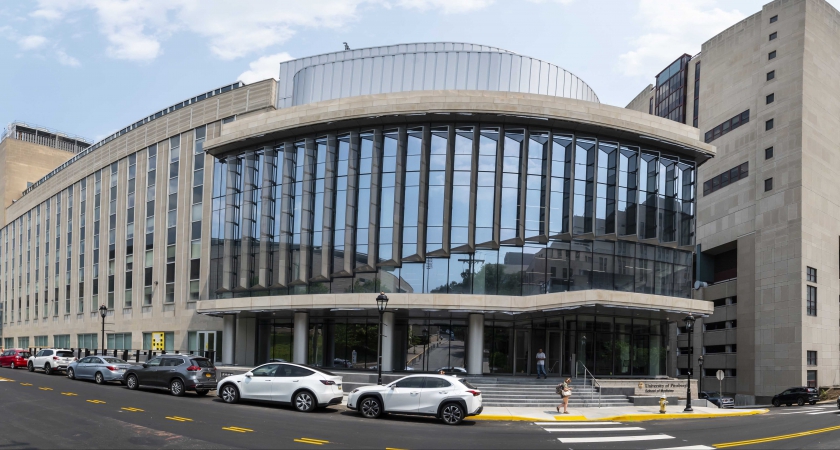
Health Sciences’ six schools occupy five primary buildings: School of Medicine in Scaife Hall; Dental Medicine and Pharmacy in Salk Hall; School of Health and Rehabilitation Sciences in the new building at Fifth Avenue and Halket Steet; Nursing in Victoria Hall; and Public Health at 130 DeSoto St.
Other offices include the Biomedical Sciences Towers, the Murdoch Building on Forbes Avenue and the Medical Arts Building and Kaufmann Medical Building on Fifth Avenue.
In total, the master plan covers 4.4 million square feet in 54 buildings — 25 owned by Pitt; 17 leased from UPMC and 12 leased from external landlords. The team has toured more than 4 million square feet of space to make its assessment.
Current and future needs
Jeffrey Bees, vice chancellor for finance and resources for Pitt Health Sciences and the School of Medicine, told the CUPS committee that “our facilities are one of our most important things, after our people. (We) want to make sure that we are best equipped for the future (so we can pursue) our mission of advancing science and helping everybody else’s careers,” he said.
Regarding both recent and planned space changes and consolidation, he said there’s an effort to make sure “that the plan that we put together provides room for future growth,” specifically mentioning a boom in Pitt’s research activity. “There is an absolute energy and momentum forward in all of our research. We continue to grow the research portfolio, even with the (federal funding-related) headwinds we’re experiencing.”
His team members are talking to leaders in each department regarding current and future needs.
“It’s not only us understanding who the researchers are, how they do their work, who they collaborate with, what are the kinds of space that they need,” Bees explained, but trying to “look across the horizon a little bit and trying to understand where are the growth opportunities (and making sure we are) providing ourselves enough space within the footprint that we ultimately come into to be able to sustain that growth within the footprint.
“This is not at all saying, ‘Ah, we’ve reached the high-water mark,’” he added. “No, we’re actually planning for continued growth.”
Addressing a question from Ben Gordon, associate professor in the Dietrich School’s Department of Religious Studies, about Pitt’s two concurrent master plans, one for the full campus and one for Health Sciences, Bees explained that Oakland is an “intricate overlay place.”
“The University leases space from UPMC. UPMC actually leases space from the University. There’s a bit of a patchwork there,” he said, noting that UPMC plans to move various functions from its Oakland footprint into the new UPMC Presbyterian tower, set to open in January. “We will see certain in-patient units move out of what is the existing Presby building there. We will see some functions move out of Montefiore Hospital and move over.
“They will still do surgery in Montefiore. The ORs will still be active there,” he added. “I expect that they will still use some of the ORs that are in Presby today as well.”
Bees also noted he “wouldn’t be surprised” if changes were made regarding the clinical space in the Kaufmann Medical Building.
“I’ve had a couple of conversations already with my counterparts on the UPMC side and have expressed an interest in us being plugged in,” he said. “They’re keeping us up to speed. We’re a little bit early. They haven’t completed their entire plan yet.”
Acknowledging Health Sciences’ footprint expanding to other areas, including on Second Avenue along the Monongahela River, Bees said while that “space is good … a lot of times we’ve got people that have a preference to be in Oakland because they’ve got clinical responsibilities.
“We want to make sure that we’re making things efficient for folks as well.”
Gina Bleck, Pitt’s vice chancellor for planning, design & construction, clarified that the larger Campus Master Plan is “significantly deeper,” and that the architectural consultants at Sasaki specifically left out some areas of Health Sciences and the School of Medicine “knowing that this was happening, so they’re not in conflict.
“They’re nested. And Sasaki, although it’s (initial work is) finished, will have a link to the depth of work in this plan moving forward,” she said.
Planning efforts for other campus entities, including the Cathedral of Learning lawn and plazas at Soldiers & Sailors Memorial Hall and the Barco Law Building include what Bleck called “individual interventions” and planning efforts with the “full fabric in mind so they all knit together, not in silos or vacuums.”
Good proximity
Following the main presentation, Cerilli addressed another CUPS committee question about how Health Sciences ended up with a 54-building portfolio, explaining the six schools’ history as evolving in a wheel-hub-and-spoke fashion.
“They have their main hub, right? And then everybody spoked out. So it was like, ‘OK, we’re full. We need something else.’ And everybody has moved to alternate locations,” she said. “Yes, there are 54 buildings, but you have to figure, we have six schools. And if you do an average, not every school has one building.”
Looking at comparable schools across the country, Cerilli noted, an average school of medicine has 20 buildings and an average nursing school has three buildings.
Noting that facilities at the top six medical centers in the U.S. are within 25 miles of each other, Cerilli said, “We would have all six schools within five miles of each other, which would be amazing.”
Thanking the presenters for their “hard work,” CUPS Chair David Salcido, an assistant professor of emergency medicine, said he looks forward “to seeing what comes next. … I’m looking forward to new space,” he said. “If folks have questions, they can send them to me and we can pass them along to (Cerelli and Bees).”
Shannon Wells is a University Times reporter. Reach him at shannonw@pitt.edu.
Have a story idea or news to share? Share it with the University Times.
Follow the University Times on Facebook.