

Pittsburgh’s much-debated, partially-finished comprehensive plan project is set to receive a financial boost to get it over the finish line.
Officials announced Monday morning that the Heinz Endowments, in partnership with the Pittsburgh Foundation, will pay $750,000 to help complete the project, which aims to create a roadmap to guide future development in the city through the year 2050.
“ We believe that in order to help reinforce and sometimes reestablish belief in civic institutions for all of our residents, the comprehensive plan for the city is a really important and valuable document,” said Heinz Endowments President Chris DeCardy.
“ We really see this as a promising opportunity to ensure that every voice that is served by this plan is involved in the creation of the plan, and that the plan can be a durable document that can help build a stronger civic infrastructure for all of us.”
The comprehensive plan has been a topic of contention since its kickoff in 2024, mostly due to its price tag. Originally an initiative of then-Mayor Ed Gainey, it was allocated a total of $6 million to pay consultants, a decision that some City Council members questioned at the time.
Since then, criticism of the plan’s expense has been a recurring refrain in Council, especially in the wake of the city’s persistent financial challenges. Mayor Corey O’Connor criticized the plan during his primary campaign last year. Council tried to cancel project contracts with consultants Sasaki, Common Cause Consultants, HR&A Advisors & Urban AC LLC last year. But Gainey maintained that Council did not have the power to do so, and the bills expired at the end of the year.
Pittsburgh Mayor Corey O’Connor says the city is in more financial trouble than he previously thought — but he doesn’t plan to make staff cuts or tax increases.
Mayor Corey O’Connor has repeatedly hinted at the possibility of an arrangement with outside funders to help pay for the plan. Last week, he indicated such an agreement might be a way to save money in the face of persistent financial challenges, and said he was “looking at some partners” to contribute. He has also said future initiatives of his administration, such as an upcoming zoning overhaul, will align with the comprehensive plan once it is completed.
“It’s important that we finish this plan so that we have a comprehensive growth strategy,” O’Connor said in a statement Monday. “Through this partnership with the foundations and the adjustments we’ve made, we are able to deliver a Comp Plan while saving taxpayers over $1 million.”
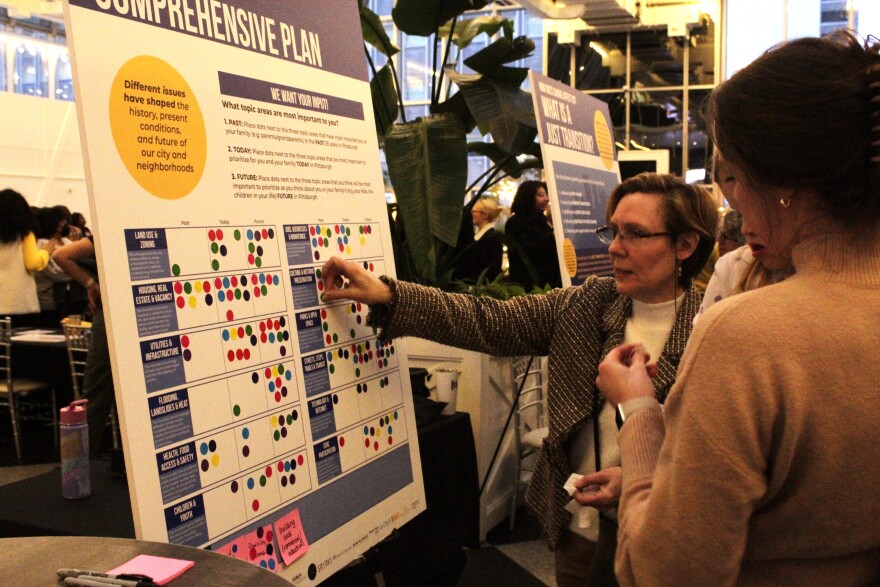
Visitors stick dots on a poster to indicate areas of focus in the city of Pittsburgh at a kickoff for the city’s Comprehensive Plan in January 2025.
The citywide plan is managed by the Department of City Planning. O’Connor’s new planning director, Ivette Mongalo-Winston, said the partnership with the foundations would allow the city “to move into the final phase of planning where we will engage with residents and stakeholders.” It was not clear how much work on the plan will be completed in-house by City Planning and what portion will be completed by the consultants.
DeCardy said the final details of the grant are still up in the air, and clarified that while the resources will be coming from the Heinz Endowments, the Pittsburgh Foundation will help with coordinating the grant agreement and connecting the funds to the city. The Endowments also will not be engaged in the plan’s final outcome, he said.
“ We’re engaged to support a really good approach and process that includes the entire community, and believe that including the entire community will lead to the best result. But no, we’re not going to be putting our thumb on the scale,” DeCardy said.
“ We’re involved in it because we think it’s a really exciting opportunity to build the Pittsburgh of the future that we all want to be part of.”
Councilor Erika Strassburger said she was relieved to hear the comprehensive plan will be completed. Strassburger has pushed for the plan in the past, but following a discussion last week of the city’s continuing money woes, she said Pittsburgh had “spent too much” on it.
“ I’m glad we’re moving ahead with this,” she said. “I’m glad we’re not canceling the contracts that predated this administration necessarily, that we’re not starting over 100 percent from scratch with new contracts, and that we’re gonna get this done ideally this year.”
Other councilors said some of the damage had already been done. Councilor Deb Gross, who voted against the effort from the outset, said she was concerned about the money that the city had already spent.
“ I’m grateful to the Heinz Endowments for the $750,000, but I think this was far too many checks to write to consultants given the budget situation,” she said. Other cities have spent less per capita for their plans, she said: “ $5 million has been spent. I can’t get that back.”
Councilor Barb Warwick said she hoped that other foundations would help fund projects within the city.
“ We do get a lot of help from our philanthropic partners here at the city, but given the financial situation that we are in at the moment, we really need to see more,” she said.
While she agreed with Gross that the “price tag was too big” on the plan, she emphasized a desire to not “ throw the baby out with the bath water.”
“ Lots of good work has been done. Lots of good data has been gathered,” she said. But, she added, “There’s more that we need to do, especially in terms of reaching those hard-to-reach community members.”
According to the Comprehensive Plan’s website, the program should be completed in August.