
Witnessing constant political and religious upheaval makes it difficult for a child to imagine an individual future in Baghdad, Iraq.
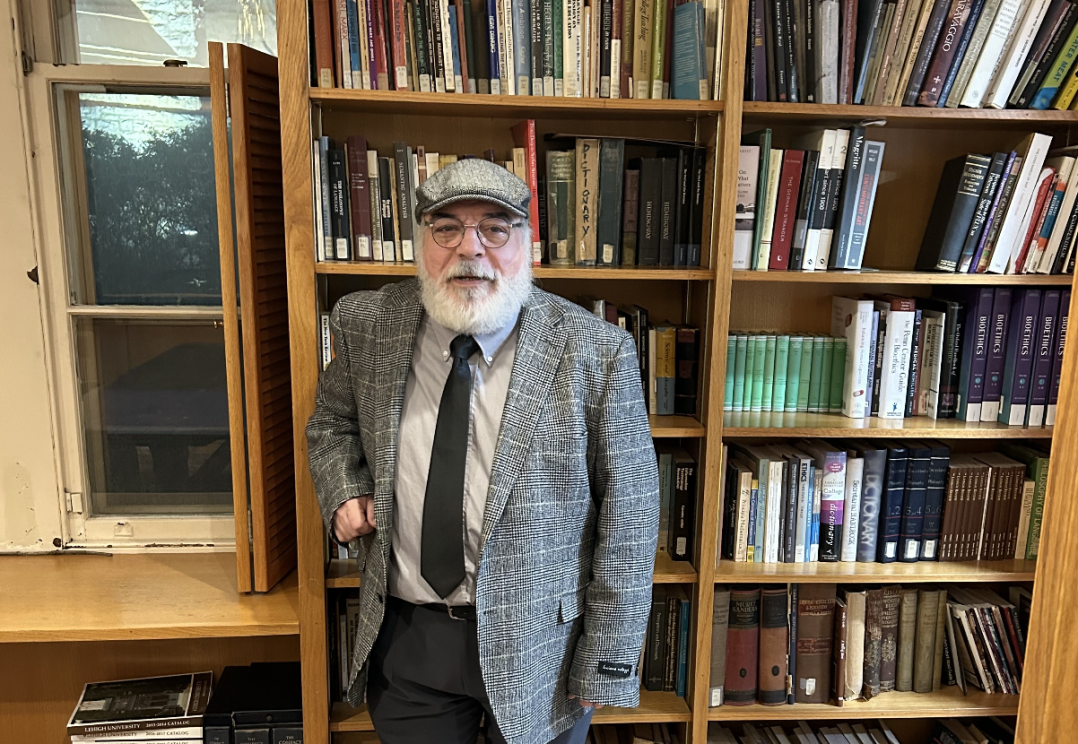
Philosophy professor, researcher and author, Aladdin Yaqub, said he faced these realities while growing up in Baghdad from the mid-1950s through the 1970s.
He said constant changes in political power, attacks on the public and military coups plagued his home throughout much of his childhood.
“When I was 4 years old, I remember looking from our window and seeing members of the royal family being dragged in the street,” Yaqub said. “They tied them to cars, and they ran their corpses throughout the city roads.”
While attending primary and intermediate school, Yaqub said he started reflecting on his surroundings and the place he called home.
Without realizing it, he said he was examining the validity of certain ideologies and the political actions of those in power. This curiosity laid the foundation for the philosophical mindset that later shaped his career.
He said it wasn’t until his undergraduate studies in mathematics at the University of Baghdad that he began to question not only his surroundings but also his academic path.
Through a love of literature and language instilled by his father, Yaqub developed an interest in sharpening the skills essential for literary and academic success.
His questioning of mathematics as his primary focus eventually sparked an interest in philosophy.
Yaqub continued his studies abroad because he said he wanted to pursue an educated in the U.S. He later graduated from the University of Wisconsin-Madison with a master’s degree in mathematics and philosophy, and earned his Ph.D. in philosophy in 1991.
He said it was during a seminar on truth theory, which became the focus of his dissertation, that he began composing his first book, “The Liar Speaks the Truth,” later published by Oxford University Press.
“I stopped working in the fall of 1991 as a professor in philosophy and spent that time working on my dissertation and transforming it into a book,” Yaqub said. “Then I submitted it to Oxford, and bam, it was accepted. I was very surprised.”
While conducting his own research, Yaqub said he spent 1991 to 2006 teaching philosophy at several institutions, including the University of Wisconsin–Madison, Florida State University, Luther College and the University of New Mexico. In 2006, he began teaching philosophy at Lehigh while continuing his research.
Yaqub later authored three additional works: “An Introduction to Logical Theory,” a translation of Al-Ghazali’s “Moderation in Belief,” and “An Introduction to Metalogic.”
For nearly 40 years, Yaqub said he’s has balanced teaching, researching and writing books, papers, and poems, while also playing the African drum.
“It’s very difficult (to balance),” Yaqub said. “Most of what I actually do is read, and then I teach during the semester. Between reading and teaching and working with the student and mentoring and meeting help sessions, I just don’t have time.”
Despite this, he said he prioritizes the quality of instruction in the classroom.
For many philosophy students, like Dario Rivalini, ‘26, the impact of Yaqub’s coursework reaches far beyond the books.
“Just as a professor, he always put his students above himself and sometimes his peers, but never in a hostile way,” Rivalini said. “Looking at him as that type of person, he’s always been a model for that type of attitude that I want to take into post-grad.”
With deep respect for his field and those who aspire to work within it, Yaqub said he makes a significant effort to support students pursuing philosophy.
Kyle Ramsingh, ‘26, said Yaqub’s teaching style helped ensure students understood the material.
“He really focuses on reading everything on his own and not resorting to the internet for help because he says it sways philosophy,” Ramsingh said. “I think his teaching style is something that helped me understand the content in the class a lot more.”
At 71 years old, Yaqub continues working to guide the next generation of philosophers while balancing his own research.
His newest project involves annotating the Qur’anic exegeses of six early Mu’tazilite masters, a project he considers the culmination of decades of work in Islamic philosophy and theology.
After these exegeses, which heavily involved rational theology, were deemed too heretical, they were destroyed in the ninth and 10th centuries. Yaqub works to locate surviving fragments of these works and translate and annotate them.
He said the process requires carefully reconstructing the historical context of the texts — determining when they were written, what was happening at the time and what ideas scholars were discussing — to properly annotate them and rebuild what “a lost intellectual tradition.”
After finishing this work, Yaqub hopes to spend more time on the creative pursuits he’s long balanced alongside his academic career.
“Once I’m done with (my research), I’m going to simply play drums, write poems and read,” he said.