
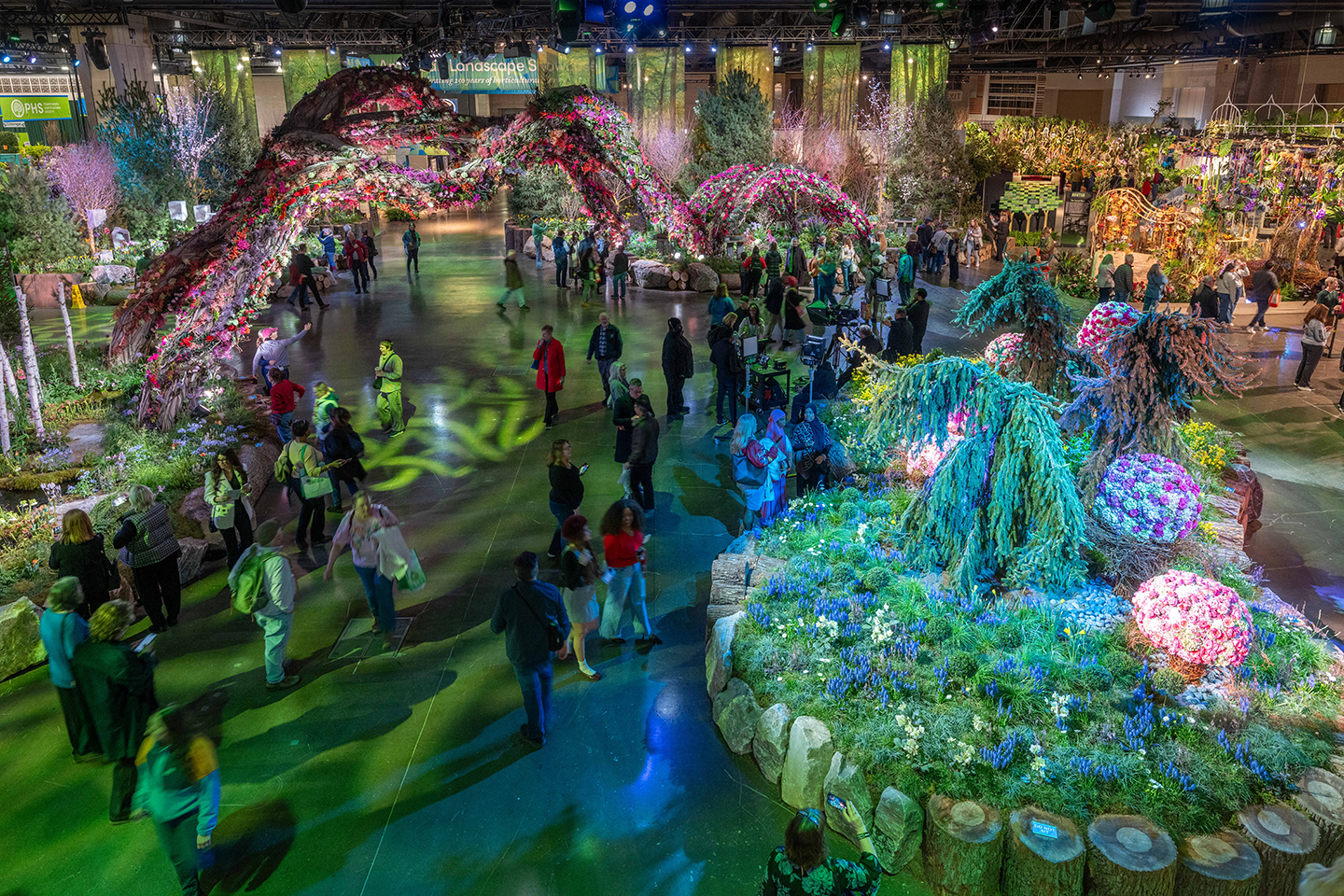
The Entrance Garden at the 2026 PHS Flower Show, entitled “The Forest Floor,” was inspired by this year’s theme, “Rooted in Time.” (Photo/Rob Cardillo)
This year’s show theme — “Rooted: Origins of American Gardening” — explored the connection between plants, people, tradition and 250 years of the nation’s history.
By Amy V. Simmons
Amid a mix of late winter weather patterns that included everything from snow to spring like temperatures, the 2026 PHS Philadelphia Flower Show returned to the Pennsylvania Convention Center on February 28 and ran through March 8.
The Pennsylvania Horticultural Society was founded 51 years after the Declaration of Independence was signed. Its 197-year-old Philadelphia Flower Show itself began two years after that, so in many ways, it has grown along with the history of the United States, almost from the beginning.
All of this year’s exhibits, displays, and events focused on the nation’s 250 years and beyond.
At the beginning: Pennsylvania’s original inhabitants
This year’s exhibit from Philadelphia’s W.B. Saul High School of Agricultural Sciences, “Uprooted, Re-planted” paid homage to the farming and cultivation practices of Pennsylvania’s Indigenous people here long before the nation was founded – in particular, the Lenni Lenape. It earned the PHS Sustainability Award, which is presented for the “educational major exhibit that demonstrates the best use of sustainable gardening practices to the public.”
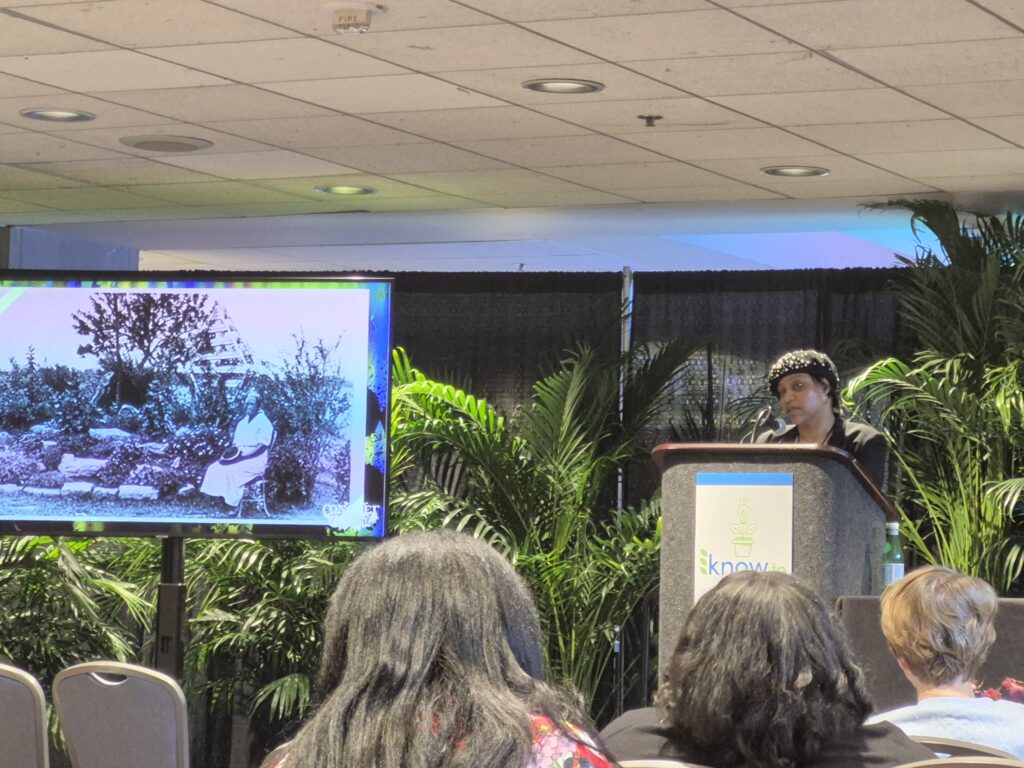
Horticulturalist and author Abra Lee speaks about one of her favorite photos which includes many of the features found in classic African American gardens. (Photo/Amy V. Simmons)
The beauty of roots
Taking inspiration from this year’s Show theme, the Philadelphia Society of Botanical Illustrators’ exhibit — ““Rooted in Time” — A Botanical Reflection on America’s Native Flora” — included a curated display of artwork celebrating not only what is observed above ground, but also the intricate root systems that have sustained America’s native plants for generations.
Botanical artist Robby Schlesinger — a Massachusetts native who lived in Florida for a while before moving back north and landing in Philadelphia — said that “Rooted in Time” was the perfect theme when contemplating the nation’s 250th anniversary.
“All the plants in our exhibition had to be native plants, and I think that’s true of a lot of the displays,” she said. “Just going back to [focus on] the roots of the plant — there’s so much to be learned about roots, and about how important they are, especially with climate change.”
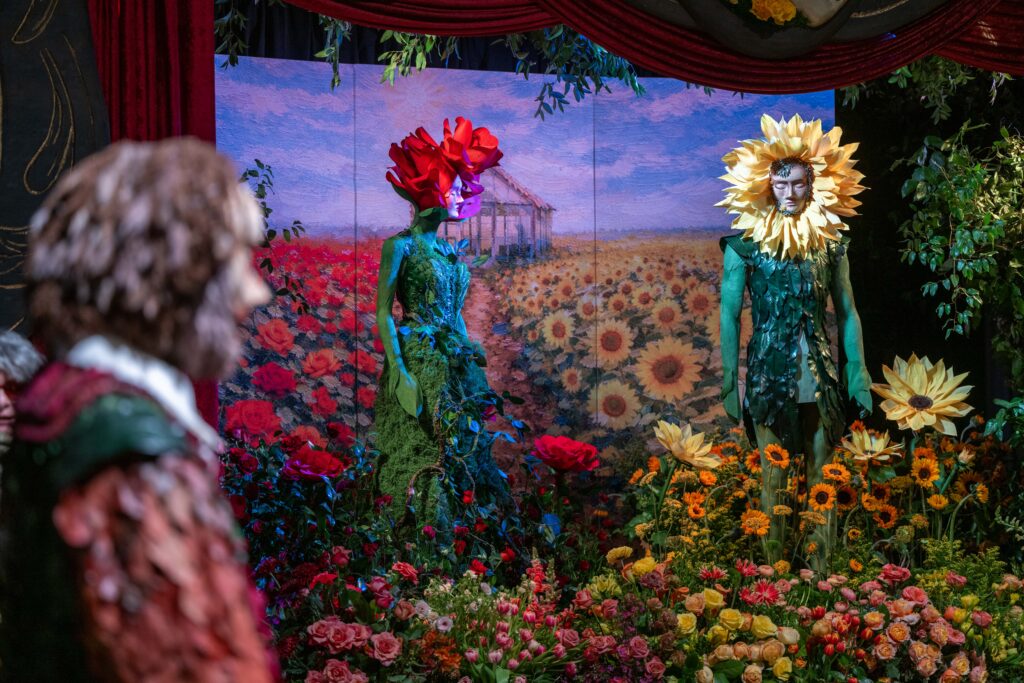
Jennifer Designs’ exhibit, “Rooted in Love” (Photo/Rob Cardillo)
Schlesinger expressed concern in particular that after the harsh winter we’ve experienced in the region, there may even be some plants that won’t come back in the spring, so people need to be vigilant.
“Documenting them is really important, keeping track of how they grow,” she said.
People should consider native alternatives first before turning to box store choices for their gardens, Schlesinger said.
“It’s important for everybody who plants anything in their yard to stop and think, ‘Is there a native species that I could put in instead that would do the same thing?’ because a lot of times, they’re interchangeable,” she said. “If you want some ground cover, there’s native ground cover — use that. If you want tulips, make sure you’ve got some that are easier to take care of because they’re used to growing here, [and that] you’re not fighting against [worrisome thoughts like], ‘Oh, is it too cold for them?’”
Besides providing life to native flora, well-established, centuries-old root systems also have a distinct aesthetic that art can capture, Schlesinger believes.
“You only have to look at them — they’re beautiful, and they’re so complicated, and that’s really fun [to explore],” she said.
The endurance of the African American gardening tradition
Horticulturalist and author Abra Lee explored the deep connections between the centuries long story of Africans in Americans and the gardening traditions that continue to this day in her well attended presentation in the Flower Show’s Know to Grow educational series.
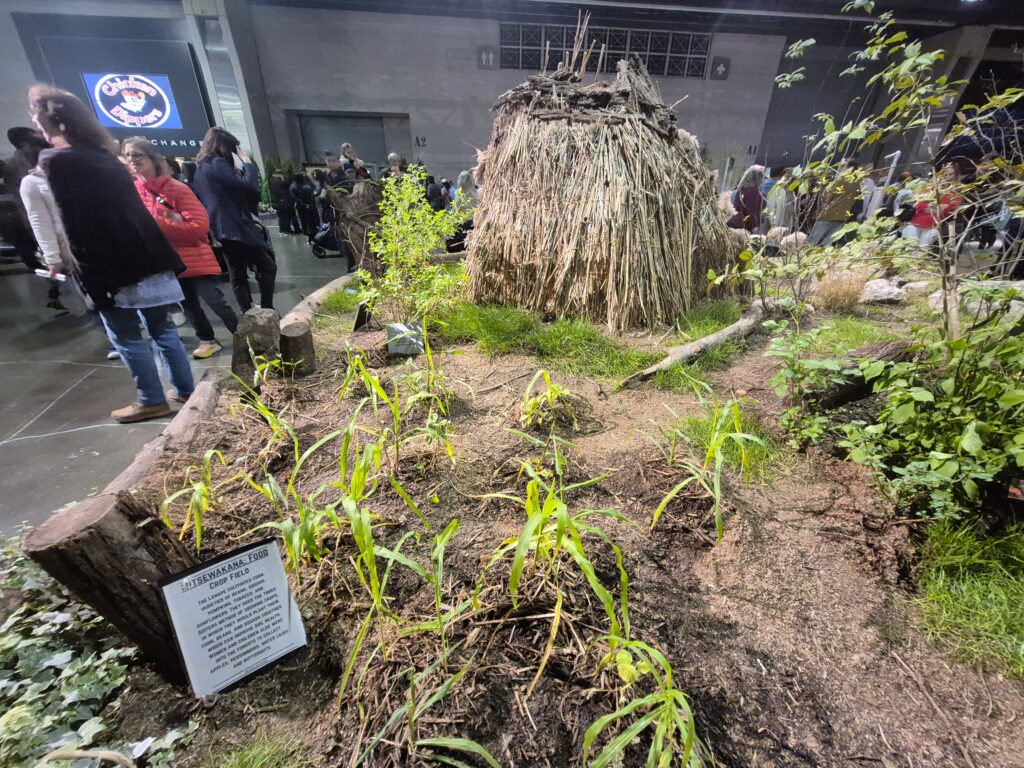
The exhibit from W.B. Saul High School, “Up-rooted, Re-planted” focused on Pennsylvania’s Indigenous roots prior to the nation’s founding, featured a representation of a Lenni Lenape home, native plants, garden, stream and animals. (Photos/ Amy V. Simmons)
Her book on the topic, entitled, “Conquer the Soil: Black America and the Untold Stories of Our Country’s Gardeners, Farmers, and Growers,” explores the lives and work of 45 Black men and women who have greatly contributed to American horticulture, yet are not well known. It is set to be released in February 2027.
During her talk, Lee explored the interconnection of gardening traditions, self-determination and individual expression that have been a part of African American life since their arrival in the nation in the 17th century. She used anecdotal observations from her family and other African American gardeners, as well as archived photos and writings to illustrate both the depth and breadth of these connections. Lee also spoke about Black horticulturalists, anthropologists, designers and other professionals like Zora Neale Hurston, Dr. Harold Hamilton Williams and others who dedicated much of their life’s work to studying and documenting these practices.
As Black professionals, it was important for them to take into account and record the nuances, diversity, and strength of these horticultural traditions.
One of the people Lee spoke about was abstract artist Alma Woodsey Thomas, a teacher in the D.C. public schools who in her 70s had a successful show at the Whitney Museum, and whose work is extremely rare, including some pieces now hanging in the National Gallery of Art.
It was during Lee’s research of Thomas’s work that helped her to put words to the connection between what is known as Black Garden design and folk gardening.
“It’s not formal, and it’s not informal, but it is an abstract garden style,” Lee told attendees as she showed examples of the artist’s work.
It is also a style that white garden writers in the early 20th century are both intrigued and baffled by, especially the way that everyday objects with spiritual significance like grave goods (pottery and china artifacts used to marked graves in African American cemeteries in the South),
native plants and flowers, vegetables, fruits and ordinary repurposed items worked so well together — and why they would be used in the first place.
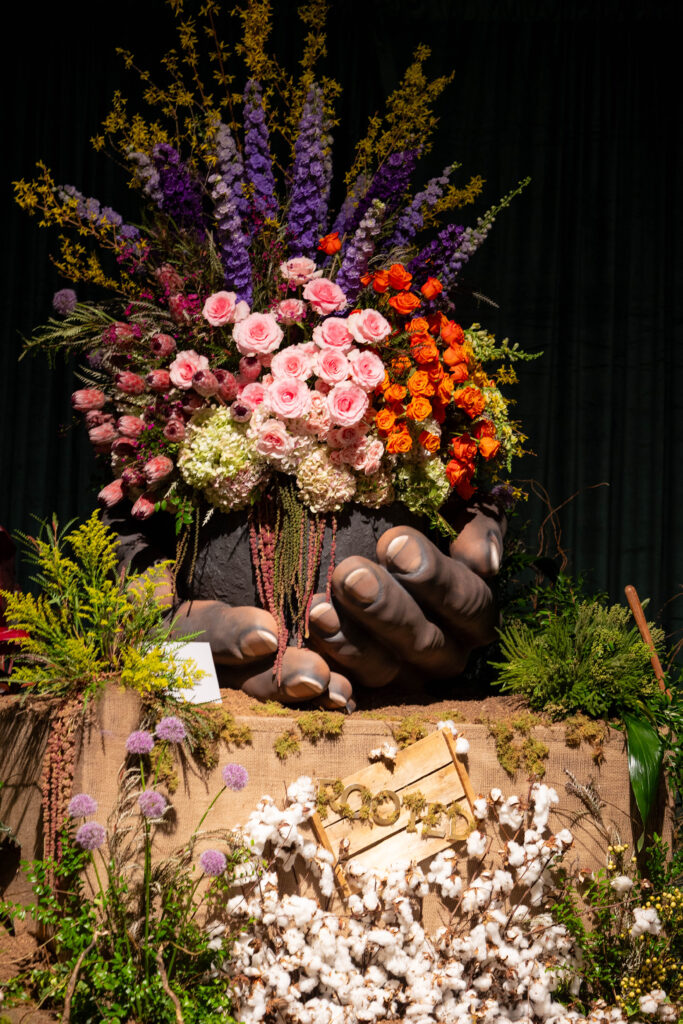 Photos from the opening Member’s Preview Day on Friday, February 27, 2026 of ROOTED: Origins of Tissarose Floral’s exhibit, “Ikechi” (Photo/Morgan Horell)American Gardening, held Feb 28 – March 8, 2026.
Lee quoted an article written by one such House Beautiful writer named Martha Fisher after coming across a garden in a Black neighborhood in the south, which was published in May 1933, based on what she thought she observed.
“In them, the sunshine yellow and tobacco brown of sunflowers are juxtaposed with excellent, if unconscious, effect to the faded pink of the “Bouncing Bet”; the searing orange of marigolds burns simultaneously against the bludgeoning purple of clematis or the murky red of coxcomb. …Descendents of the aristocratic flower denizens of the garden of the ‘big house,’ which no doubt found their way into this humble milieu in the shape of seeds and cuttings carried from the scene of the day’s labor in the basket that is the inseparable appendage of every black arm in domestic service, rub branches with the utilitarian tomato plants, or creepers of the yam.”
Although Fisher doesn’t really comprehend all the components of this African American garden — the overtly racist and stereotypical Jim Crow tone of the article illustrates how she lacks the perspective and personal experiences that would allow her to do so — she still recognizes its significance.
“The garden under discussion seems to be fast disappearing from the American scene. If we wish to have a look at it, we must look quickly. There is beauty in these gardens.”
Lastly, Lee referred to a quote by award-winning landscape architect Everett Fly and how it aptly ties together different elements of African American gardening tradition:
“Every community has not had a school or church, but virtually every community has had a cemetery and a garden.”
“I think that you see the link now between the cemetery, the spiritual medium, the garden, and the self-expression of these communities,” Lee said. “Worship takes on a new meaning, because life itself becomes more meaningful. So, the impact that these gardens and designs have [on these communities], it impacts their character — it impacts their quality of life. And that’s why I talk about beauty, beauty and ornamental horticulture being a quality-of-life issue for so many [people] to dismiss that we don’t ever have to back away from that.”
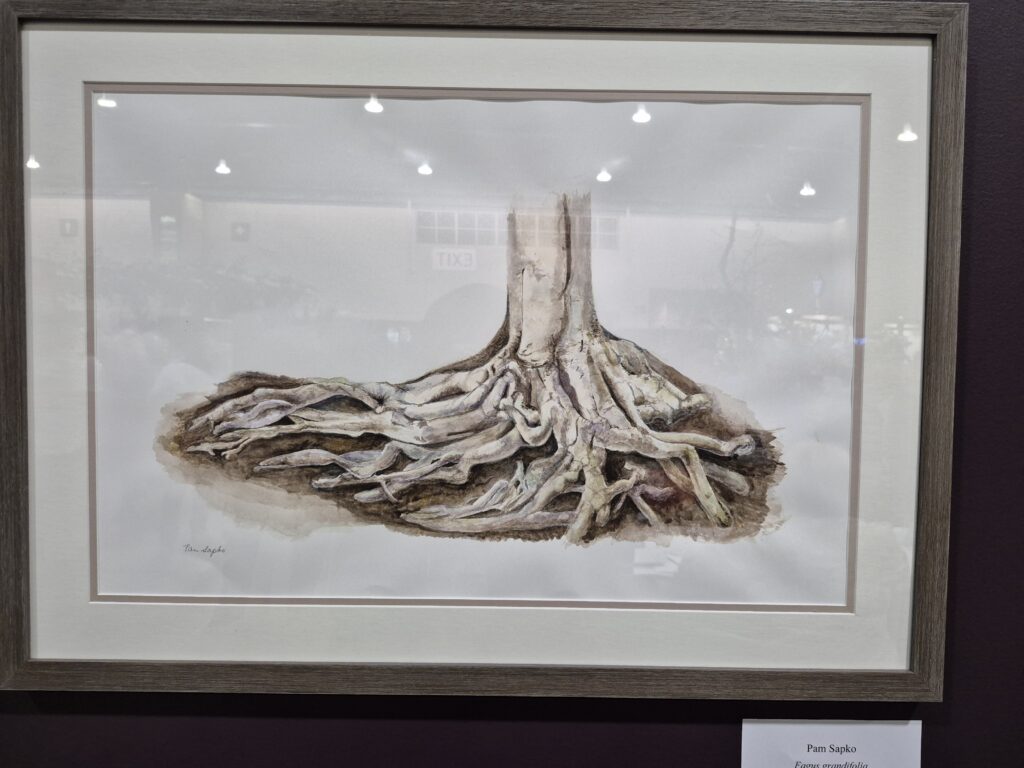
Botanical artist Pam Sapko’s illustration of the root system of an American Beech tree, of which she says “unlike the predictable structure of branches above ground, the roots twist and bend, creating unexpected shapes, resembling elbows, was part of knees and legs,” was part of the Philadelphia Botanical Illustrators Club curated exhibit. (Photo/ Amy V. Simmons)
Lee said that she was particularly impressed by Lankenau Environmental Science Magnet High School’s exhibit, “Inheritance” which embodied examples of the ingenuity and adaptive nature of African American gardening practices, a concrete expression of spiritual and ancestorial connection that endures to this day. The exhibit earned a PHS Flower Show Gold Medal, as well as the Alfred M. Campbell Memorial Trophy.
“The students have [created] mosaics, and they have edged these cinder blocks with [these] mosaics,” Lee said. “They are using dried flowers and live flowers to fill the cinder blocks. They didn’t miss a beat with this garden. This is the garden I saw in Barnesville. …This is the garden that Lena Williams of Philadelphia herself described, and this is the garden that Martha Fisher saw as well in Alabama.”
The African American gardening tradition is intertwined with American history, even prior to the nation’s founding, something that is important to remember as we celebrate the semiquincentennial this year.
“We’ve been here since day one on this soil, and we brought those traditions from the coast of West Africa, and we’ve made them our own, and by we what I’m saying specifically for Black Americans, and African Americans like myself, Black immigrants,” Lee told the SUN after her presentation. “When you’re looking at African Americans, you’re looking at people that were stripped of their culture, their language, their family, their friends, their land. And then they come; and they still hold on to something. They still hold on to the spiritual medium. They still hold on to their self-expression, and they reproduce that through the garden in their own way, with their own style, and with their own grave goods that we now use as garden decor, and when we say things like “recycling” or “repurposing” and “upcycling” and “sustainability.”
That’s what Black gardening tradition is. We’re just using a different language for it today. We are using it as decoration, and as beauty, and as something to feed our soul, and now we relabel it — but it’s same thing.”
Throughout the year, PHS offers events and programs throughout the region. For more information, visit: www.phsonline.org.