
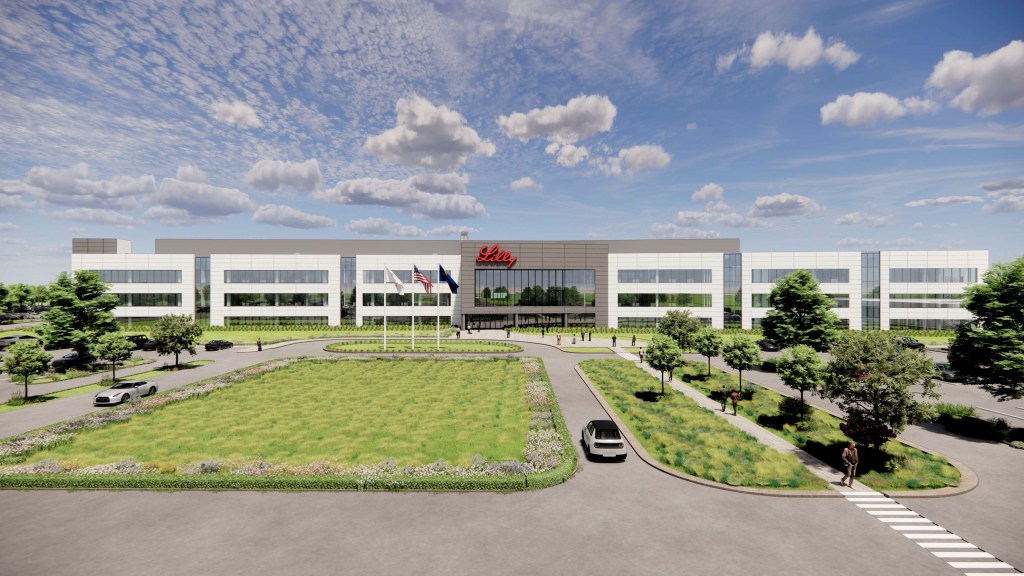
Parkland School Board members are expressing skepticism of a proposal to grant Eli Lilly a tax break for its $3.5 billion complex under development in Upper Macungie Township.
The township already approved its portion of a proposed Local Economic Revitalization Tax Assistance program, or LERTA, but school board members said Tuesday they needed more information from the pharmaceutical giant before agreeing to anything similar.
During an informational discussion at Tuesday’s board meeting, debate centered on whether the district could afford to grant a tax abatement given looming deficits and whether denying one would be against the spirit of the regional and state cooperation that drew Lilly to the area.
A workshop held just prior to the full board meeting reviewed cost-cutting options for a school district budget that currently includes a $17 million deficit. Board members acknowledged that closing that gap will likely mean further raising property taxes and questioned whether it was wise to grant a pharmaceutical giant a tax break in that fiscal environment.
“What are the risks? Is Lilly going to abandon this project because they don’t want to pay school property taxes?” Parkland School Board member Jon Macklin asked. “I’m struggling to understand what the incentive is for the Parkland School District.”
Macklin questioned why such a large and profitable company would need a tax break from a local school district, but he said the project will be good for the region and he expressed support for the state granting millions in incentives, including a $5 million grant that will turn Lehigh Carbon Community College into a Lilly training site.
How LCCC will help train a future workforce for Eli Lilly’s Lehigh Valley plant
The state’s LERTA program is designed to spur development in “deteriorated areas of economically depressed communities.” It requires approval from the township, county and school district to authorize tax breaks that allow land owners to delay full payment on the value of new construction.
Macklin questioned whether the Upper Macungie location where Lilly plans to build even qualifies as a “deteriorated area,” asking district solicitors if they thought the land “truly qualifies under the spirit of the law.”
District Solicitor Jessica Moyer said that legal determination was the township’s responsibility and reminded the board the township has already approved LERTA boundaries for the parcel Lilly intends to develop.
The idea behind LERTA is to encourage companies to build by allowing them to delay paying taxes on the full value of developed property. Throughout the process, the land owner continues to pay the full land tax, which means the Parkland School District would continue to bring in the same amount of tax revenue the parcel was already generating.
The district would, however, forgo portions of the higher payments that would be due if Lilly was required to pay taxes on the full property value, which will rise as its plant is constructed.
Upper Macungie Township commissioners have approved the tax break, which would go into effect when construction is complete and last for 10 years. It has yet to be voted upon by the Parkland School Board or Lehigh County commissioners, which also must give the OK.
Lilly’s plans for the site, located just west of Fogelsville between Interstate 78 and Old Route 22, will be discussed at the Upper Macungie Planning Commission meeting Wednesday night.
The school district could grant a LERTA that lasts for less time and it could also adjust the payment schedule. Under Upper Macungie’s proposal, the tax exemption decreases by 10% each year, and Lilly would assume full tax responsibility on year 11 post-construction.
“We need to work these numbers,” Parkland School Board Vice President Chris Pirrotta said, requesting a future workshop meeting in which the full board could review their options.
Parkland Superintendent Mark Madson also requested more information, saying he’d like to see estimates of how much tax revenue the district could receive under various versions of a LERTA.
Madson and Parkland School Board President David Hein said that accurate revenue projections could be difficult to generate considering there aren’t local projects of comparable size to Lilly’s $3.5 billion investment plan. LERTA requests have been rare for the Parkland School District, Hein said, noting that he has not seen one in his 13 years on the board.
Hein called Lilly’s investment a “once-in-a-generation opportunity” that will require “give and take on both sides.” He said it’s yet to be determined how a Lilly foundation might contribute to the school district.
Both Pirrotta and Macklin said they’d like more clarity on who exactly is asking the school district to grant Lilly a LERTA.
“It’s surprising that it’s being asked,” Pirrotta said.
The presentation from district solicitor King Spry listed current LERTAs in other nearby school districts, including two in the Bethlehem Area School District, one in the East Penn School District and one in the Easton Area School District. The presentation also noted that the State College Area School District denied its portion of a LERTA approved by State College and Centre County.