
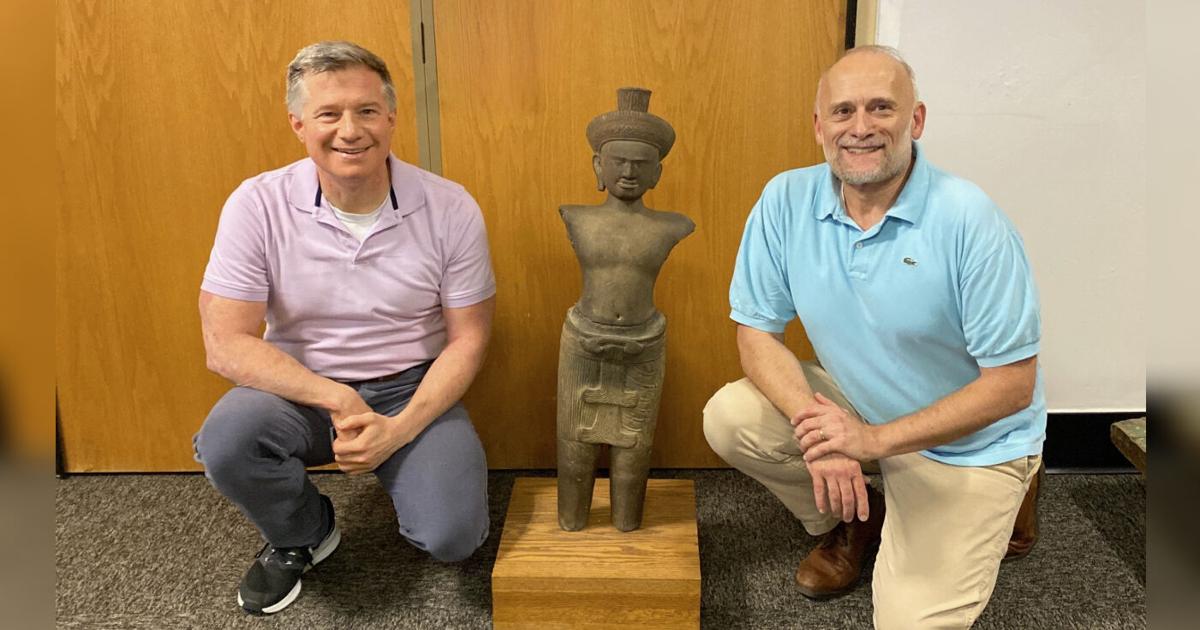

Geoffrey K. Fleming, Director and CEO of the Reading Public Museum and Scott A. Schweigert, Curator with repatriated stone Khmer sculpture.
Courtesy of The Foundation for the Reading Public Museum
READING, Pa. – The Foundation for the Reading Public Museum has decided to return a 10th‑ or 11th‑century Cambodian Khmer stone sculpture to the Kingdom of Cambodia.
According to a press release from the museum, the repatriation was done in close cooperation with the Cambodian government and its Ministry of Culture and Fine Arts.
Officials say the sculpture came to the museum as part of a recent bequest. When it arrived, staff immediately flagged it as a potentially high‑risk antiquity and set it aside for further study. They soon determined it was likely looted from its original site and chose not to add it to the museum’s permanent collection, the release says.
“Ensuring the proper ownership of antiquities from around the globe is a responsibility that the Reading Public Museum takes very seriously,” said Geoffrey K. Fleming, Director and CEO of the Foundation. “Returning this sculpture without delay reflects our commitment to ethical stewardship and international heritage laws.”
The museum says the return was made possible with help from legal and cultural experts who specialize in the recovery of Cambodia’s stolen history. By working directly with Cambodian officials, including the Ministry of Culture and Fine Arts, the Foundation ensures that this important remnant of the Khmer Empire will once again be part of the Kingdom’s national cultural narrative. Many Khmer artworks were taken from temples and other sites during political unrest in the 1960s and 1970s, experts say.
Bradley J. Gordon, an attorney and advisor in Phnom Penh, praised the museum’s actions, saying Cambodia is “deeply touched” by the museum’s decision to investigate the sculpture’s origins and initiate its return. He encouraged other museums and private collectors to follow Reading’s example.
The Reading Public Museum says it remains committed to transparency in how it acquires and researches objects, and to supporting global efforts to protect and restore cultural heritage.
Read Gordon’s full statement below:
“It is tremendously gratifying to see the Foundation for the Reading Public Museum step forward and reach out to us. On behalf of the Kingdom of Cambodia, we are deeply touched by the ethical responsibility shown by the Museum staff in assessing the sculpture’s origins and initiating its return. We hope the repatriation of this Angkorian-period statue heralds a new chapter of research and insight into Cambodia’s rich cultural past. We applaud the Foundation’s leadership and hope their transparency serves as a powerful example. We encourage other museums and private collectors holding Khmer antiquities to follow Reading’s lead by examining their own collections. By coming forward voluntarily, you join a world-wide effort to heal the wounds of the past and ensure that Cambodia’s stolen history is restored to its rightful home for future generations.”