

Scranton took its first steps to regulate data centers.
City council on Tuesday introduced a pair of ordinances from the administration of Mayor Paige Gebhardt Cognetti that involve amending the city’s 2023 zoning to address potential data center proposals.
Though no data center has been proposed in the city, officials said updating the zoning ordinance to define and account for data centers would put in place parameters and safeguards for the eventual possibility.
Council voted 5-0 — with President Tom Schuster, Patrick Flynn, Mark McAndrew, Sean McAndrew and Jessica Rothchild all in favor — of the introduction of each ordinance.
The two companion pieces of legislation add terminology and language regarding data centers and create an overlay district for them, with boundaries to be determined. Additional zoning amendments also are anticipated to come throughout the year as pending state law regarding data centers continues to develop, according to the ordinances.
In Scranton, one of the proposed ordinances would add to the city zoning code the following: terms and definitions of data center, data center accessory use, data center equipment, high-impact (hyperscale) data center, moderate-impact data center, minor-impact (micro-scale) data center, information technology (IT) and nuclear microreactor; regulations for conditional uses and uses by special exception; and standards and requirements involving lot and building dimensions, deployment of operational and backup electric systems and power sources needed for electricity, emergency management protocols and required impact studies, according to a public notice in the March 12 edition of The Times-Tribune.
The other ordinance would amend the city zoning map to establish a “Technology and Energy Overlay” district and its boundaries; as well as requirements related to lot and building dimensions, signs, submissions of letters, studies, reports and operational plans, building location and orientation, architectural standards, screening and buffering, landscaping, deployment of operational and backup power sources, emergency management, required impact studies and operational plans, administration and enforcement provisions, and submissions for permits, according to a separate public notice also published March 12.
Council members all strongly backed the proposed ordinances as “proactive” measures that would protect the city and its residents if data center proposals ever do arise in Scranton.
“I believe that these ordinances put us in position to be proactive rather than reactive,” Flynn said. “By updating our zoning code now, we’re making sure that if opportunities come to Scranton down the road, we have the right safeguards, regulations and review processes already in place.”
Rothchild said, “We do need to add definitions and language into our zoning ordinance because they do not already exist for data centers.”
Noting the city could later “amend, supplement or repeal” zoning amendments regarding data centers, Mark McAndrew said council “will do our due diligence to protect the city and regulate these data centers.”
Sean McAndrew added, “The biggest point is we’re protecting our city.” He also thanked the administration for including council in discussions about the proposed ordinances beforehand.
Data center development exploded last year in Lackawanna County and the broader Northeast Pennsylvania region. Locally, many of the proposed data centers are in the Midvalley and North Pocono areas.
Regarding pending legislative initiatives at the state level to regulate the emerging data-center industry, Schuster said of the city actions, “We’re taking a proactive stance to protect the interest of the city.”
After introductions, council tabled both ordinances pending a public hearing not yet scheduled. The ordinances eventually would return to council for a second vote on advancement and a third vote on adoption.
Scranton first issued a public notice on March 7 announcing the city’s intent to regulate data centers with a zoning amendment to be introduced March 10. But that did not occur. Schuster had said that notice was inadvertently issued early, and the introductions instead would take place March 17.
While data center regulation is not yet enacted in Scranton, the proposed rules take effect immediately, according to the March 12 public notices that both say, “The proposed amendments shall be enforceable and applicable upon and after the date of first advertisement as a pending ordinance.”
The city initiative also comes after Lackawanna County planning officials recently advised the Scranton-Abingtons Planning Association — a zoning collaboration including Scranton, Dunmore, Clarks Green, Clarks Summit, Dalton, Dunmore, Newton Twp., South Abington Twp. and West Abington Twp. — to each address data centers on their own. Municipalities must allow every lawful land use somewhere within their borders, including data centers. SAPA municipalities can share land uses. For example, because Dunmore has the Keystone Sanitary Landfill, none of the other SAPA communities have to allow landfills. But SAPA members have not had data centers outlined in their zoning, and a full SAPA update would take a few years to undertake and complete.
All SAPA member towns, as well as Olyphant, Moosic and Throop, are working on implementing data center standards. Municipalities that have adopted data-center standards include Archbald, Blakely, Carbondale, Clifton Twp., Covington Twp., Dickson City, Mayfield and Jessup. The standards implemented by these towns generally have included: height restrictions; requirements for “will-serve” letters from water, electric and wastewater utilities confirming they have adequate capacity to serve a proposed data center; aesthetics and buffers regarding building facades, exteriors and setbacks; requirements for studies on water usage, environmental and sound impacts; whether a data center would be a conditional use or a special exception; and prohibiting on-site electricity generation to power a data center.
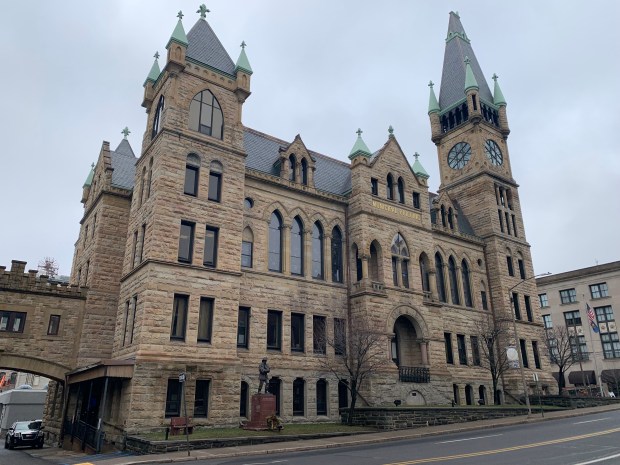 Scranton City Hall on March 4, 2026. (JIM LOCKWOOD / STAFF PHOTO)