
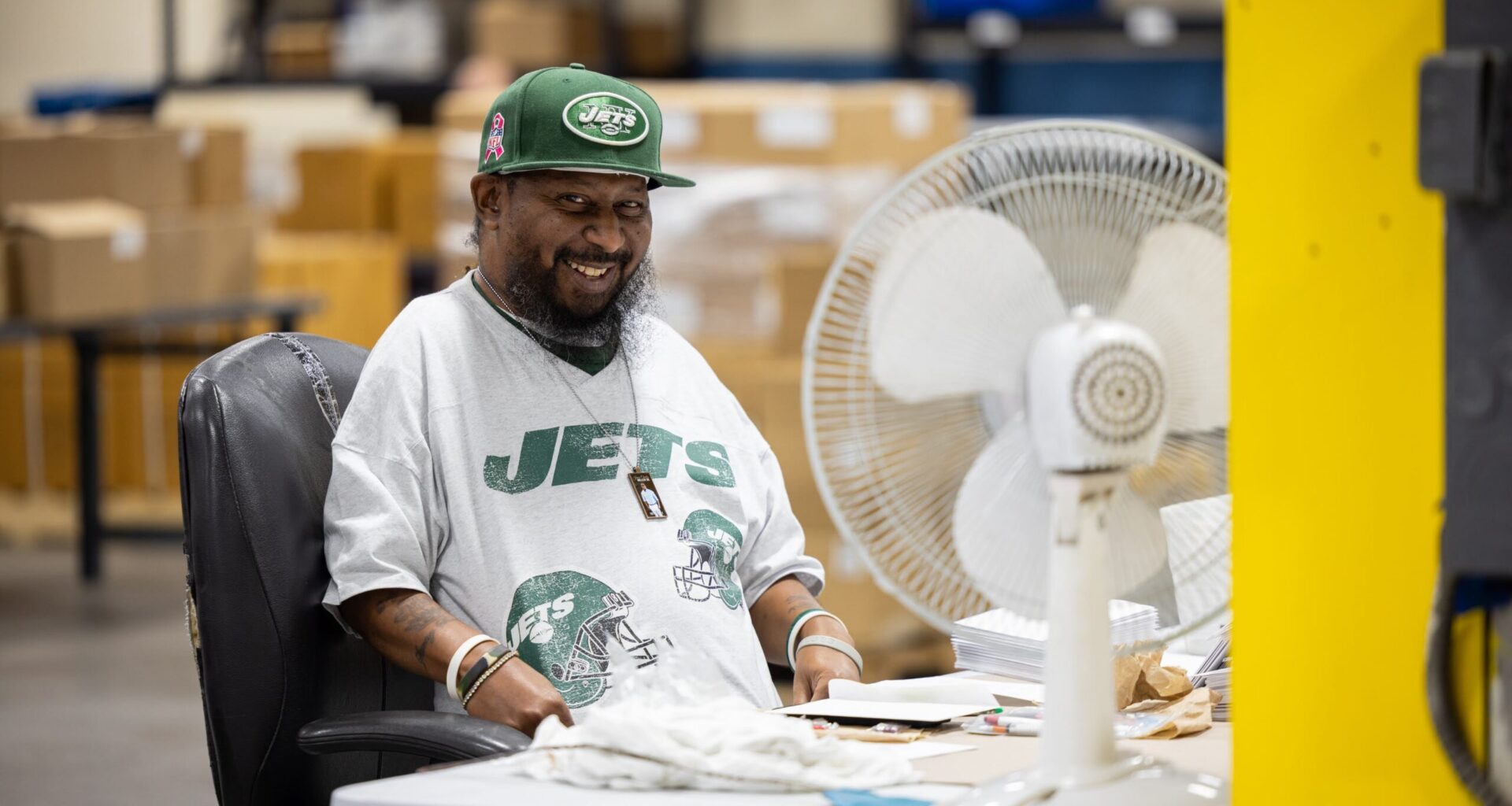
image above courtesy of Baker Industries
Allyson Gross began working as a line assembly lead at Baker Industries in September 2024. She had recently been released from incarceration for manufacturing or possession with intent to deliver and was seeking employment.
A contact at Baker Industries referred her, and she immediately heard back after filling out an application.
“Before I even got the job at Baker’s, I applied to so many places. I couldn’t even get a job everyone denied me,” said Gross. “I’m talking about Walmart, Home Depot, all the places that are big on hiring felons.”
After working at Baker Industries for about seven months, Allyson graduated from the program and landed a better paying job with Stockwell Elastomerics as a machine operator.
“I would not have the job I have now if it wasn’t for Baker Industries,” said Gross.
Without intervention, 60% of formerly incarcerated people are likely to be arrested within three years, and 70% within five years.
However, formerly incarcerated people who find employment are 24% less likely to return to incarceration. Gross is one of many whose lives were changed by a second-chance nonprofit.
Second-Chance Nonprofits
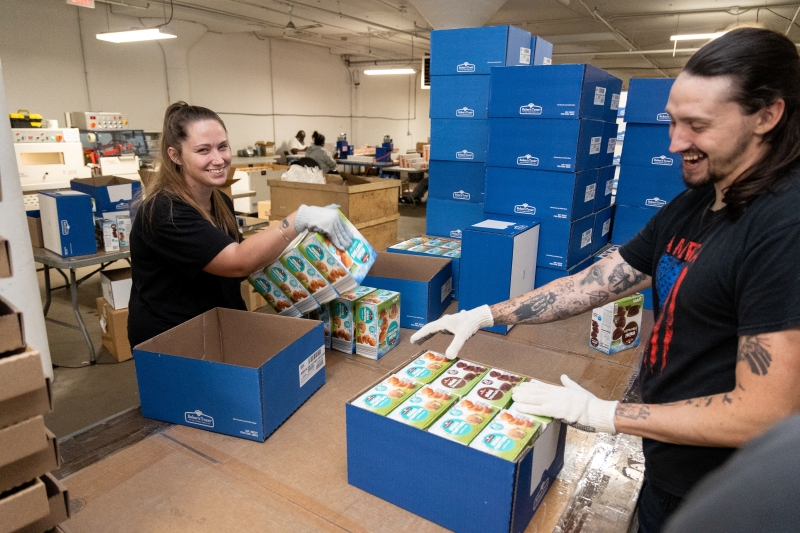
image courtesy of Baker Industries
According to the United States Chamber of Commerce, roughly one million Americans are released from incarceration each year. Without reliable employment, it is likely that these individuals will return to incarceration.
Organizations like Baker Industries and Ready, Willing, and Able are actively working to change that.
Baker Industries is a nonprofit that focuses on manufacturing products and making them ready for retail. They are half funded by their merchandising contracts with companies and half through private philanthropic organizations in Philadelphia.
The organization works with companies that produce snacks, gifts, medication, and other merchandise. Most employees at Baker Industries work in packaging, kitting, and assembly.
In 2025, about 40% of employees at Baker Industries reported having a disability, and 50% were either on parole or probation. Employees typically work at Baker Industries for up to a year before moving on to another job.
“At the heart of our approach is individualized support,” wrote Nicholas Watson, President of Baker Industries, in an email to Generocity. “We don’t apply a one-size-fits-all timeline or program. We meet people where they are and build a path forward that reflects their specific needs and goals. Our measure of success isn’t how quickly someone moves on — it’s how well prepared they are when they do.”
The three main components of how Baker Industries supports second-chance employees are: real work for real pay, job readiness, and trauma-informed support. Baker Industries pays workers on a weekly basis for the work that they do.
Baker Industries also offers a 12-week course designed to prepare employees for a career. The course includes hands-on job search assistance, conflict resolution, leadership, and resume writing.
Trauma-informed support is at the core of everything they do.
“Rather than moving people through quickly, we can provide a stable, trauma-informed environment where participants have the space to face their challenges, build their skills, and grow into the workforce at a pace that sets them up for lasting success,” wrote Watson.
Baker Industries states that the demand for second-chance employment far exceeds what they can provide. Watson also believes that the limitations Baker Industries faces are larger than just their organization.
Watson believes support is something all human beings need, not just when they are in crisis. If society evolved to understand that, providing second-chance employment would not be as difficult.
Another nonprofit revolutionizing second-chance employment is Ready, Willing, and Able.
Ready, Willing, and Able (RWA) is a nonprofit that provides housing and employment to men diagnosed with substance abuse disorder. Half of their funding comes from a contract with the city, and the other half is earned revenue through their job training program.
RWA employs these individuals to clean business corridors around the city. Employees are taught basic job skills such as time management, maintaining work throughout a shift, and completing reports when necessary.
Employees also learn how to honestly describe gaps in their resumes and their criminal history. They also learn how to improve their job search process so they can tailor to jobs they want and highlight the skills they already possess.
RWA Executive Director Kevin Peter says most employees lack basic computer skills, which can hinder their ability to seek employment.
“So many of the men we work with are older men, in their mid40s and older, some of them in their 60s and they never really had an introduction into working on a computer,” said Peter.
Employees typically live at Ready, Willing, and Able’s facility until their recovery is complete, but they have the option to stay at RWA for up to three months even after finding new employment. During that time, RWA works with them and sometimes with other city agencies to secure independent housing.
Philadelphia’s World of Second Chances
The city of Philadelphia has a program that incentivizes businesses to hire formerly incarcerated people. The Fair Chance Hiring Initiative (FCHI) is a program started by the city’s Department of Commerce.
Under the FCHI, small or medium-sized local businesses that generate less than five million dollars in revenue can apply for assistance from the city. These businesses must pay their formerly incarcerated employees a minimum of $16 an hour and schedule them for at least 21 hours a week.
Employers must also hire and retain the employee for 90 days. Employers under this initiative can receive up to six dollars an hour in reimbursement for pay for up to 960 hours in the first 180 days of employment.
They are also eligible for a $500 one-time payment for each employee who completes the new hire period.
In order to qualify for the FCHI, employees must have lived in Philadelphia before and after incarceration, during the time they were hired, and throughout their employment with a business. Employees also must have some sort of record within seven years before their first day of work.
Employees may also receive a one-time payment $1,000 retention grant for completing their new hire period.
City Council has also made it easier for formerly incarcerated people to obtain gainful employment. In 2011, Philadelphia adopted the Fair Criminal Records Screening Act, commonly known as the ‘Ban the Box’ law, which initially made it illegal for employers to ask about an applicant’s criminal history prior to receiving a completed job application.
Philadelphia was the first major city in the United States to include private employers in this law. Later, the law would make it illegal for employers to ask about an applicant’s criminal history before an offer was made, and it would apply not only to full-time employees but also to contractors and gig workers.
In September of last year, City Council amended the “Ban the Box” law. This amendment was introduced by Councilwoman Rue Landau.
Landau was part of the initial implementation of the law in 2011 when she was Director of the Philadelphia Commission on Human Relations. According to Landau, updating the law required working in tandem with organizations like the city’s Chamber of Commerce and the nonprofit Community Legal Services.
Previously, employers were able to look back up to seven years into an applicant’s history, but now it is only four years.
Employers also have to issue a written notice when taking action on an applicant’s criminal history. This notice must specify which convictions are being scrutinized and include a copy of the background check, and they must give the applicant ten days to dispute the notice.
“I’ve seen firsthand the lifechanging impact Ban the Box and Clean Slate laws can have on many Philadelphians,” said Landau. “But policy only works when it keeps up with reality… Updating the fair chance hiring law makes sure people get a fair shot at employment without being punished for their past.”