
If you’d told me when this year started that 10 weeks in I’d be penning a love letter to the Philadelphia Parking Authority I would have assumed you’d lost your mind. The PPA? That maddeningly efficient city agency that has now started sending $100 speeding tickets to anyone driving more than 30 MPH on Broad Street? That is the bane of every Philadelphian’s life? That PPA?
Indeed. I’ll get to why, but first some background:
Listen to the audio edition here:
At some point during snowmageddon — that period when it was too cold and too icy and there was too much snow on the ground to properly dig out my car — I, like perhaps many of you, called for an Uber to take me across town. The fee was outrageous — $27 for a two-mile trip, plus I had to wait 20 minutes. What’s more, when I got in the car I started talking to the driver and realized something else: Most of that money, including the so-called surge fee for high demand times, was not going to my driver. Instead, between 40 to 70 percent of every fare on Lyft and Uber goes to the big tech companies based in Silicon Valley. The driver got a relative pittance, plus my tip.
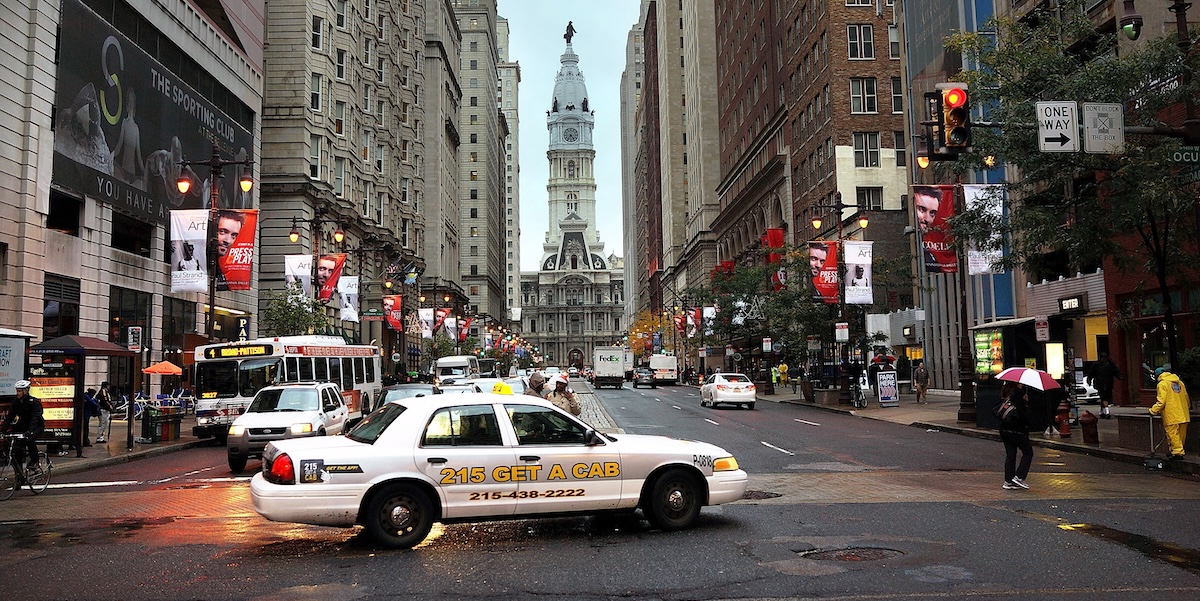
So the next time I needed to travel the snowy streets I tried something different: I took a cab. I downloaded the Curb app — which works pretty much the same as Uber, but for taxis — and found a ride for about half the fee of a rideshare. That’s in part because Curb adds no surge fees, but determines the fare based on time of day, distance and historical data, according to Heidi Robb, director of the PPA’s taxi and limo division, which regulates cabs. It arrived in two minutes, and got me where I needed to go with no problems. (Well, except for the snippets of Newsmax’s right-wing propaganda that popped up on the TV screen during the ride, thanks to a Curb-Newsmax partnership.)
The best part: All but 5 percent of the fare — the credit card fee that Curb takes — stayed local, most of it going into the pocket of my driver, who either owned or leased a taxi license through the PPA. The PPA takes another 1 percent per Curb ride, and 1 percent of the driver’s quarterly total. So with just that one ride, I paid less, supported a local businessman, kept money circulating in Philly — and stuck it to Big Tech. Win, win, win, win.
As if that weren’t enough …
It’s been a tough time for taxi drivers these last few years. Just look at the numbers: At its peak before rideshares came to town, Philly had nearly 2,000 taxis on the road. In February, there were just 663, according to Robb. That’s the result of an influx of ride shares like Uber and Lyft, plus a downturn during Covid. The numbers, Robb says, are slowly recovering, but “taxicab drivers complain every day that there should be caps on [ride shares], which take money out of their pockets.” A taxi medallion — similar to a liquor license, with limited numbers bought and sold by individual cabbies or companies — used to cost $350,000 each. Now, they go for just $16,000 — a fairly devastating depreciation for anyone who bought one years ago.
While many of the medallions used to be owned by New York companies, Robb says the majority are now locally-owned, either by the drivers themselves or by a company that leases them to others. Unlike with ride shares, taxi drivers periodically undergo three days of in-person training on customer service, dress code, car condition and the like; they must also take an English test and a driver’s test, plus pay a fee before they receive their certificate of operation. The PPA does two trainings a month, Robb says, with about 10 drivers each, so for about 240 people a year.
If you’d told me when this year started that 10 weeks in I’d be penning a love letter to the Philadelphia Parking Authority I would have assumed you’d lost your mind.
After my first trip, I’ve made taxis my go-to ride any time I need a car service, and have encouraged everyone I know to do the same. More often than not, folks are happy I suggested it. One friend came back from a trip to Florida this week and stepped out of the airport to find dozens of travelers staring at their phones, waiting for their ride shares to arrive. She walked by all of them, straight to the first cab in the taxi line, and was home before some of them probably even got in their cars. “And,” she told me, “the driver knew exactly where to go without any directions.”
As the regulatory agency for taxis, the PPA enforces its standards through safety inspections. It also fields complaints from riders. And, as I learned, it has another helpful role as well.
One of my recent taxi excursions felt like a throwback. I accidentally left my house without my cell phone, so I wasn’t able to call a car to go back home. Instead, after an evening event in Fairmount, I headed to the SEPTA stop … just in time to watch my bus drive away. As I was standing in the frigid cold, I spotted a cab with the lights on up the street. So I did like we did in olden times and waved my arms, shouting “taxi” — to the surprise of a young woman at the bus stop who called out “I have never seen anyone do that!” while I ran across the street to catch the driver’s attention. I paid cash for the ride … and then promptly lost my wallet.
The next morning, when I realized what had happened, I assumed there was no hope. After all, I had no electronic record of the taxi driver or cab number. But I took a chance. Another driver gave me the number of his dispatcher; the dispatcher sent me over to taxi lost-and-found, which turns out to be a PPA operation as well. A lovely woman named Eliza answered the phone, and asked me for as much detail about my ride as I could give — where I got in, where I was dropped off, how much I paid, what time I arrived. Eliza then spent three days tracking down the driver; leaving him a message; calling him back; leaving followup notes for her colleague on night duty; and periodically giving me updates.
Finally, at 7:30 in the morning a few days later, Eliza called me back. She’d talked to my driver … but no dice.
So why is this a happy story? Because who would have thought — in this day and age, at this especially hated semi-governmental organization — that anyone would care enough about one customer’s wallet to actually spend three days trying to find it?
Turns out, Eliza does this — as well as fielding other customer complaints — all day long. Robb says Eliza has fielded more than 120 lost and found calls since January 1, often — often — managing to get people back their property. A couple weeks ago that included tracking down and mailing a rider’s iPad — to England. “We do everything we can to get people their belongings back,” Robb says. “We will take calls about Ubers and Lyfts, but mostly people have to do that through their apps.”
As if I wasn’t already inclined to skip the Big Tech rideshares, now I have another reason to always take taxis. I mean, would you rather have a human with a name and a nice phone voice trying to solve your problems — or a nameless voiceless app? I think you know my answer.
 MORE ON GETTING AROUND THE CITY
Photo by Spencer Platt for Getty Images.