
Finally, your mouse problem can further the advancement of science. Well, assuming you can catch the devilish things.
Get a compelling long read and must-have lifestyle tips in your inbox every Sunday morning — great with coffee!
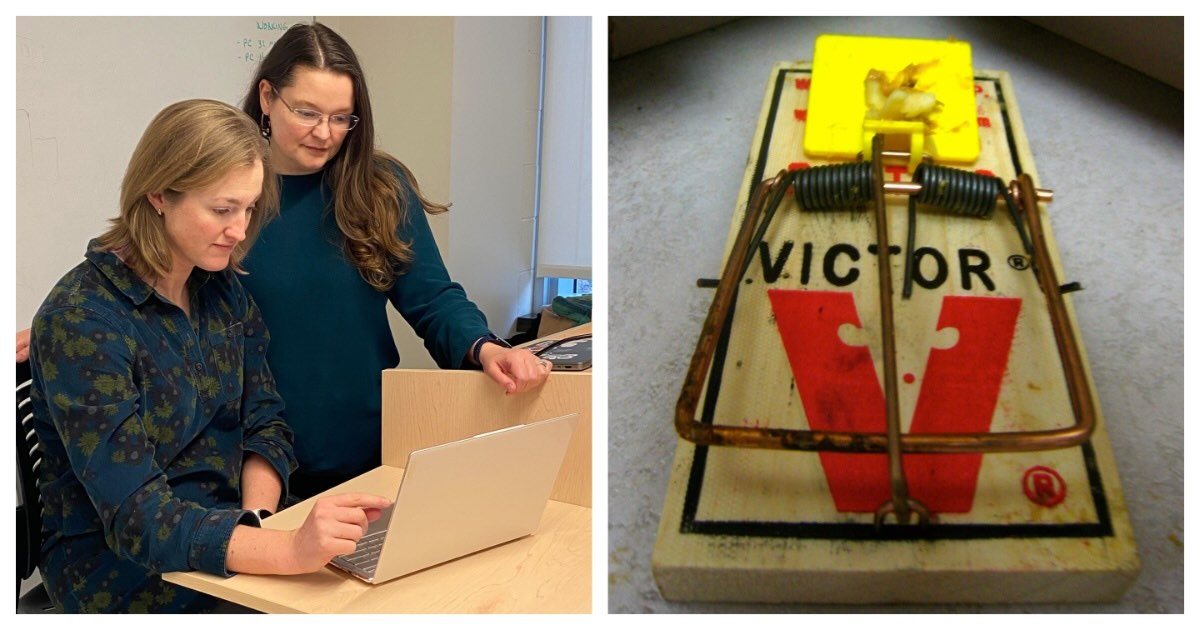
Left: Drexel doctors Adrienne Kasprowicz and Megan Phifer-Rixey, who are conducting a study of mice in Philadelphia and beyond | Right: A baited Victor mousetrap / Photograph via Flickr/CC
Most right-thinking human beings hate mice. They leave their little turds all over the kitchen counter. They gnaw open bags of food. And, oh yes, they can carry all sorts of viruses, bacteria, and diseases, from hantavirus to leptospirosis. Fun stuff.
Scientists, on the other hand, love mice. The little critters have a lot of similarities to the humans who despise them — you are far more genetically similar to mice than you would ever care to admit — so they are useful in scientific testing. Breeding mice in large numbers is effortless and quick to do. It’s also easy to keep mice; they don’t require a lot of care and upkeep, which is part of why they thrive so well in your basement and attic and behind your walls — and in the laboratory.
Two scientists particularly interested in mice are Drexel biologists Megan Phifer-Rixey and Adrienne Kasprowicz. Their team is involved in a years-long study of the rodents, specifically about the genetic and behavioral differences between urban mice and rural mice. And it so happens that Philadelphia is an excellent place to find mice, with our fair metropolis consistently landing at the top of lists ranking the most mice-infested areas of the country.
They’ve already finished phase one of their study, which involved catching mice alive in New York City, Philadelphia, and Richmond, Virginia, as well as in rural areas in the general vicinity of those cities. The researchers are hoping to publish their findings from phase one later this year. (They can’t really discuss those on the record just yet because their data hasn’t been peer-reviewed.)
The team needed live mice for phase one because a living mouse gives you access to more research possibilities than does a dead one. “We have genomic data,” explains Phifer-Rixey. “We have gene expression data. And we have microbiome data. The main focus of the project really is on understanding how cities affect mice — understanding how diverse the [mouse] populations in cities are, how connected they are, if there is evidence that they are adapting to living in cities.”
Phase one gave them, as she puts it, “an intensive, full suite of information.” But for phase two, they are looking for mice from Philly and those other areas in the state that most homeowners would agree mice should be in: dead.
“Philly is a big, complex city,” she says. “It has highways, it has rivers, it has lots of parks and lots of neighborhoods. We’d like to see how those things affect the movement of wildlife and, to do that, we don’t need all this comprehensive data — but what we do need is a lot of DNA from a lot of places. And so we’re switching to this different sampling strategy.”
This is where you come in. If you catch a mouse at home, whether you use a classic snap trap or one of those fancier 21st-century ones that electrocute the poor things, the Drexel docs want your mice. All you have to do is stick them in a Ziploc bag in the freezer and email wewantmice@gmail.com. They’ll schedule a pickup.
“We’d really like to get a broad distribution from across the city so we can look at the citywide patterns that we’re experiencing,” Phifer-Rixey tells me. “But that requires lots of samples from lots of different areas.”
So why is all this important?
“We’re evolutionary geneticists and evolutionary biologists,” she explains. “We’d like to know how features of cities like high-density development, highways, and rivers all act to shape genetic variation in wildlife. But more broadly, we are interested in how wildlife in general interacts in cities. A lot of wildlife lives in cities. We don’t always notice it.”
The scientists also say that this work will be useful to the people who work for the city in public health and urban planning.
That’s all well and good, but what about the rest of us who just want to know why it’s so hard to get a mouse to actually go to a trap, and what works best as bait. While they can’t speak on this from a scientific level right now, the pair said they could reveal some purely anecdotal information.
The two agree that the classic idea of cheese isn’t the answer for baiting — unless it’s particularly stinky cheese, which you probably don’t want to waste on mice — and that peanut butter tends to be more effective. “When we get desperate, I have used Nutella, I have used bacon bits, I have used sesame seeds,” says Kasprowicz. “If you have something that they really like getting into, steal that away but put some of it out as bait. That’s a familiar thing for them.”
But even then, you may be out of luck. The pair do confirm that it seems to be very difficult to trap a mouse in the city, whereas that has not been their experience in the country. So does this mean that Philly mice are smarter than mice in, say, Delco? They can’t say for sure.
“I’ve seen mice walk past bait,” Kasprowicz adds of mice from Philly proper. “It’s kind of crazy.”
Says Phifer-Rixey: “Taunting … taunting you.”