
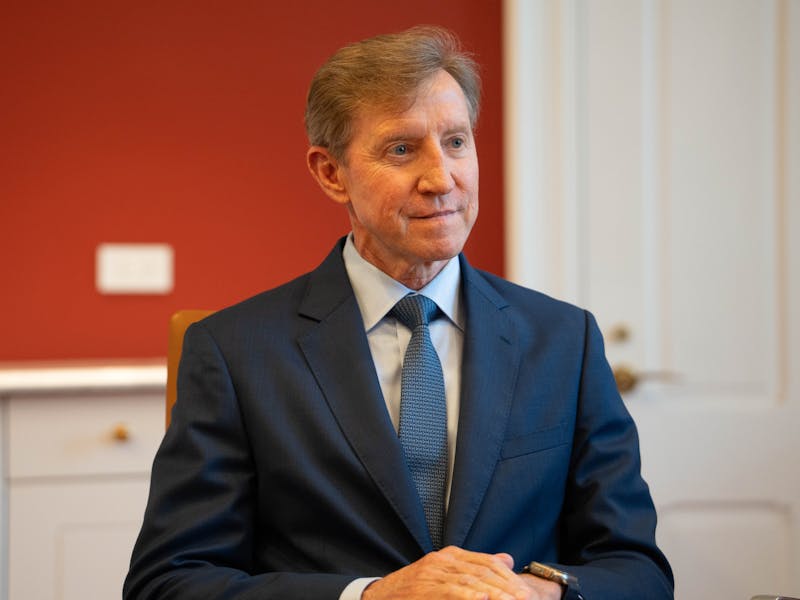
Penn President Larry Jameson addressed equality, opportunity, and diversity in a Wednesday message to the University community.
The March 18 statement — titled “We hold these truths to be self-evident” after the Declaration of Independence — comes ahead of America’s 250th anniversary this July. Jameson’s message reflected on Penn’s history and reiterated the University’s commitment to “access and inclusion” on campus.
“Our commitment to excellence is inseparable from our commitment to access and inclusion,” Jameson wrote. “It is often said that diversity and excellence go hand in hand. I would go further: they are synergistic—each strengthens the other.”
Jameson referred to diversity of background and thought throughout his statement — referencing the University’s “cultural and affinity groups” and emphasizing the “interdisciplinary programs” and “collaborative research centers” offered by Penn.
“We encourage open expression, civil discourse, and respect for different points of view,” the message read. “These guiding principles have been the foundation for many of our most important discoveries and contributions to society.”
Jameson’s affirmations come after the University scrubbed references to diversity, equity, and inclusion efforts across Penn’s undergraduate and graduate school websites and programs last year.
Penn’s DEI rollback began in 2025 after 1968 Wharton graduate and President Donald Trump signed an executive order requiring universities that receive federal funding — such as Penn — to terminate any DEI programs that could violate federal civil rights laws.
Earlier this year, Penn’s University Council voted to rename its Committee on Diversity and Equity — the last major vestige of DEI at the University — just hours after the Trump administration dropped its appeal against a federal ruling barring the Department of Education from threatening to withhold university funding over DEI.
Jameson also listed Penn First Plus and The Quaker Commitment as programs aiming to make education at Penn more accessible.
“Higher levels of education are associated with greater economic mobility, better health and longevity, and stronger civic engagement,” he wrote. “Universities therefore advance not only individual success, but also the broader public good.”
Penn First Plus — launched under former Penn President Amy Gutmann — provides a range of academic, financial, and social resources for first-generation, low-income students.
The Quaker Commitment, which first went into effect in this academic year, provides full tuition coverage for families making up to $200,000 annually with typical assets.
“These initiatives reflect a guiding principle: talent is widely distributed, but opportunity is not,” Jameson wrote.
At a University Board of Trustees meeting in March, Penn outlined a 3.8% increase to its financial aid budget for the fiscal year of 2027.
Jameson also made references to “Penn Forward” — a campuswide strategic framework he announced last September. The plan’s six working groups are set to begin rolling out initiatives this year.
“Penn Forward explores how to strengthen networks for mentoring, shadowing experiences, and internships, further leveling the playing field for students,” the message read.
Jameson’s allusions to the Declaration of Independence come as Penn prepares to celebrate the 250th anniversary of the United States this summer.
“Opportunity, respect, intellectual openness, and the conviction that talent can come from anywhere have shaped Penn since its founding and remain essential to its future,” Jameson wrote. “At Penn, these ideas are not catchphrases—they are enduring elements of our culture.”
Staff reporter James Wan covers academic affairs and can be reached at wan@thedp.com. At Penn, he studies communication and computer science. Follow him on X @JamesWan__.