
Pennsylvania’s welfare fraud rate surged 165 percent in 2025, vaulting the Commonwealth to the fourth‑highest rate in the nation and raising fresh questions about whether Harrisburg and its largest cities are equipped to protect taxpayer dollars.
The spike comes as the state’s primary anti‑fraud watchdog, the Office of State Inspector General, operates with long‑standing vacancies and limited independence, while major jurisdictions such as Philadelphia and Pittsburgh lack their own welfare fraud units or truly independent inspectors general with law‑enforcement authority.
State data reviewed in the report show welfare and medicaid fraud complaints and confirmed cases grew far faster than overall benefit enrollment in 2025, resulting in a 165 percent jump in the fraud rate and placing Pennsylvania fourth among states. That surge stands in stark contrast to federal improper‑payment trends, where major programs like Medicare — specifically in “home health aid” programs in where tax dollars are spent to pay family members to stay home and care for elderly relatives — have pushed error rates under ten percent for nine consecutive years, underscoring what tighter controls can achieve.
Officials in Harrisburg have touted headline arrests and restitution totals, pointing, for example, to the Attorney General’s Medicaid Fraud Control Section, which was ranked first in the nation for the number of Medicaid fraud charges filed in 2024 and third in convictions, recovering more than 11.3 million dollars in misused Medicaid funds that year. Yet the 2025 figures suggest that prosecutions alone are reactive in nature, and not keeping pace with nor attempting to prevent the growth in suspected fraud and that front‑end prevention and oversight may be lagging.
An overstretched state inspector general
By statute, Pennsylvania’s Office of State Inspector General is responsible for investigating and prosecuting welfare fraud referrals statewide and conducting collections on behalf of the Department of Human Services. The office’s mission includes preventing, detecting and deterring fraud before benefits are authorized, and recovering overpaid program benefits after improper payments occur.
But lawmakers have acknowledged that the welfare fraud unit has carried a “fairly high number” of vacant positions over multiple years, with unfilled investigator slots reported as ranging from 25 to 39 at points in the last decade, raising concerns that the office lacks the manpower to keep up with caseloads. The Department of the Auditor General notes that it can only review and audit welfare programs and has no enforcement power over individual recipients, meaning all welfare fraud complaints must be handled and prosecuted by the already‑stretched inspector general’s office.
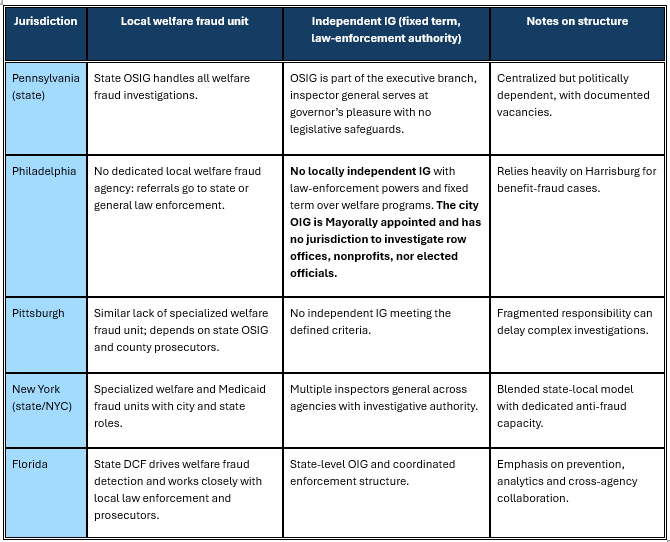
Unlike some states where inspectors general enjoy fixed terms and statutory insulation from political pressure, Pennsylvania’s OSIG operates as an executive‑branch agency whose leader serves at the pleasure of the governor, limiting its independence. Furthermore, a lack of bipartisan consensus on Republican-led bills to strengthen fraud-fighting laws, and the 2025 fraud spike is prompting advocates to question whether an office that is both understaffed and structurally subordinate to the administration can effectively police billions in annual public assistance spending.
Local blind spots in Philadelphia and Pittsburgh
Those concerns are compounded at the local level, where Pennsylvania’s largest cities lack dedicated welfare fraud investigation forces and independent inspectors general with their own law‑enforcement authority and fixed terms that outlast the political administrations that appoint them. Complaints about welfare fraud originating in Philadelphia and Allegheny County must typically be referred to state agencies or general‑jurisdiction law enforcement, rather than to specialized local units trained to investigate benefit schemes.
Reformers point to other big jurisdictions as models. New York has built a network of inspectors general embedded across agencies, and the state’s welfare and Medicaid anti‑fraud efforts combine specialized state investigators, city‑level enforcement in New York City, and close coordination with prosecutors. Florida, meanwhile, has Inspectors General in every state agency under the command of Melinda Miguel, a Chief Inspector General at the Gubernatorial level who has served under three bipartisan governors. implemented a comprehensive anti‑fraud strategy in which the Department of Children and Families uses data analytics, audits and coordinated investigations with local law enforcement and state attorneys to pursue welfare fraud, backed by a robust reporting and case‑tracking system.
Oversight structures across jurisdictions
Calls for independence and resources
Policy experts say Pennsylvania’s experience illustrates the difference between counting prosecutions and actually preventing and reducing fraud. While the Attorney General’s office can tout record numbers of Medicaid fraud charges, the rapidly rising welfare fraud rate suggests systemic weaknesses in screening, data‑sharing and oversight that a small, politically dependent inspector general’s office may be ill‑equipped to address.
Reform proposals now circulating in good‑government circles include giving the state inspector general a fixed term and clear law‑enforcement authority independent of the governor, increasing funding to fill long‑standing vacancies, and authorizing major cities to create their own inspectors general with jurisdiction over local benefit programs and contracts. Without such changes, critics warn, Pennsylvania may continue to rank among the worst states for welfare fraud, even as other jurisdictions demonstrate that stronger oversight structures and investment in prevention can bend the curve in the other direction.
Based in Philadelphia, A. Benjamin Mannes is a consultant and subject matter expert in security and criminal justice reform based on his own experiences on both sides of the criminal justice system. He is a corporate compliance executive who has served as a federal and municipal law enforcement officer, and as the former Director, Office of Investigations with the American Board of Internal Medicine. @PublicSafetySME