
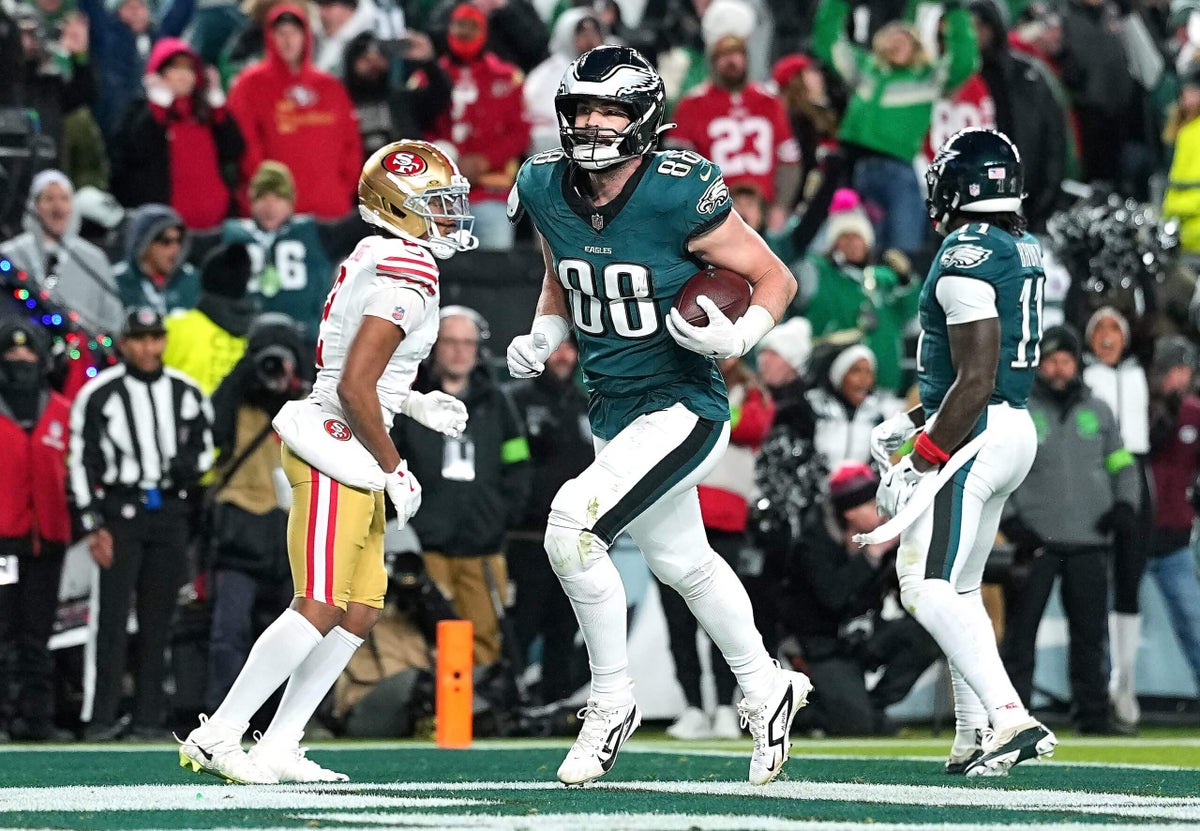
The second week of free agency is winding down, and the Eagles have added eight new players and re-signed three others from last season — and still have A.J. Brown on the roster.
General manager Howie Roseman often makes the point that the roster-building calendar is not confined to the first week of free agency and draft weekend. You can expect the Eagles to remain active. Here’s what they’ve done to date:
Added: CB Riq Woolen, TE Johnny Mundt, CB Jonathan Jones, Edge rusher Arnold Ebiketie, WR Marquise “Hollywood” Brown, QB Andy Dalton (via trade), TE Stone Smartt, RB Dameon Pierce
Re-signed: TE Dallas Goedert, TE Grant Calcaterra, P Braden Mann
What does this mean for the team? Here are five thoughts following the initial flurry of free agency:
1. The Eagles pivoted in free agency when they did not re-sign Jaelan Phillips, who received $30 million per season in Carolina. When Woolen lingered on the market on Day 2, the Eagles pounced on him on a one-year deal that gives them perhaps the NFL’s best cornerback trio — even if cornerback might not have been the top need.
This move fits Roseman’s approach. He doesn’t swing for singles or doubles with moves of consequence. He swings for the fence. Woolen might represent a boom-or-bust signing, but you can imagine what the boom would look like. On a one-year deal, the downside is the opportunity cost more than the contract itself. It’s not going to plague them if it doesn’t work out.
Some of Roseman’s best work has come from pivoting off Plan A. In 2020, the plan was to sign Byron Jones. When they couldn’t land him, they traded for Darius Slay and signed Javon Hargrave. In 2022, the Eagles tried to trade for Calvin Ridley and sign Allen Robinson at wide receiver. Neither move materialized, and they traded for A.J. Brown on draft night.
My guess is the Eagles aren’t finished with moves of consequence. An eventual trade of Brown will qualify, of course, but there could also be another splash move coming. Pay attention to what the Eagles do at edge rusher. They have opened money. If Brown is traded post-June 1, there’s more cap flexibility to add to the 2026 roster.
This offseason could resemble 2022, when the team made roster-shaping moves after the initial wave of free agency. At the league meetings that March, Roseman defended a depth chart that looked considerably different a few months later. A.J. Brown, James Bradberry and C.J. Gardner-Johnson all came later — in addition to the draft. With cap space, A.J. Brown’s uncertain status and nine draft picks (including four in the top 100), there’s more work to do.
2. After Goedert responded to a pay cut in 2025 by setting a career high in receptions and touchdowns, I did not expect him to return on a reduced salary. He was the top available tight end in The Athletic’s Top 150, with a projected salary of $13 million per season. For the Eagles to keep him at a reported salary of $7 million is a major development this offseason. Much has been made about the cap space it preserves in 2026 because the Eagles did not need to release him, and that’s a clear benefit to that short-term flexibility, but the on-field implications in 2026 are even more important. The bill will be due for Goedert at some point. He represents a strong starting tight end on a team-friendly salary.
When a player signs a team-friendly deal, one often needs to wonder what the rest of the league knows that you don’t. In this case, the Eagles are operating with more information than the rest of the NFL. Goedert’s age and injury history might be held against him, and he was not the same blocker in 2025 as in previous seasons, but he’s in the top half of the league among tight ends and is not paid like a top-16 tight end. In my offseason blueprint, I suggested that the Eagles “prepare to move on from Dallas Goedert — unless sentimentality is an appeal.” My guess is it helped the Eagles that Goedert spent the first eight years of his career in Philadelphia.
However, the Eagles should still be aggressive in trying to find Goedert’s replacement. A tight end trio of Goedert, Johnny Mundt and Grant Calcaterra punts the future of the position down the road another season. The middle rounds of this draft could be a sweet spot to find a tight end. It would make sense for them to seek a rookie to develop and create a belated pipeline at the position.
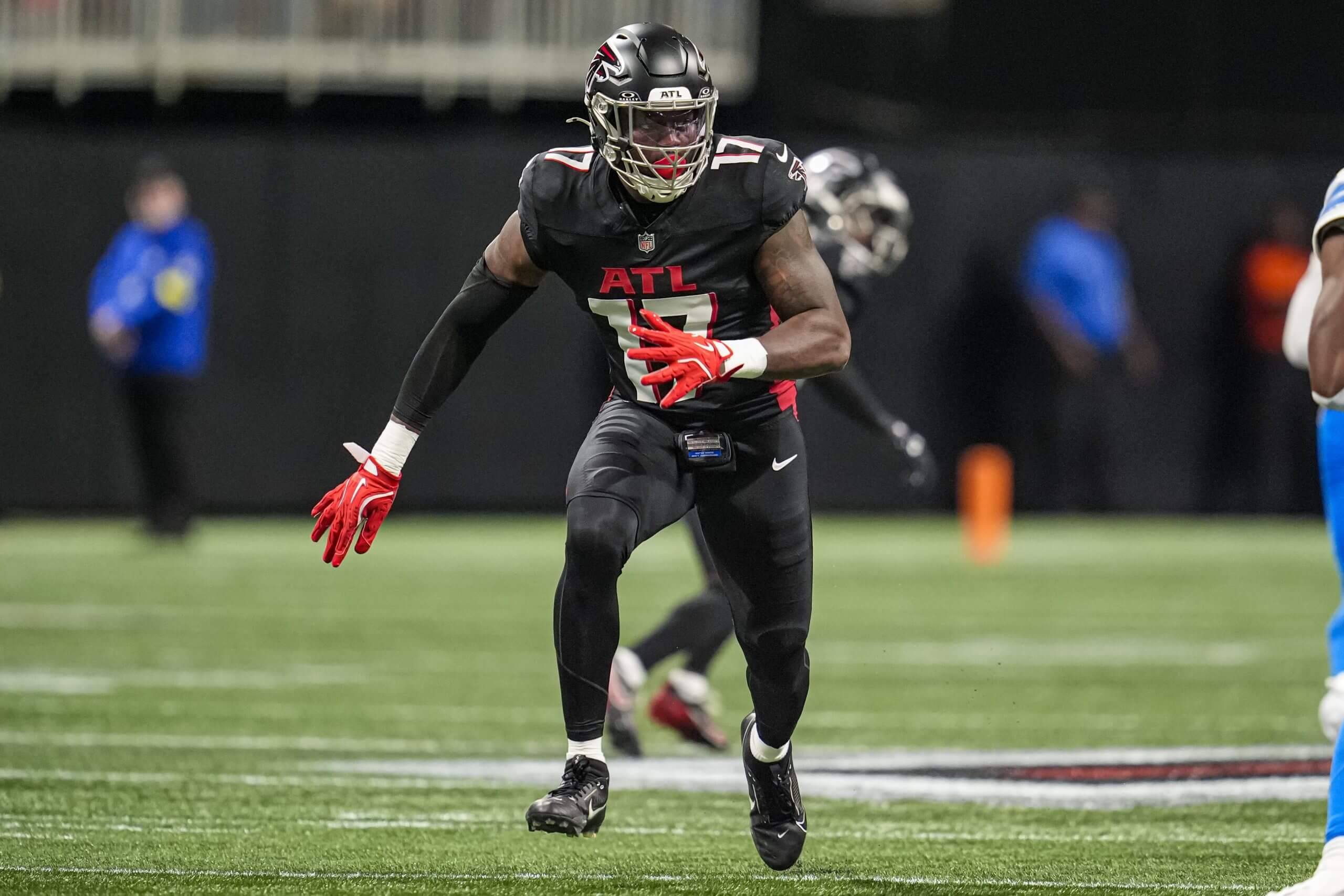
Arnold Ebiketie could become a big contributor for the Eagles. (Dale Zanine / Imagn Images)
3. The signing that deserves more attention is Ebiketie, who has a pathway to become a legitimate contributor for the team. If you were burned by the excitement around Azeez Ojulari last year, that’s understandable, because the profiles are similar — former second-round picks who drew interest from the Eagles out of college, had NFL production, but were pushed down the depth chart by other moves.
The logic that applied to the Ojulari signing is still applicable this season, and Ebiketie has a runway to contribute and the tools to do so. In four seasons with the Falcons, he had a sack or quarterback hit on 4.3 percent of his pass rush snaps. That’s not elite production, but consider how it compares to other top edge rushers in this class, such as Jaelan Phillips (4.6 percent), Odafe Oweh (4.3 percent), Boye Mafe (2.8 percent), K’Lavon Chaisson (3.8 percent), Joseph Ossai (4.6 percent) and Kwity Paye (2.8 percent).
Each of those players received bigger deals than what the Eagles gave Ebiketie. Part of that can be attributed to Ebiketie hitting the market after a down year, which is why a one-year contract made sense for him to try to reset his value. The tools were apparent when he came out of Penn State (a 128-inch broad jump, a 38-inch vertical jump, 34 ⅛-inch arms on a 6-2, 250-pound frame) and the spurts of production are evident.
There’s still a chance the Eagles draft over him or even trade for Jonathan Greenard. But this is the signing that might not have received enough attention relative to the potential impact on the team.
4. The addition of Marquise “Hollywood” Brown should not be interpreted as an indication that A.J. Brown will or will not be in Philadelphia. Jahan Dotson left in free agency. Outside of DeVonta Smith and A.J. Brown, the only receivers on the roster are Darius Cooper, Johnny Wilson, Britain Covey, Quez Watkins and Danny Gray.
This is a position the Eagles want to fortify — and they’re not finished yet. Hollywood Brown arrives with a reputation as a field stretcher. Some of that is based on the player he was earlier in his career, considering he only had 12 targets of 20-plus yards last season after topping 20 in four of his first five seasons.
Brown said his game has evolved and that he’s now a more complete receiver. He ran a greater percentage of slants and out routes last season, but his bread-and-butter is still running go routes. In fact, 25.9 percent of his routes since entering the NFL have been go routes. That’s the second-highest percentage of any of the top 20 players in targets of 20-plus yards during his career.
If the Eagles are looking for a player who can keep the back of the defense honest, this fits the description. (It also explains why they were linked to Darnell Mooney.)
Hollywood’s new role is independent of A.J. Brown — and it presumably isn’t entrenched any more than Devin White’s or Parris Campbell’s or a number of other well-known veterans Roseman took a flier on with a one-year deal.
But he could turn into a wide receiver version of Adoree’ Jackson — capable enough to find meaningful playing time at the position if he’s superior to the younger options. The Eagles will likely add a wide receiver in a draft deep at the position. They could still add an established receiver. That’s especially the case if A.J. Brown is shipped.
It might be a stretch to expect Hollywood Brown to return to the form of 91 catches for 1,008 yards in 2021. But it’s not far-fetched to think he can be in the range of 587 yards, like last season, which is better production than Dotson had in Philadelphia (or before he arrived in Philadelphia).
5. So, what’s next? Roseman likes to “draft-proof” the roster — meaning he tries to fill out the depth chart before the draft so the Eagles don’t enter draft weekend with a pressing need. You saw the Eagles make some small moves in the past week, as noted above. Here’s what else to keep an eye on (other than A.J. Brown’s status):
• Edge rusher is a big position to watch, even with Ebiketie. Greenard is challenging to predict because it requires compensation in a trade and with a new deal, but the interest is present.
• Safety is a weakness for the Eagles. They could slide Michael Carter II from the slot to safety, try Jonathan Jones in that role, and plug the position in the draft. This could be a spot for a signing similar to the Jackson addition last year at cornerback. Jabril Peppers and Taylor Rapp both have a background with new secondary coach Mike Pellegrino.
• The team needs more depth along the offensive line, so I’m expecting that to be a priority in the draft. They can still fortify the depth from the veteran market. Justin Skule has experience with Philly’s scheme.
• After acquiring Andy Dalton, do the Eagles ship Tanner McKee for draft capital? They have been reluctant to move him in the past, but they have more flexibility now. I’d pay attention to the 2027 draft capital.
• While the draft is an opportunity to add a wide receiver, there are more veterans lingering on the market. If Jauan Jennings’ price comes down, he could be an intriguing fit if the Eagles plan to trade Brown.
• The depth chart is settled at kicker and punter. The team must still address long snapper.