
PITTSBURGH – The war that brought the United States into being is usually thought of as a valiant effort by men in tri-cornered hats and breeches, wielding muskets in order to escape the clutches of a tax-mad king.
It was, like many things in history, a little more complicated than that.
There was outrage over taxation without representation, to be sure, but there were plenty of machinations, intrigue and treaties made and broken. And despite the perception that much of the action in the Revolutionary War took place at storied East Coast locations like Lexington, Concord, Bunker Hill, Saratoga and Fort Ticonderoga, a location in “the West” like Fort Pitt was not sitting idly on the sidelines.
A new exhibit, “Pittsburgh’s Revolution,” at the Fort Pitt Museum in Point State Park, gathers together artifacts and stories from the likes of George Washington and Native American war chief White Eyes to look at the crucial role that Western Pennsylvania played in the Revolutionary War. The exhibit is opening just weeks before the NFL Draft begins in Pittsburgh and celebrations of America’s 250th anniversary begin in earnest.
“This is all history and this is all our origin story,” said Mike Burke, the Fort Pitt Museum’s assistant director. “Pittsburgh has a great sense of history and tradition. We want people to come to the museum and check out that history.”
Burke continued, “We wanted to roll out something that outlined Pittsburgh’s role in this foundational conflict.”
Fort Pitt, built about 1760 during the French and Indian War, was a fulcrum of activity when the Revolutionary War broke out a decade-and-a-half later. Located where the Monongahela, Allegheny and Ohio rivers meet, it was where negotiations happened with Native nations and a central point in defending what was then called the Ohio Country. Burke pointed out it was taxes levied to help pay for the French and Indian War by King George III and Britain’s Parliament that helped spark the Revolutionary War.
“This is what really upset people in the West,” Burke said. “They were upset at the violation of their rights as Englishmen.”
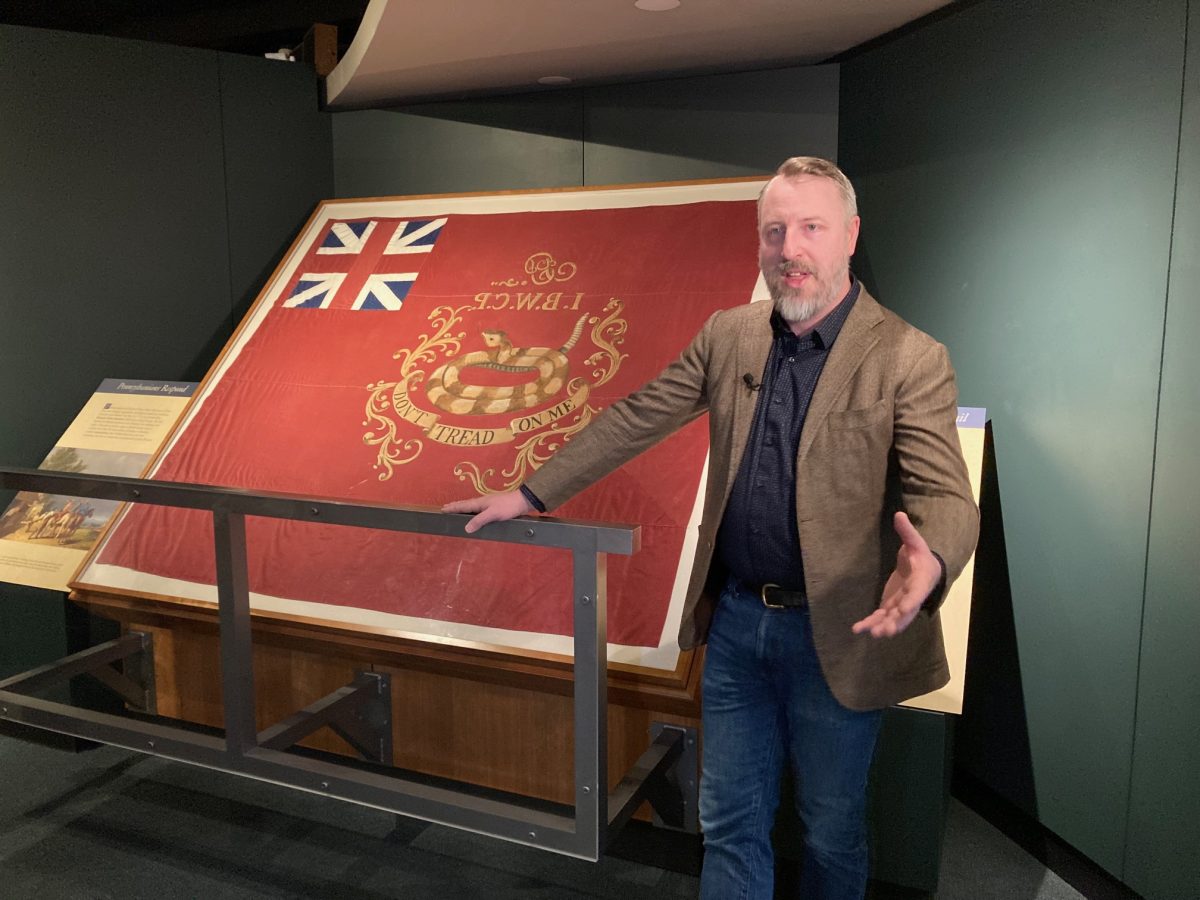
One of the objects in “Pittsburgh’s Revolution” is directly related to this – an original flag created for the Battalion of Westmoreland County in 1775. The flag bears a rattlesnake, a creature coiled and ready to strike, along with the motto “Don’t Tread on Me.”
The exhibit also has a Spanish-made musket that was used in Pennsylvania during the Revolutionary War; relics from Hanna’s Town in Westmoreland County, the site of a fierce battle in 1782 that destroyed the community; a sword and pistols used by Gen. William Irvine, the commander of Fort Pitt from 1781 to 1783; a trunk and tea canister used by a Continental Army paymaster to secretly transport money used to pay American troops stationed at Fort Pitt; and a 1777 letter written by Patrick Henry, the Founding Father who proclaimed “Give me liberty, or give me death,” emphasizing the need to defend Fort Pitt “to the last extremity.”
Living history programming will be happening at the Fort Pitt Museum throughout the run of “Pittsburgh’s Revolution,” with 18th-century demonstrations and cannon and artillery firings. A speakers series is also planned.
The Fort Pitt Museum is open 10 a.m. to 5 p.m. daily. For information, go online to heinzhistorycenter.org or call 412-281-9284.