
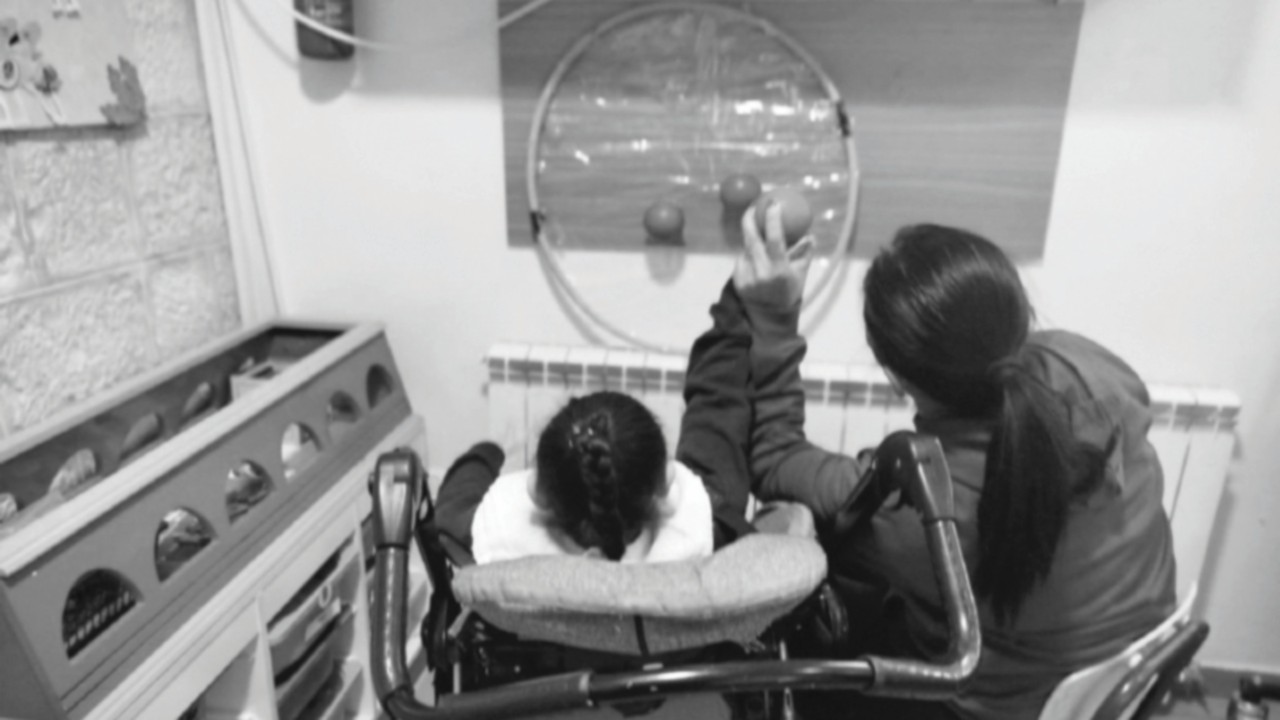
Silence envelops Bethlehem on the first Sunday of the year. It is the suspended silence of a land awaiting the promised peace while surviving the violence of occupation. Not far away, soldiers stand at the checkpoints, rifles raised, meticulously checking anyone who leaves the city. It has been raining without pause for days; the last Christmas lights still shine in the windows, while at the door of the Hogar Niño Dios an inflatable Santa Claus welcomes the children.
Once you cross the threshold, the silence turns into the rhythm of spoons tapping on plates, of wheelchairs gliding across the polished floor, and of prayers.
A few steps from the Grotto of the Nativity, life does not follow the logic of geopolitics but the far more stubborn logic of charity. The Hogar, which means “home” in Spanish, was founded twenty years ago from a Sisters of the Incarnate Word intuition. Upon arriving in the early 2000s to support the hospitals of the Holy Land, the sisters soon encountered an invisible reality, which was the many children with disabilities who had been left in hospital wards and never claimed. These were kids born into families who either could not, did not want to, or did not know how to care for them. This is why the sisters decided to take them in.
At the beginning, the building had only the ground floor, a single room where the sisters slept on the floor so they could give the beds to two boys and an adult woman.
Today, ‘The Hogar’ hosts 39 people, including five adult women and 34 children. Many of these people arrived there to escape unspeakable violence, like one of the women who had been beaten by her relatives until she was left permanently, accused of prostitution. In addition, there are mothers who are forced to live beside their own children without ever revealing their blood ties.
The stories intertwine like olive branches. One little girl arrived when she was only a year and a half old; now she is six. She was malnourished and marked by abuse that foreshadowed a future of cognitive and motor impairment. “We thought she would never coordinate her movements, that she would always have an intellectual disability” the sisters recall. Instead, today she writes, reads, and goes to school. It is the miracle born from the methodical dedication of the women who loved her.
Then there is a boy whose destiny is a tangle of faith and prejudice. Adopted by a Muslim family from Hebron, he was loved by his parents until his disability emerged. From that moment on, the mother’s extended family did everything possible to push him away, seeing his physical limitation as an unacceptable stain. Instead, his parents never truly gave him up as every weekend they brave the roads of the West Bank to come visit him. They would like to have him with them, but social pressure is likely stronger than the desire to keep their son close.
The day at the Hogar begins early; by 06.00 a.m. the sisters and the children are already awake. By 07:30 the house is buzzing and no one here ever pauses. Some leave for school, some follow sensory activities, some go to physiotherapy. It is a care machine that never stops. There are bibs to change, sheets to wash, cooks preparing meals for forty people. However, after October 7, 2023, the day of Hamas’s attack on Israel, everything became more difficult. Before the war, the Hogar welcomed around 250 volunteers a year; in the past two years, barely 15 have arrived. The absence of volunteers means both a lack of helping hands, and daily isolation for these children.
Yet even before October 7, 2023, their lives were marked by confinement.
The sisters recount the absurdity of daily life under occupation. At Christmas 2024 they were stuck, together with all the children, at Checkpoint 300, which separates Bethlehem from Jerusalem. They were on their way to the “House of Santa Claus” for a moment of joy. A female soldier stopped them: one of the children’s documents was not in order. “For them it was inconceivable that sisters would care for children without parents, without documents, with severe disabilities”, they explain. Only the insistence of the mother superior prevented them from being sent back.
“Another time, we had to take a fourteen-year-old boy with a severe infection to a hospital in Jerusalem”, the sisters continue. But Israel considered him an “adult” and therefore required a special permit for him to be admitted there. For the sisters of the Hogar, he was simply a son. “We are his family”, they told the hospital. “We cannot ask his parents for documents”. Once again, their tenacity and determination finally secured the boy’s admission.
Another time, a child had to cross the checkpoint with a leg in a cast. “The soldiers wanted to open the cast to check that we weren’t hiding weapons inside”.
However, the building is not staffed only by the sisters. Isabel, 55, was an engineer in Spain. Hers was a “good and ordinary” life, as she describes it, “made of travel and parish life”.
“God brought me here to discover my vocation, which paradoxically I never thought would involve children. I didn’t like them; I didn’t know how to behave with them”, she confesses as she feeds Duah. And yet, in 2016 she left everything. Today she is a Consecrated Virgin of the local diocese. “It isn’t rational, but I had the certainty that this was what God wanted for me”, she says.
Next to her is Elisabetta, also in her fifties, who arrived through the “Seven Signs” program of the Opera Romana Pellegrinaggi. She is an ambulance rescue driver for the Misericordia, accustomed to emergencies in Italian ambulances. She whispers, “But here there is nothing to rescue, it is they who rescue us. Every day you meet the Lord in the other, in the silence of service”. Elisabetta waits for the 18.00 p.m. rosary, helps put the children to bed, and then returns to her rented home in Bethlehem.
Although almost all the residents come from Muslim families, the nature of the institution is deeply Catholic, and the children take part in all the prayers. “Most of them do not have the cognitive ability to distinguish between faiths”, the sisters explain, “but they perceive the sacredness of the love they receive”.
The Hogar is a free zone where time has stopped but life runs intensely. Over the years, many children have died from pre-existing conditions; some, too violent to ensure the safety of the others, had to return to their families that are often violent and dangerous themselves. Nothing more is known about them. But for those who remain, this is their home “for life”.
As the sun sets behind the hills of Beit Jala, the rosary is prayed at the Hogar. Israeli soldiers stand at the checkpoints, politicians debate borders, but here, where the border becomes grace, between Isabel’s arms and Elisabetta’s smiles, the Kingdom of God grants citizenship without the need for permits.
by Lidia Ginestra Giuffrida
#sistersproject