
The Pennsylvania legislature last overhauled the state’s open records law, known as Right-to-Know, nearly two decades ago.
Now, some elected officials and media advocates say it’s time for an update.
Right-to-Know “hasn’t been addressed since 2008,” Rep. David Delloso (D-Delaware) told the Pennsylvania Capital-Star. “I think a timely response is due.”
Delloso, majority chair of the House Intergovernmental Affairs & Operations Committee, repeatedly noted the law’s age in an hour-long informational hearing on Right-to-Know Monday. Panelists urged lawmakers to either extend leniency for responding government units or tighten exemptions.
Drafters created the Right-to-Know law with a goal to empower citizens, labelling all records as public — unless otherwise specified by an exemption — and giving agencies five days to respond with just one 30-day extension.
SUPPORT: YOU MAKE OUR WORK POSSIBLE
But Lancaster County Commissioner Ray D’Agostino, testifying on behalf of the County Commissions Association of Pennsylvania, said that “within 15 years of implementation” it became clear to counties that the law needed to be updated.
“The environment in which the law operates today is very different from that which was envisioned at the time it was passed,” he said.
While requests used to be for individual records, now the shift was toward “large-scale data extraction” and “commercial data mining” that required “an extraordinary breadth of records,” said D’Agostino. Some commercial enterprises even repackage the information and sell it, he added.
“What was once a simple document retrieval may now require retrieval records from different systems, coordination across multiple departments, legal review and careful redaction of confidential information,” he said. “All this must be completed within strict statutory timelines, regardless of the size and complexity of the request.”
D’Agostino supported charges for commercial requests as well as a “blackout period” around elections to keep administrators free to focus on Election Day, rather than records requests.
Other identified issues for governments
Ron Grutza, the senior director of government affairs with the Pennsylvania State Association of Boroughs, echoed D’Agostino’s remarks about charging fees for commercial requesters. He also emphasized the need to address so-called vexatious requests — or bad faith public record searches designed to tie up officials — and artificial intelligence.
“When someone has an ax to grind, especially with smaller boroughs and townships, they know that they can shut down the office for a week or so by sending these complex requests,” said Grutza.
Stakeholders said that AI, in particular, has disrupted the system, flooding government agencies with lengthy or burdensome submissions.
“The incursion of AI … is affecting all government and, frankly, all representational bodies,” said Delloso. “I was in union representation (and) suddenly members are handing in grievances that are AI generated with long-standing, extinguished cases that have no appeal and no bearing on their particular grievance.”
Senate Bill 431, authored by Sen. Tracy Pennycuick (R-Montgomery), would allow agencies to reject requests “automatically generated” by technology like AI if they have a “reasonable suspicion.”
Grutza said that his association supported the proposal, which also allows denials for requests that contain links and documents if the responding officer “believes that downloading … could pose a cybersecurity risk.”
Barriers to public access
Melissa Melewsky, an attorney with the Pennsylvania News Media Association, assists journalists throughout the commonwealth — including the Pennsylvania Capital-Star — with Right-to-Know requests and public access.
While the 2008 law is a “significant improvement,” Melewsky warned about continuing efforts to exempt entire subject areas from public scrutiny, which could “erode the Right-to-Know law (and) risk death by 1,000 cuts.”
SUBSCRIBE: GET THE MORNING HEADLINES DELIVERED TO YOUR INBOX
“That’s obviously not something we want to see happen here in Pennsylvania,” said Melewsky.
And though request deadlines are strict, members of the media may often seek records informally — only to be diverted to the Right-to-Know process for “plainly public” documents like meeting minutes, contracts and salaries, said Melewsky.
Those documents are often granted a 30-day extension, which Melewsky said should be reserved for “special circumstances but, in practice, has become (a) standard operating procedure.”
Some public documents could be proactively disclosed, she continued, which could reduce the burden on local governments and maintain public access. Additionally, some public entities share files as PDFs, rather than machine-readable documents or databases, limiting their usefulness for public analysis.
“What was once a functional data set, in effect, becomes a static printout,” said Melewsky. “That’s not a neutral, administrative choice. It materially alters the records and diminishes its value to the public … the risk is only increasing as government agencies rely more heavily on databases and data-driven systems to manage their operations.”
Melewsky also said that the state’s criminal investigation exemption was one of the broadest in the nation and creates a significant barrier.

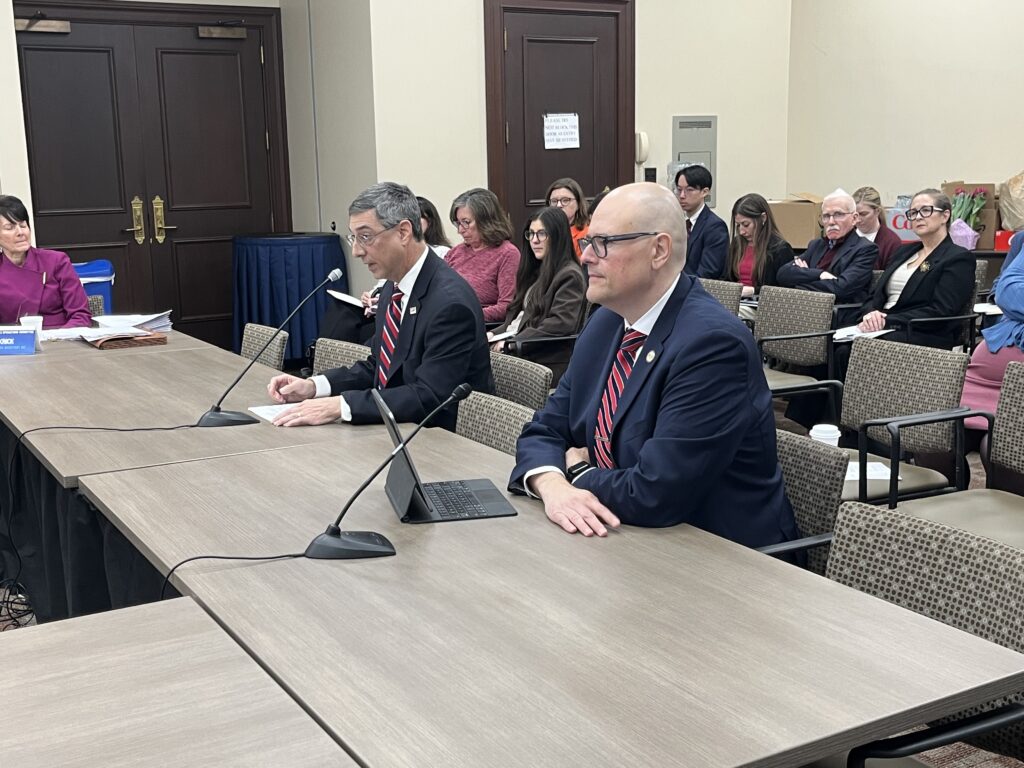
At left, Melissa Melewsky, an attorney with the Pennsylvania News Media Association, describes public access barriers before a committee on March 23, 2026. (Photo by Whitney Downard/Pennsylvania Capital-Star)
“As written and interpreted, Pennsylvania’s criminal investigation exemptions shield most law enforcement records even long after cases are closed and resolved. This includes even basic incident reports, which were public under the prior, more restrictive law,” Melewsky said.
And as traditional police blotters are phased out, she said, “the result is that the public often has no meaningful access to basic information about criminal activity in their community.”
“That wasn’t the intent of the Right-to-Know law, and it’s something that could be meaningfully addressed by the legislature,” she added.
Non-criminal investigative exemptions can include inspection reports for child care facilities or nursing facilities as well as infrastructure safety records. According to the Office of Open Records 2025 report, non-criminal and criminal investigative records were the top two cited exemptions in filed appeals.
Melewsky also cautioned against the “vexatious requester” label, noting that available data doesn’t indicate it’s a widespread practice and it could limit public scrutiny.
“A requester who persistently seeks information could be characterized as vexatious simply because the requests are inconvenient or uncomfortable,” said Melewsky.