
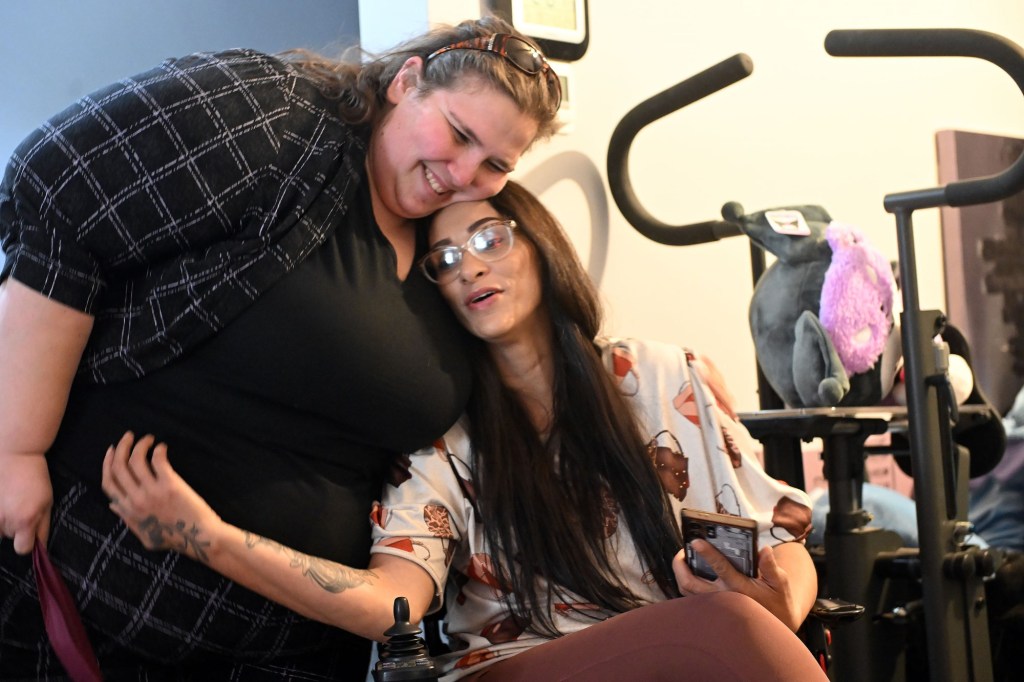
Just about six years ago, Noemi Gonzalez’s life suddenly changed.
The Reading single mother of four suffered a spinal infection that, after going untreated, left her completely paralyzed. For months she was unable to move any of her limbs, forcing her to rely on the help of others to tackle the simplest tasks like feeding herself or using the restroom.
“It was embarrassing to be honest,” the 45-year-old Gonzalez said. “I had always been such an independent person before this happened so this was devastating. I lost my mobility, my independence and, at one point, my will to live.”
After several months, with the help of intense physical therapy and treatment from specialists, she was able to regain some of her movement and was allowed to move from an assisted living facility back into the home she shares with her mother on Mineral Spring Road.
But that move meant she would need home-based care.
Gonzalez said she now relies on a caretaker every single day to survive, to regain her independence, to be present for her family and to accept her new reality.
“Finding reliable care was very difficult,” she said. “Agencies would send me caretakers who would get to know me, my routine, my schedule, my doctors and my family. And then they would just quit.
“It wasn’t that they didn’t care, they just weren’t being paid enough to survive and support their own families. When you can get paid more to flip burgers than to care for another human being, what kind of message does that send?”
Her personal experience made it all too clear to Gonzalez just how important home care workers are. And it’s why she is lending her voice to support them.
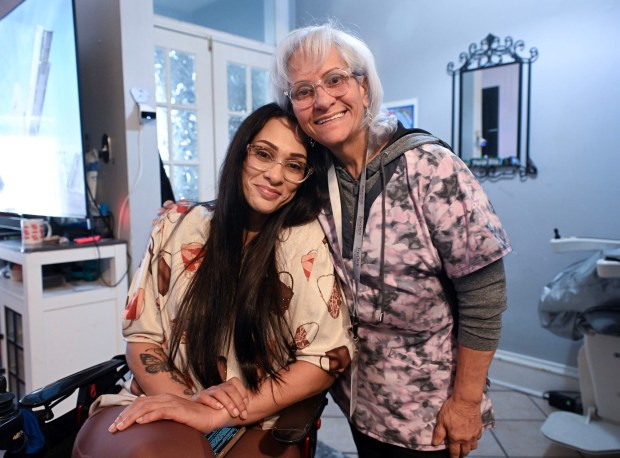 Noemi Gonzalez, left, has had to rely on her mother, Judith Haddock, for much of her home care. (BILL UHRICH/READING EAGLE)
Call for action
On Tuesday, hundreds of home care workers, patients, advocates and families from across Pennsylvania were scheduled to travel to the Capitol to urge lawmakers to address a home care workforce crisis and raise Medicaid reimbursement rates to be regionally competitive with all neighboring states.
Rachael Gleisner, director of TruCare Home Care Services, said the home care worker industry — which serves about 468,000 Pennsylvania residents each year — simply cannot attract workers due to low Medicaid reimbursement rates that suppress wages. She said that is the result of a failure of Pennsylvania’s Legislature to address reimbursement rates through five consecutive years of state budget negotiations.
The average direct care worker in Pennsylvania gets paid $20.63, trailing neighboring states by $5 to $16 an hour, according to the Pennsylvania Homecare Association.
The association, of which TruCare is a member, is advocating for a $21 million investment in the consumer-directed home care workforce, which would increase caregivers’ hourly wages to a minimum of $15 and provide access to paid time off.
“Pennsylvania definitely has to get competitive about this,” Gleisner said. “Our workers cannot survive on these wages and there is no reason why they should have to. These people are helping those who need this care to survive.”
The association plans to host a press conference at the Capitol to bring attention to the workforce shortage and invited Gonzalez to share her story with state lawmakers.
Gonzalez said she is thrilled to use her experience as an example of why something needs to be done. She said speaking in Harrisburg is important because she wants state lawmakers to understand that with a little bit of help people with disabilities can continue to contribute to their communities.
“When we invest in caretakers, we’re not just funding a service, we are investing in human potential,” she said.
Gonzalez said one of the biggest issues she has run into was that her caretakers weren’t being reimbursed for mileage though they were expected to drive her to appointments. And early on there were lots of visits to occupational therapists and physical therapists.
“They were told they needed to take me there, but they wouldn’t get reimbursed for mileage and while I was at my appointment they weren’t getting paid for that time even though they were by my side the entire time,” she said.
Gonzalez said she had three caretakers after her injury who each left after short stints working with her.
“Every single one that left didn’t just leave a job — they took a piece of my stability, my progress, my hope with them,” she said. “They were great women but, unfortunately, the system just didn’t pay them enough to do the work that they do.”
After the departure of her third caretaker, Gonzalez’s mom stepped in to fill the role.
Mother’s sacrifice
Judith Haddock decided to become a caretaker through TruCare Home Care Services to create some stability for Gonzalez. She received the necessary training to become an employee where she would be paid, receive benefits and earn paid time off.
“I should be retired by now, but this is something I had to do,” the 70-year-old said.
Gonzalez said her mother’s sacrifice has been a blessing for her.
“Because of her support I was able to focus on healing, I was able to rebuild my life, I was able to give myself another chance,” Gonzalez said.
Gonzalez is now able to use her arms, has about 30% of feeling in her hands and can bear weight on her legs. Walking, however, is still not something she is able to do at this point.
Gonzalez said now she’s not just surviving, she’s thriving. She has gone back to school and earned two associate’s degrees from Reading Area Community College and is working on her bachelor’s degree in social work through a joint program at RACC and Kutztown University.
“If it weren’t for having that reliable care in place, I would have never been able to continue to live the life that I set out to live prior to my injury,” she said.
But the most important thing that stability has given her is the ability to focus on being a mother to her four children.
“To be present for them and show up to their activities means so much,” she said. “While I may not be the kind of mom that I was before this happened, I try to lead by example that we can do anything we put our minds to.”
But given her mother’s age, Gonzalez said she knows the time is coming when her mother won’t be able to be her caretaker. And that has brought more urgency to her advocacy.
“I would not be who I am today if I didn’t have stable care in place,” she said. “And I should not be terrified at the thought that my progress could end if my mother can no longer be my caretaker. I should be confident in a system that will help me continue to thrive and be independent.”
Statewide issue
She said she is not alone in that worry.
Gonzalez noted that Pennsylvania is in the midst of a statewide home care crisis that sees more than 112,500 shifts of in-home care go unfilled every month for seniors and adults with disabilities.
And that creates a challenge for people like her, who would much rather live at home.
She said it’s cheaper for her to stay in her home with help from home care workers than for her to live at an assisted living facility. On average in Pennsylvania, it costs 127% more for institutional care than for home-based care, according to data from the homecare association.
And home-based care, she says, allows people to stay in their communities and retain their individuality.
“It’s not a funding shortage in my opinion, it’s a funding mismanagement when they are willing to spend money to institutionalize someone rather than invest in someone to keep them living safely in their home,” she said.
And just because someone needs help, Gonzalez said, doesn’t mean they don’t deserve a chance to live on their own terms.
“My physical disability doesn’t and shouldn’t diminish my intelligence, my leadership or my contribution to society,” she said. “What limits people like me is not our bodies, it’s a system that fails to provide the support we need to function independently.”
Gonzalez, who is on Medicaid, said she is looking forward to the day when she is able to put her degrees to use so she can stop relying on other taxpayers for care and begin to give back to the system. But she can only do that if she has the help she needs now to make that a reality.