
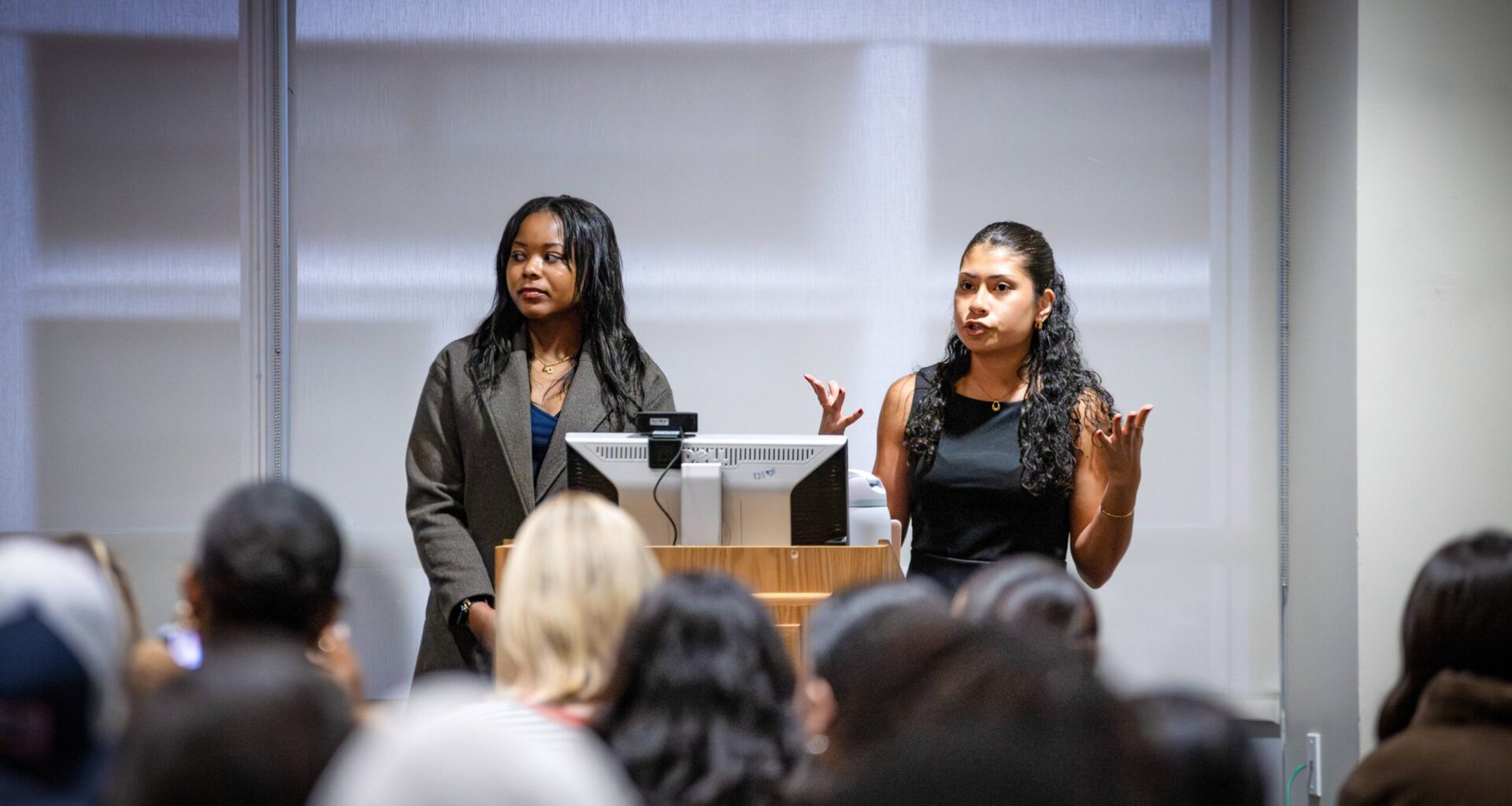
Dia Gordon (left) and Vanessa Flores (right) address students at the TSG town hall on March 23. | JUSTIN ALEX / THE TEMPLE NEWS

Vanessa Flores, Temple Student Government’s director of diversity, equity and inclusion, and Dia Gordon, TSG’s director of health equity and wellbeing, are running unopposed for student body president and vice president, respectively, under the campaign Temple Together.
“We really want to focus on community and create a more unified student body,” Flores said. “That’s the foundation of everything we’re running on.”
Flores, a junior political science major, and Gordon, a sophomore political science and economics major, are campaigning with the slogan “Together, we thrive.” Their platform emphasizes building a more connected and unified student body while addressing key campus issues like safety and resource accessibility.
“I’ve been in TSG for a while now, and I have seen a lot of things that I would want to change myself,” Flores said. “I just did not have the power to do so before, so I want to be more hands-on and actually hear what students want.”
Flores and Gordon hope to increase public safety by working with the administration to add one or two more blocks to the Temple University Police Department’s patrol zone and improve campus lighting.
Temple Together proposes changes to the university’s Good Neighbor Initiative, which encourages students living off campus to maintain respectful relationships with surrounding North Philadelphia communities.
The Good Neighbor Initiative holds students and student organizations accountable for their behavior off campus, allowing the university to address incidents that occur beyond campus boundaries.
“Right now, it’s mostly report-based, and it takes so long for anything to happen,” Flores said. “We have seen situations where someone reports an issue, and by the time it is addressed, it doesn’t even matter anymore.”
Reports of the violations are reviewed by the Office of Student Conduct and Community Standards, where students go through the university’s disciplinary process. Consequences can extend to suspension to expulsion.
The pair hopes to work more directly with off-campus housing providers and university administration to improve accountability and report response times.
Accessibility and affordability are also key priorities for the campaign. Temple Together aims to reduce the financial burden of textbooks by advocating for more affordable options.
“We want to push for professors to have PDF versions of their textbooks and make sure students know about the resources that already exist, like library access and textbook support,” Gordon said. “There are ways to make this more affordable, but students need access to them.”
Temple currently offers Open Educational Resources through the library, including textbooks, lecture notes and videos that are free for students and faculty to use. The library also has a Textbook Affordability Project, which is a grant stipend that awards professors who remove commercial textbooks and move to OERs.
The two also plan to improve commuter support, like advocating for a new commuter lounge and better SEPTA discounts for students.
Temple currently has a SEPTA semester pass program that offers students a 10% discount for SEPTA transits.
Temple Together plans to add a new position, director for commuters, to their administration. This position would advocate for commuters and serve as correspondent between commuter students and administration.
Current TSG President Lourdes Cardamone’s administration introduced the idea of improving the commuter lounge, which is located on Berks Street near Warnock Street.
“I feel like those students need more support,” Gordon said. “Even something like transportation costs can make a big difference in a student’s experience.”
Flores and Gordon hope to increase TSG’s visibility on campus through a monthly newsletter. A lack of awareness about TSG’s role is one of the organization’s biggest challenges, Flores and Gordon said.
To increase visibility, the two proposed an ambassador program where students from organizations elect a representative to TSG. The ambassador program would place representatives within different student communities, like commuters, student-athletics and Greek life, to better understand and address specific needs.
“Students experience Temple in very different ways,” Flores said. “Having those perspectives would allow us to respond more effectively.”
For Temple Together, success would ultimately be defined by stronger engagement and a more visible presence across the university.
“I want to see more students involved and actually engaged with TSG,” Flores said. “I want people to know what we’re doing and feel like they can be a part of it.”