
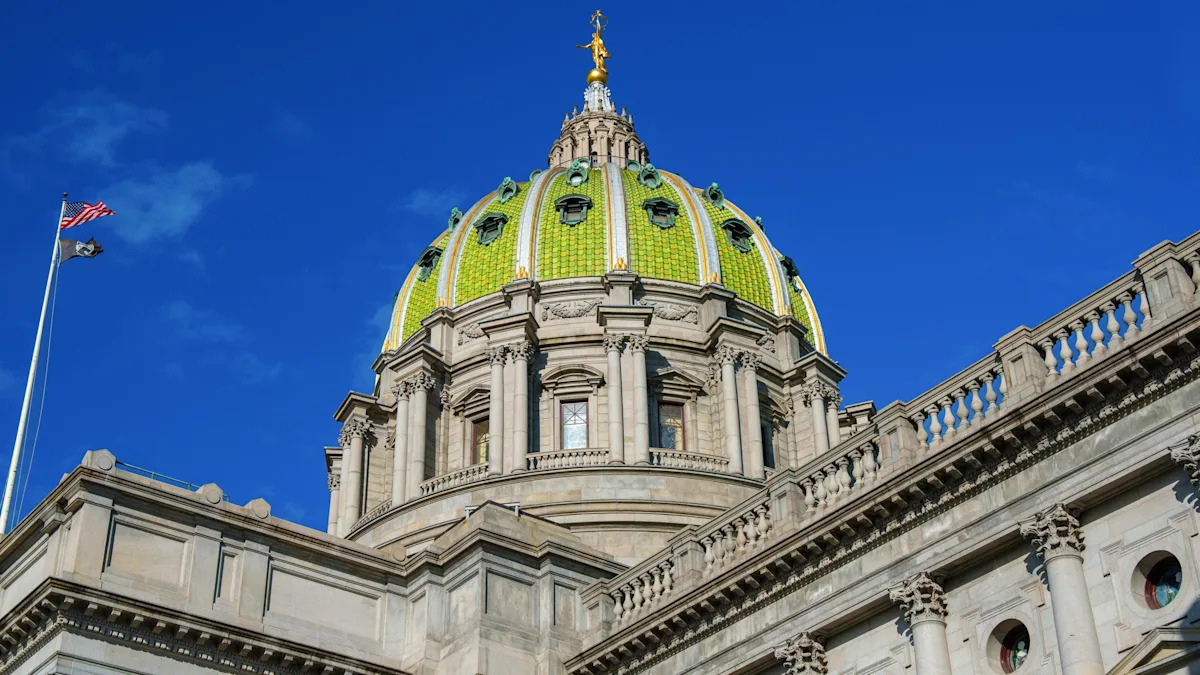
“In this world, nothing can be said to be certain, except death and taxes,” Benjamin Franklin once famously quipped. But in his adopted home of Pennsylvania, even taxes after death are certain, too.
The Keystone State is one of only five states that currently levy a tax on the transfer of an estate—including primary homes—to the next generation.
Unlike the federal estate tax, which offers a massive $13.99 million shield for individuals (and $27.98 million for married couples) Pennsylvania’s tax starts at the first cent, offering no floor and no mercy for the “asset-rich, cash-poor” middle class, whose wealth is often tied up in the place they call home.
“The death tax is wrong on every level,” Sen. Michele Brooks, sponsor of three bills currently before the State Assembly which would reform the tax, said via statement. “Pennsylvania is one of only a handful of states that still imposes this tax, which places an unfair burden on families simply because they have lost a loved one. We’re taxing people at one of the most vulnerable moments in their lives and that needs to change.”
Whether inheriting a $50,000 condo or a $5 million enterprise, heirs are hit with rates ranging from 4.5% for adult children over 21 to a staggering 15% for non-lineal beneficiaries. And unlike estate taxes, which are paid by the estate before distribution, inheritance taxes are paid by the individual beneficiary. In Pennsylvania, heirs have nine months after the death of the decedents to pay.
However, a new wave of reform is hitting Harrisburg. With a slate of proposals now moving through the State Assembly, the tide may finally be turning against the so-called “death tax.”
$100,000 shield passes key obstacle
Senate Bill 100, a Brooks-sponsored measure to exempt the first $100,000 of inherited assets for family members, became the first proposal to clear the Senate Finance Committee this week—marking an important step toward becoming law
Under Pennsylvania’s current mandate, the inheritance tax is levied at different rates depending on the recipient’s relationship to the deceased:
Surviving spouse or children 21 or younger: 0%
Direct descendants and lineal heirs (such as children over the age of 21): 4.5%
Other heirs except charities or other exempt organizations: 15%
SB 100 would fundamentally shift the math for family heirs.
Consider a home valued at $250,000 being passed to a daughter. Under current law, she would owe a $11,250 tax bill, due in full within nine months. Under SB 100, the taxable base would drop to $150,000, reducing the bill to $6,750.
That $4,500 in savings is especially significant when considering that households who receive an inheritance of at least $5,000 are about 2.5 times as likely to become homeowners than those who don’t, according to a recent report from Realtor.com® on generational wealth and homeownership.
For Black and Hispanic households, such an inheritance makes them over five and seven times more likely to become homeowners, respectively.
Competing proposals for reform
But Sen. Brooks isn’t stopping at a $100,000 exemption. She has also introduced two additional measures—Senate Bill 750 and Senate Bill 751—designed to eventually dismantle the inheritance tax entirely.
“I won’t stop until the death tax no longer exists,” Brooks said. “This legislation is an important first step, providing immediate, practical relief to families across the commonwealth.”
Senate Bill 750 focuses on the 12% sibling tax, systematically eliminating the levy over a seven-year period. Senate Bill 751, meanwhile, targets the 4.5% rate for direct descendants. It proposes a gradual reduction, dropping to 4.0% in 2027, and continuing an annual descent until it hits zero in 2035.
By breaking these into separate bills, Brooks is giving the General Assembly menu options for reform. If the budget can’t stomach a total repeal, they can at least vote to save siblings or children from the highest burdens.
The House alternative: Total abolition
Across the rotunda, Rep. Valerie Gaydos is leading the charge for a cleaner, albeit more controversial, break.
“This policy is not just economically misguided. It is morally out of touch,” she said via statement. “At a moment when families should be healing, the state is sending a bill. That is not compassion. That is bureaucracy over humanity.”
Her legislation, House Bill 1394, would effectively kill the death tax within 60 days of passage.
Unlike Brooks’ tiered approach, Gaydos’ bill is a total repeal of the state’s authority to collect inheritance taxes. While it has garnered strong support from the House Republican Caucus, it faces a steeper climb without the bipartisan support that Brooks has been able to garner.
The $1.7 billion question: Can the Commonwealth afford it?
The primary hurdle for any tax reform is often the math of replacing it, and that may be the biggest obstacle ahead for Pennsylvania lawmakers who wish to alter the state’s inheritance levy.
In the fiscal year ending in 2025, the inheritance tax funneled $1.7 billion into Pennsylvania’s general fund—nearly $29 million (or 1.7%) more than official estimates.
Even supporters of reform, like Sen. Art Haywood who voted in favor of SB 100, worry that cutting the tax without replacement revenue could run up the state’s deficit—currently estimated at $4.8 billion for the fiscal year ending in 2027.
“The general assembly has spent quite a bit of probably two decades or more on reducing revenue into the commonwealth,” he told the Pennsylvania Capital Star. “Then we have these significant gaps in terms of funding public education, public health, roads and bridges.”
It’s a similar dilemma currently facing the states that are grappling with eliminating property taxes: Yes, relief is necessary, but so are the services that this revenue funds. So far, no clear replacement for revenue generated by the tax has emerged.
Death and taxes may still be the only certainties in this world, but for the first time in generations, taxes after death in Pennsylvania are officially up for debate.