
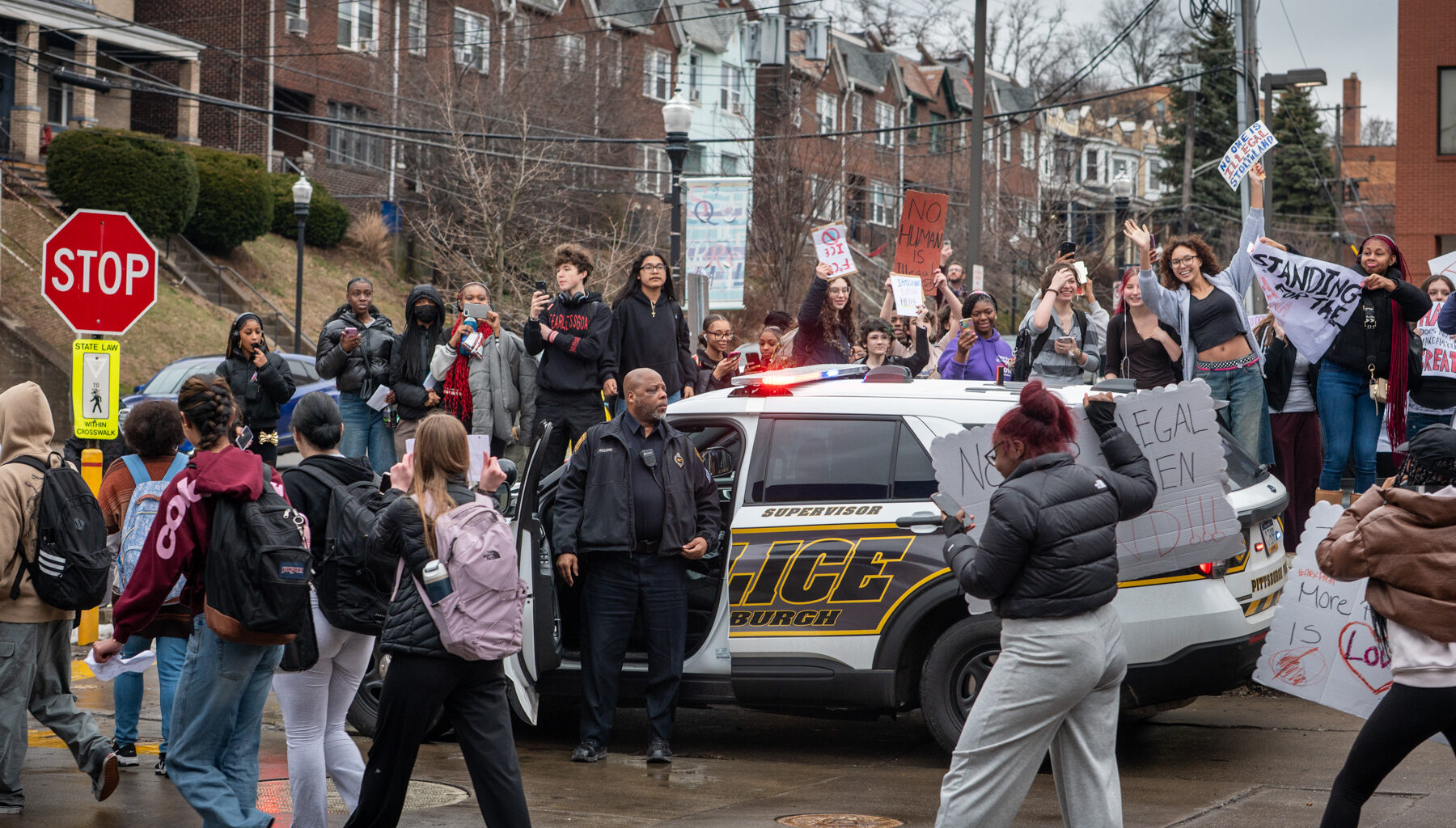
Pittsburgh lawmakers are considering ordinances to limit cooperation between city employees and federal immigration agencies, following Allegheny County’s passage of a bill this month.
Bills introduced to council Tuesday would prevent city employees inquiring about immigration status, prohibit any formal agreement between city police and immigration officers and designate “safe spaces” where federal officers aren’t permitted. They would also commission a report on all city departments’ use of surveillance technologies.
Council cosponsors Erika Strassburger, Deb Gross and Barb Warwick announced the bills a week after a video emerged showing city officers assisting Immigration and Customs Enforcement (ICE) agents during a December arrest in Mount Washington.
“We really wanted to draw a line in the sand to make it crystal clear where the City of Pittsburgh stands,” Strassburger said in an interview after the meeting.
“The vast, vast majority of immigrants, refugees are here to work hard, provide for their families, be part of a community and should be given a path to citizenship that, unfortunately, they are not able to seek right now.”
Municipalities across Allegheny County are increasingly passing resolutions to prohibit cooperation with ICE agents, though two have formalized agreements of cooperation. Earlier this month, the county passed a bill setting limits on cooperation with federal immigration.
According to the release, the city bills would:
Prohibit city employees or contractors from inquiring about immigration status
Prohibit city employees from investigations or law enforcement action based on a person’s citizenship or immigration status
Prohibit city employees and agencies from helping immigration agencies access people in city custody
Prohibit the city from entering into any 287(g) agreements formalizing partnership between local law enforcement and immigration enforcement
Designate city parks, recreation centers and some other properties as “Safe Community Places” where employees would not allow federal immigration law enforcement into nonpublic areas without judicial warrants
Bar the use of city-owned or controlled property for federal immigration enforcement activities
Require the city’s Department of Innovation & Performance to report to council and the public on the city’s use of surveillance technologies.
These would also apply to city contractors and lessees of city property, according to release.
A handful of residents spoke out in support of the city bill Tuesday.
Maddy McGrady, a Highland Park resident and the human rights program manager for Global Switchboard, said the bills represent “a common sense step” demonstrating that “immigrants are welcome in Pittsburgh, that immigrants can access city services without fear of our local government … and that we will not be complicit in scapegoating and terrorizing our immigrant communities.”
One critic, Mark McCune, described himself as a “Kennedy Democrat” who opposes the bill because he thinks immigration is a federal matter.
“So you can sit there and drink your lattes and embrace your San Francisco buddies, but that shouldn’t happen here in Pittsburgh, because we believe, most of us believe, in the rule of law, and until that changes on the federal branch, that you don’t have a right to ignore it.”
The Republican Committee of Pittsburgh issued a press release denouncing the bill, which its chair Todd McCollum dubbed “a dangerous precedent.”
“You cannot selectively cooperate with federal authorities when it’s convenient and block them when it’s politically expedient,” McCollum added.
Public Source reached out to an ICE spokesperson, who did not immediately respond to a request for comment. Mayor Corey O’Connor’s office did not respond to a request for comment by publication time.
The bill will move to standing committee next week, where it may be held for further discussion before returning to council for a vote. Strassburger said she expects the bills will require a lot of dialogue with other members and community stakeholders. “This is not going to sail through council without ample discussions.”
Jamese Platt is an editorial intern and can be reached at jamese@publicsource.org.
Jamie Wiggan is deputy editor at Pittsburgh’s Public Source and can be reached at jamie@publicsource.org.
This <a target=”_blank” href=”https://www.publicsource.org/city-council-anti-ice-legislation-pittsburgh/”>article</a> first appeared on <a target=”_blank” href=”https://www.publicsource.org”>Pittsburgh’s Public Source</a> and is republished here under a <a target=”_blank” href=”https://creativecommons.org/licenses/by-nd/4.0/”>Creative Commons Attribution-NoDerivatives 4.0 International License</a>.<img src=”https://i0.wp.com/www.publicsource.org/wp-content/uploads/2025/07/cropped-ps_circle_favicon_blue.png?resize=150%2C150&ssl=1″ style=”width:1em;height:1em;margin-left:10px;”>
<img id=”republication-tracker-tool-source” src=”https://www.publicsource.org/?republication-pixel=true&post=1331020&ga4=G-CCLXQK5C14″ style=”width:1px;height:1px;”><script> PARSELY = { autotrack: false, onload: function() { PARSELY.beacon.trackPageView({ url: “https://www.publicsource.org/city-council-anti-ice-legislation-pittsburgh/”, urlref: window.location.href }); } } </script> <script id=”parsely-cfg” src=”//cdn.parsely.com/keys/publicsource.org/p.js”></script>