
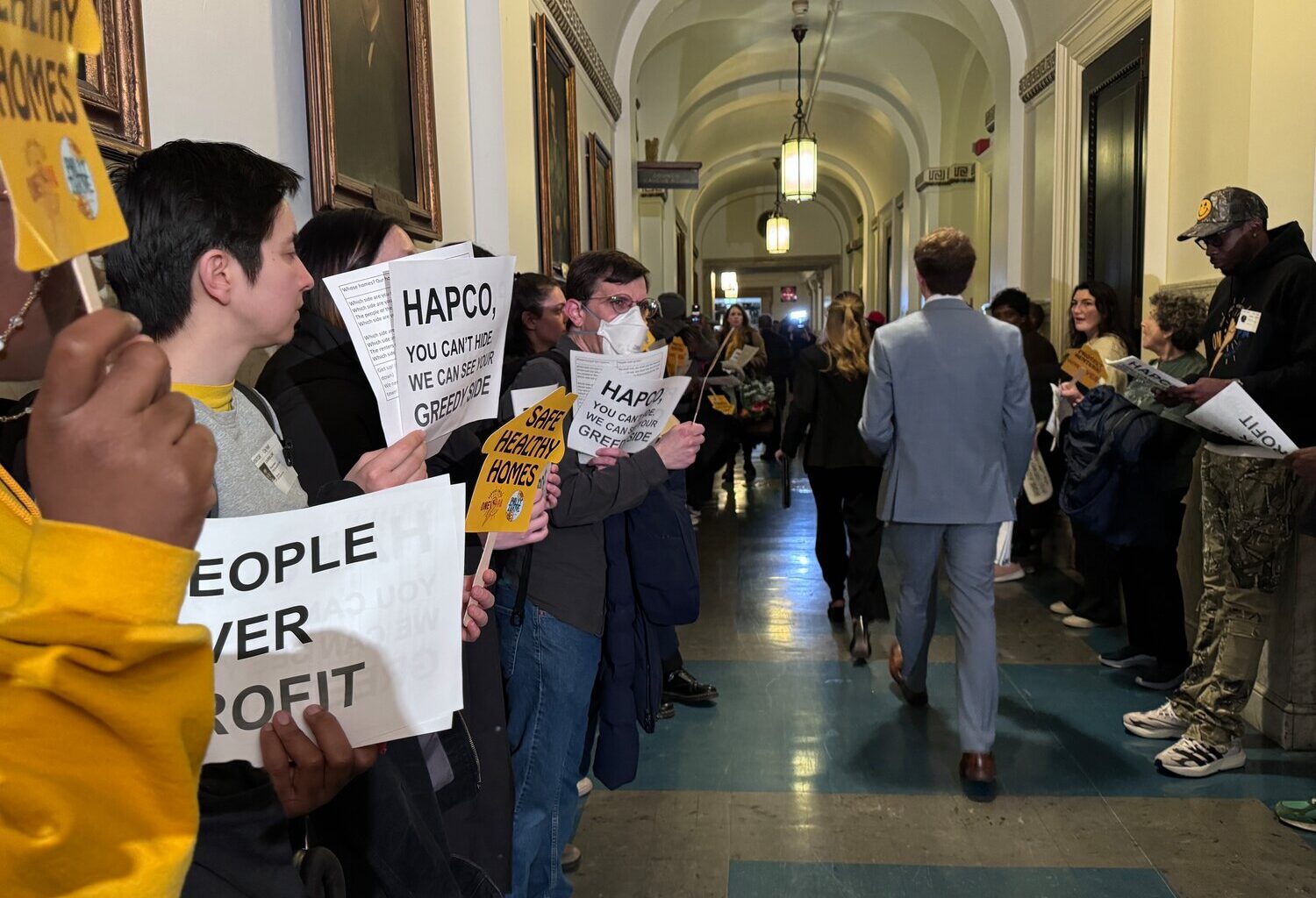
Ahead of an expected Philadelphia City Council vote on March 19 on the two remaining Safe Healthy Homes bills, a lawsuit brought by landlords, and a subsequent settlement, pushed them back to committee for more public testimony.
The “Right to Repairs Ordinance” and “Right to Safety Ordinance” were introduced by Councilmember Nicolas O’Rourke as a part of the Safe Healthy Homes Act. City Council unanimously passed the third part of the act, the “Right to Relocation” bill, in December, which creates an Anti-Displacement Fund through the Department of Licenses & Inspections (L&I) to aid tenants when they are evacuated from unsafe housing.
City Council’s Committee on Housing, Neighborhood Development and the Homeless had advanced the two remaining bills on March 4 after testimony from tenants, advocates, and representatives from HAPCO Philadelphia, an organization representing landlords. The committee had then decided to continue public testimony after the vote.
The lawsuit alleged that City Council violated Pennsylvania’s Sunshine Act, which requires state and local agencies to conduct deliberations in public. The plaintiffs took issue with committee members voting to advance the bills before public testimony concluded, and alleged Council members had deliberated in private on amendments.
In response, tenant advocacy groups and protesters showed up at City Hall, chanting in support of the Safe Health Homes Act. Tenants from Alden Park in East Falls were among the protesters. At the March 4 hearing, Kadi Ashby, president of the Alden Park Tenants Association, and Cincere Wilson, a tenant at Upsal Gardens in Mt. Airy, had testified in support of the bills.
“I think it’s important that we realize tenant protections in the city of Philadelphia,” O’Rourke told reporters ahead of the March 19 council session. “I’m going to continue to fight to make sure that we have those happen.
“Certainly, I would love for today to have been the day of celebration that it sounds like [the protesters] were prepared for,” he added. “But another day, right, as I heard someone say earlier, ‘Justice delayed is not just denied.’”
The bills
The first of the remaining bills would authorize L&I to establish a proactive inspection program; require landlords, before eviction, to provide an updated Certificate of Rental Suitability, which requires a valid rental license and no outstanding violations; and require posting of licenses, violations, appeals, and suspensions on the property.
At the hearing, Bridget Collins-Greenwald, leader of L&I’s Quality of Life Division, said, “We’ve reviewed and provided feedback to the most recent version of the amendment, which were worked on as recently as yesterday, and at this time, we believe the administration’s concerns have all been addressed and that the bill as amended can be successfully implemented.”
The “Right to Safety Ordinance” aims to provide greater protection for tenants against retaliation and their right to organize.
One aspect aims to clarify what is considered retaliation against tenants. Under the bill, retaliation would include changing a term or condition of a lease arrangement, or refusing to lease units to prospective tenants engaged in a protected activity such as reporting an alleged violation to L&I. The ordinance would also prohibit landlords from withholding access to common areas or amenities as a form of retaliation.
The bill also seeks to extend the “good cause” requirements for lease nonrenewals to all leases.
Currently, landlords are not required to provide good cause for nonrenewals on leases one year or longer. This means that a tenant who has never missed a payment or received a violation could be denied a renewal.
At the March 4 hearing, Paul Cohen, general counsel at HAPCO, urged committee members to hold off on advancing the bills.
“We have two bills that are being introduced, and I can say, stepping back, the concepts are good. We are not opposed to the concepts of safe and healthy homes,” Cohen said. “The problem is, this law should be done correctly from the beginning, and it’s not. That’s not what’s happening now.”
The Local reached out to HAPCO Philadelphia for comment on the lawsuit but did not hear back.
City Council’s Committee on Housing, Neighborhood Development and the Homeless is scheduled to meet on March 30 at noon in City Hall Room 400 to allow further public testimony. The bill would then need to be approved by the committee again before heading to a final City Council vote.
Tommy Tucker can be reached at Tommy@chestnuthilllocal.com.