
From Philly and the Pa. suburbs to South Jersey and Delaware, what would you like WHYY News to cover? Let us know!
Five musicians are debuting music written in memory of Anandibai Joshee, the first Indian woman to earn a medical degree in Philadelphia.
Joshee came to the city in 1883 and attended the Women’s Medical College of Pennsylvania, formerly at Sixth and Arch streets, the world’s first medical school for women.
“Her life is a mashup, coming from this really traditional background and going into a completely new place with totally different values and culture,” said Devi Majeske, a sitar player and pop songwriter. “I’m always looking for that way of bringing things together in a way that both parts can shine, but it doesn’t become muddled.”
Majeske, a Philly native now in Brooklyn, New York, who sometimes performs as Devi Air, was among the cohort of musicians commissioned by the Philadelphia-based South Asian American Digital Archive to compose songs for the “Anandibai Mixtape.” The other musicians include Pan V, Maya Keren, Anju and Dwight Dunston, aka Duns.
They all read the 2019 biography “A Fragmented Feminism: The Life and Letters of Anandibai Joshee” to inform their work.
“We asked each artist to learn Anadibai’s story, but then to use that story to reflect on themes in their own life. Themes of resilience, of determination, of approaching the unknown,” said Samip Mallick, the archive’s executive director. “Our hope was for the story of this woman, who accomplished this incredible thing 140 years ago, to become relevant and living today.”
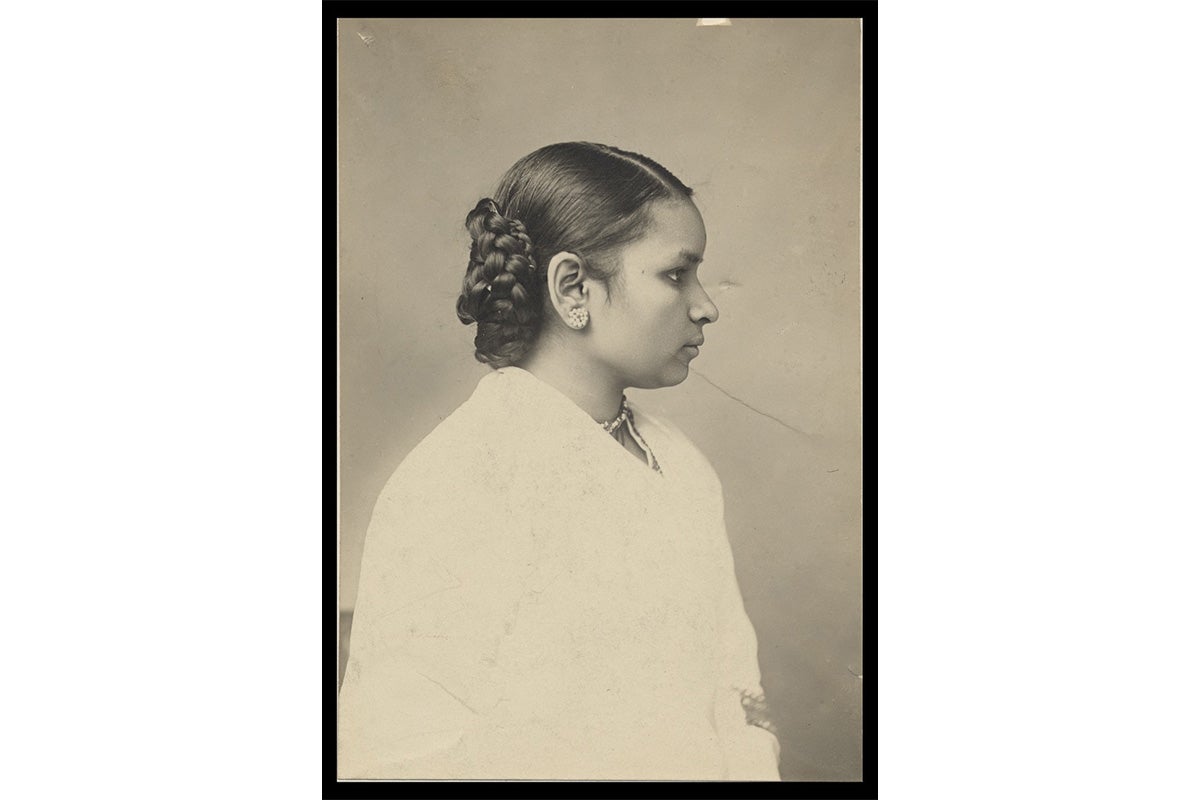 A class photo of Anandibai Joshee, who graduated in 1886 from the Women’s Medical College of Pennsylvania, becoming India’s first trained female physician. (Courtesy of the Drexel University Legacy Center Archives & Special Collections)
The life of Anandibai Joshee
Born in 1865 in Kalyan, India, to a wealthy, upper-caste family, Joshee entered into an arranged marriage at 9 years old to a widower 20 years older. At 14, she gave birth to a boy who died just 10 days later.
Joshee believed her son would have survived if she had access to proper medical care, and that more Indian women would have better medical care if women administered it. Barely a teenager, she decided to become a doctor.
“Her resilience and determination is such a consistent theme in her story,” Mallick said. “She set her mind on the way that she was going to live her life and she wasn’t willing to let anyone else stand in her way of that.”
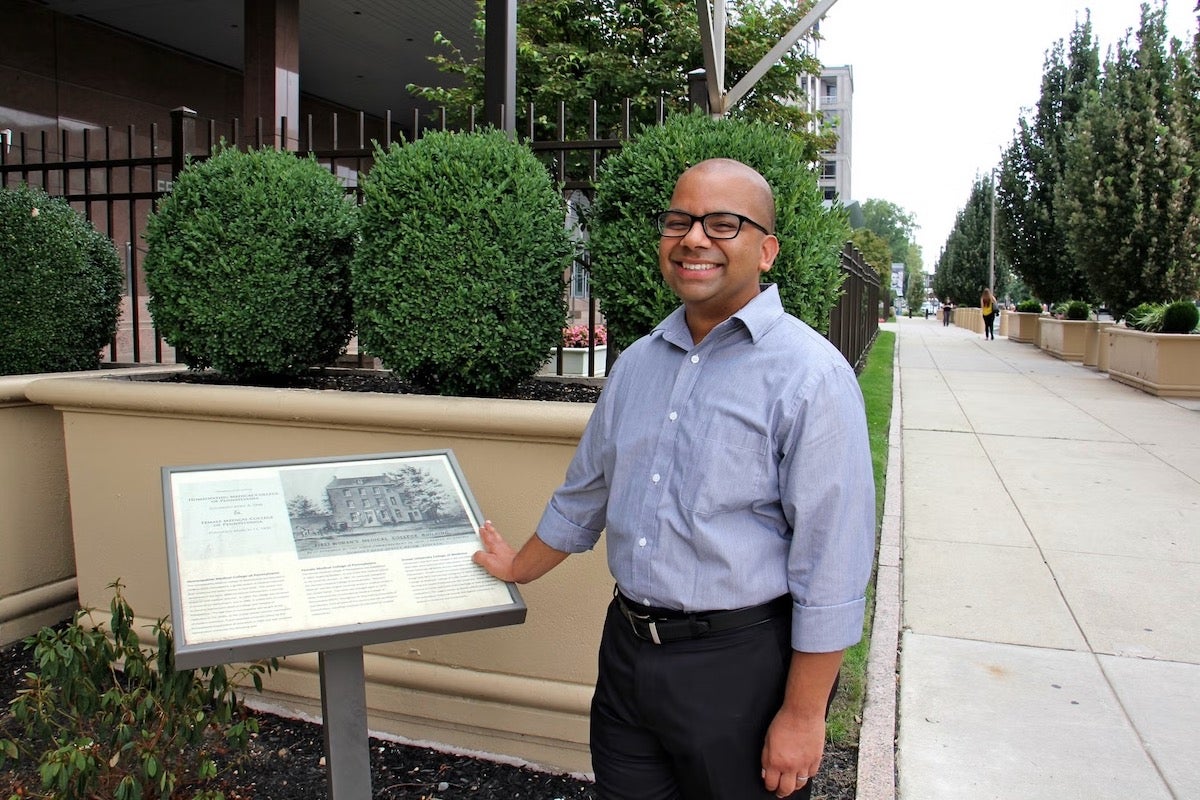 Samip Mallick, director and co-founder of the South Asian American Digital Archive, stands at 6th and Arch streets, the former site of the Female Medical College of Pennsylvania in this file photo from Aug. 21, 2019 . (Emma Lee/WHYY)
In 19th-century India, educating women was highly controversial. Joshee’s husband, a postal clerk, had progressive ideas and encouraged her education, but was thwarted by the Indian society, which largely opposed educating female doctors. He sought out a foreign Christian ministry to support his wife’s education. He found a willing sponsor in Theodocia Carpenter, of Roselle, New Jersey, who supported Joshee’s studies at the Women’s Medical College.
In 1883, Joshee explained in a letter to Alfred Jones, a member of the executive committee at the Women’s Medical College of Pennsylvania, her motivation to become a doctor:
“To render to my poor suffering country women the true medical aid they so sadly stand in need of, and which they would rather die for than accept at the hands of a male physician,” Joshee wrote. “The voice of humanity is with me and I must not fail.”
Even before her journey to America, Joshee had become a polarizing figure in India, attracting criticism for challenging the traditional role of women. Many Indians feared she would embrace American culture over her own and convert to Christianity while under the tutelage of a Christian ministry.
“She faced a lot of opposition when it was time for her to come to the United States, from her community, from extended family and from others,” Mallick said. “One of the things that’s so remarkable about her is that she determined that when she came to the United States that she would live in exactly the same way that she did in India. She would continue to wear her sari. She would continue to eat a vegetarian diet. As you can imagine in Philadelphia in the 1880s that wasn’t that easy to do.”