
It’s easy to say you support transit, as an elected official. You show up at the rally, you post about the service cuts, you vote for funding in the budget. Mayor Parker has done all of that her first two years in office.
But local elected officials control an even more powerful — and free — policy lever that decides SEPTA’s level of success: the land use rules that determine how many people can actually live near transit. That’s the issue the mayor’s latest round of H.O.M.E. initiative zoning bills tries to tackle.
Four such bills landed in City Council last week. They’re worth supporting — and also scrutinizing.
What’s in the bills?
The centerpiece of the package is a Transit-Oriented Communities bill — renamed from “Transit-Oriented Development” — which aims to allow more multifamily buildings to get built near transit. Philadelphia already has a TOC overlay on the books. Its core functions — increasing unit density by 50 percent, adding one story of height, and cutting parking requirements by half — are largely carried over into the new bill.
The current bill doesn’t change too much about the underlying rules, but it makes a number of positive changes, the most important of which is expanding the area where the law applies from 500 feet to a quarter-mile radius from selected SEPTA stations. This would impact only the 13 transit stations that already have these overlays, and so far, no new stations are proposed to be included. District Councilmembers would have to decide to add more; so far none have publicly volunteered for this.
The bill also proposes diversifying the zoning categories of buildings that can be constructed near transit spots to include, for example, mid-rise mixed-use buildings — up to three stories, including both residential and commercial uses. These are steps in the right direction, but are a far cry from what they’re doing in Chicago, Seattle, and Austin — the places that are actually building a lot of transit-oriented housing. That’s in part because Parker’s bill still maintains a minimum parking requirement and only allows for one additional story to be built in most cases, whereas many of our peer cities’ policies allow for true high-rises with several more bonus stories in transit zones.
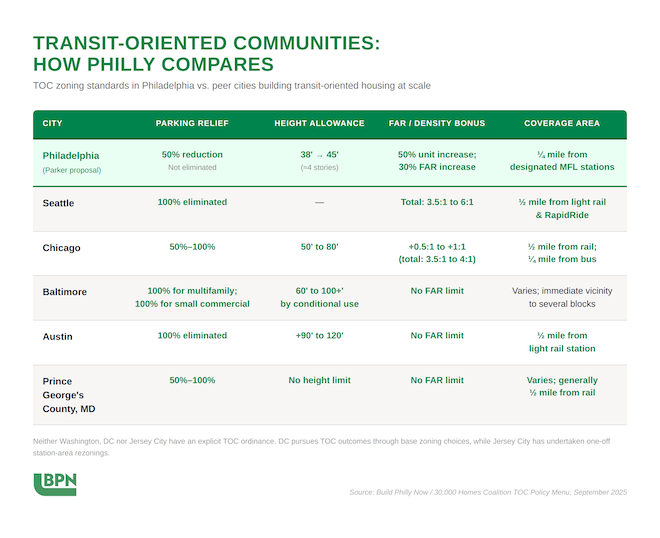
If everything passes as proposed, Philly’s TOC ordinance will still be a long way away from emerging national best practices, but the bill reflects the political considerations involved in passing a bill through this City Council. As it doesn’t appear that this is the final phase of the administration’s TOC work, it’s worth supporting as a medium step in the right direction, and to crack the door open wider to further action down the road.
A second related bill removes the ground-floor commercial or active use requirement for fully-residential buildings inside TOC zones — a technical fix to the current law.
The third bill would help save SEPTA from needing to go to the Zoning Board of Adjustment for more transit infrastructure,station maintenance or renovation projects. About a quarter of SEPTA properties — stations, end-of-line facilities, maintenance buildings — are zoned in a way that doesn’t allow transit uses by-right. According to data from SEPTA, about 83 percent of their facilities are located in commercial zoning districts, 12 percent in special purpose districts, and 5 percent in residential districts. If the Mayor’s proposal passes, legalizing transit uses in commercial districts, most of their zoning problems are solved. With funding tight, reasonable people can probably agree the marginal SEPTA dollar should go toward better service, not paying zoning lawyers.
The fourth bill, while not directly related to transit, would help support more neighborhood-scale mixed-use housing and more redevelopment of under-used commercial corridor properties — frequently co-located near transit. That bill would make several changes to CMX-1, the zoning category for small commercial buildings on corner lots, allowing somewhat more height and units, and increasing the redevelopment potential of these properties. The current CMX-1 category is full of worst-practices content, like a rule that makes the building’s allowed users contingent on the zoning of the lot next door. Zoning should say what you can do on your property; your neighbor’s lot shouldn’t factor into it.
According to sources, the administration is also working on a revamp of the Transit Improvements Density Bonus — a currently unused law that allows developers to access additional height and density if they pay for certain kinds of transit station-area capital projects.
This is in the same class of pay-for-density programs as the Mixed-Income Housing Bonus (MIHB). The MIHB awards density bonuses to projects that either supply below-market units or pay a fee into the Housing Trust Fund. Since 2019, the MIHB has produced 300 affordable housing units — 141 completed and 159 under construction — and generated $36.3 million in payments to the City.
There are limits, though, to how far the pay-for-density concept can go when applied to transit. Developers paid $36 million total to the City over six years; some SEPTA capital projects are $36 million in one shot. The per-project cost of public sector-managed construction projects is exorbitant and well-known. If the proposal allows developers to pay into a fund that eventually covers portions of capital projects, that could work. If the expectation is that home-builders will fund entire capital projects in exchange for one additional story, that seems like a bridge too far.
A few years ago, Councilmember Mike Driscoll introduced a beefed-up version of the Transit Improvements Density Bonus (Bill #240249) that would have significantly increased the density bonuses over what’s allowed under the current law, and fixed some of the other operational issues with it.
But even the Driscoll bill only allowed for eight story buildings on most lots — which lands right on top of the construction cost cliff where the economics don’t work. If the forthcoming Parker administration proposal is based on that legislation, it’s going to have the same problem.
Why does eight stories matter so much?
A 2022 study by economists Michael Eriksen and Anthony Orlando, published in Real Estate Economics, examined what it actually costs to build multifamily buildings of different heights in the 50 largest U.S. cities. They found construction costs don’t rise smoothly as buildings get taller. Instead, costs decrease with each additional story from 4 to 7, and then spike 32 percent between 7 and 8 stories.
The reason is that crossing the 8-story threshold triggers a cascade of expensive building code upgrades like faster elevators, more powerful fire pumps and standpipe systems, upgraded electrical and alarm infrastructure and, most expensively, structural steel H-pile foundations to support the additional weight. Together, these changes add roughly $40 per square foot to construction costs.
The result is what Eriksen and Orlando call a “donut” in the building height market: a dead zone where 8-10 story buildings are economically non-viable. They cost nearly as much per square foot as a 12-story tower, but produce far fewer units to cover those costs. In 24 of the 50 largest cities — including Philadelphia — unconstrained developers would build exactly seven stories in a typical location. The optimal heights are 3, 7, or 12+ stories, with nothing in between.
The study also provides Philadelphia-specific numbers. In Philly, the break-even rent — the minimum rent a developer needs to justify new construction — is actually lower for a seven-story building ($18.69/sq ft) than for a three-story building ($19.69/sq ft), because spreading land costs over more floors covers the incremental construction costs. But at 12 stories, the break-even rent jumps to $22.85/sq ft. For Type I high-rise construction to pencil out, the building needs enough additional rentable floor area to absorb those costs — and that means going well above eight stories.
This is the fundamental problem with both Parker’s bill and the Driscoll transit improvements bonus. Floor-area ratio (FAR) is a measure of how much total floor space a building can contain relative to the size of its lot. Architect Ryan Lohbauer created massing drawings for Build Philly Now showing how much extra buildable space the TOC 30 percent bonus and the Driscoll density bonus are actually worth for a mixed-use mid-rise building. The result is not encouraging.
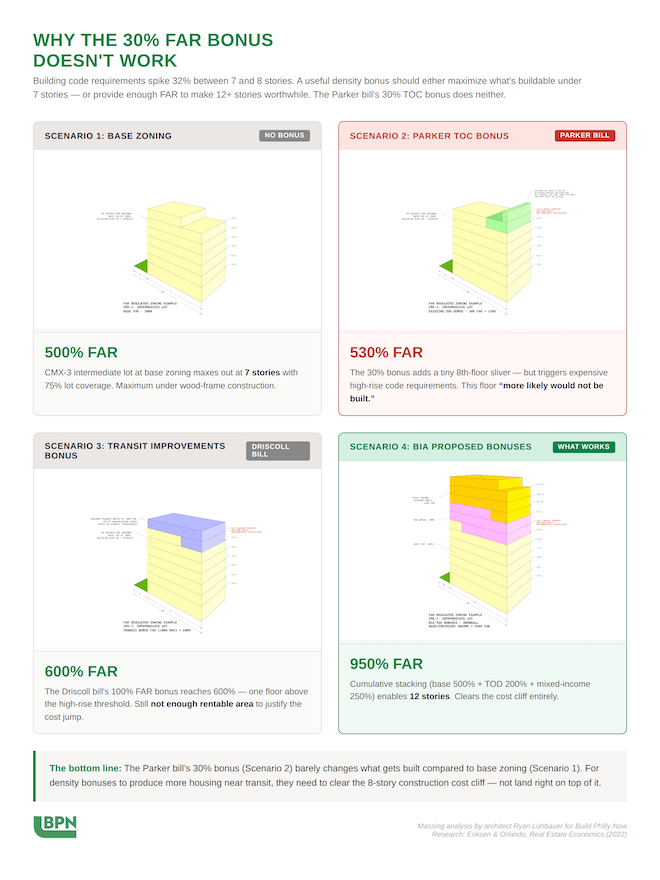
Both bonuses push a project to about 8 stories — the exact threshold where all those expensive code requirements kick in. The 30% TOC bonus produces a tiny 8th-floor sliver that, as Lohbauer’s drawings show, would most likely never be built. A developer would just stop at 7 and leave the bonus on the table.
For a density bonus to actually produce more housing, it needs to do one of two things: either maximize what’s achievable under 7 stories (wood-frame construction), or provide enough additional FAR and height to make the jump to 12+ stories worthwhile. Neither the current law, the proposed TOC bill, nor the Driscoll transit improvements bonus succeed on that score.
As I wrote last year in The Citizen, the City’s approach to planning for mid-rise housing needs a major reframe. The Parker administration’s 45-foot height increase for mixed-use zones — about 4 stories — also bumps up against the first cost cliff that Eriksen and Orlando identified, where costs jump 8 percent between 3 and 4 stories due to the shift from wood-frame to steel-frame construction. These are smaller buildings on smaller lots, so the stakes per project are lower, but it’s the same dynamic: a bonus that pushes a building right into the most expensive part of the cost curve, rather than past it.
Transit as a service is popular, as we learned during the budget fight last year. But the policies that transit needs in place to be excellent are often unpopular: sufficient revenue (taxes and fares), dedicated street space (parking), land use that supports ridership (denser buildings, less parking).
Asking the PA Senate Republicans, mostly from rural areas of the Commonwealth, to vote to raise taxes for transit was a tough ask. Asking District Council members to loosen their grip on certain kinds of zoning cases so more people can live near the train is also a tough ask of a different variety.
But the local zoning changes cost zero public dollars, and would have important benefits for commercial corridors and neighborhood economies even putting to the side the impact on transit. Ultimately, every single person with some responsibility for a piece of this issue has to do the hard thing in front of them for SEPTA to continue to serve all the people who need it today, and the growing number of people who will ride if we make it really great.

MORE ON THE FUTURE OF HOUSING IN PHILADELPHIA