
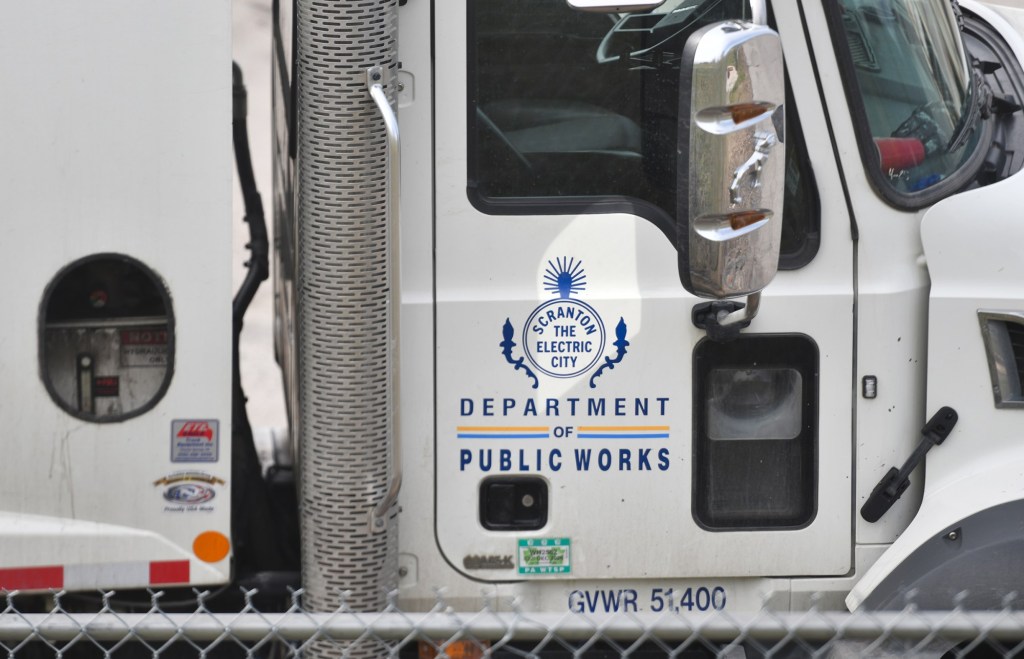
Scranton and the union representing city Department of Public Works employees reached agreement on a new contract that includes raises, increases in employee health care cost sharing and other terms union members recently approved.
The new five-year pact, which is retroactive to 2025 and runs through 2029, comes after the prior union contract between the city and Local Lodge 2305 of the International Association of Machinists and Aerospace Workers expired at the end of 2024. Mayor Paige Gebhardt Cognetti’s administration announced the new contract in a press release.
City council suspended normal rules Tuesday to introduce, advance and adopt separate ordinances authorizing the new agreement and amending Scranton’s 2025 budget to transfer funds for retroactive $2,500 lump-sum payments union members will receive for that contract year.
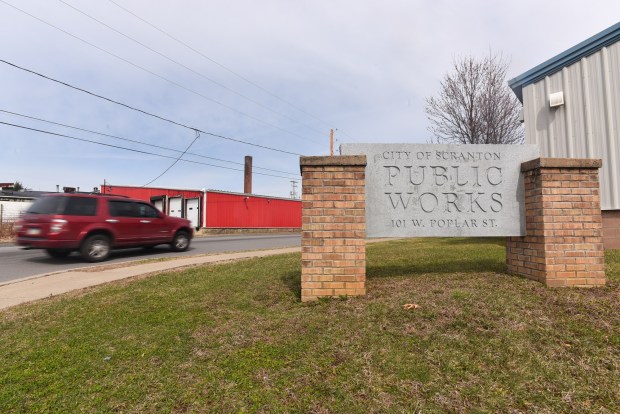 A vehicle passes by the Department of Public Works on W. Poplar St. in Scranton Wednesday, March 25, 2026. (SEAN MCKEAG / STAFF PHOTOGRAPHER)
Effective July 1, wages will increase by $2 per hour for “auto repair, equipment vehicle maintenance, mechanic, and heavy equipment operator positions” and by $1.50 per hour for all other bargaining unit positions, per the contract. Wages will then increase by 3% across-the-board effective July 1, 2027, by another 3% effective July 1, 2028, and by $1 per hour for all union employees effective July 1, 2029.
Provisions of the contract that increase employees’ shares of their health care costs over the term of the agreement apply to health care premium contributions paid via payroll deductions, copays for doctor and specialist visits and copays for prescription drugs.
In terms of residency, the contract includes language requiring DPW union members to live within 25 air miles of City Hall, consistent with contracts for other unions. The city repealed in 2024 stricter residency rules that for decades had required employees to live within Scranton’s boundaries.
The DPW contract also contains enhanced disciplinary measures for abuse of sick time and a new section pertaining to 12-hour flex shifts the city can implement at its discretion in response to snow emergencies, flooding and similar events. Employees assigned to such a shift will be paid straight time for the first eight hours worked and overtime for time worked thereafter, plus an additional $0.75 per hour for “all hours they worked hereunder during the designated flex period.”
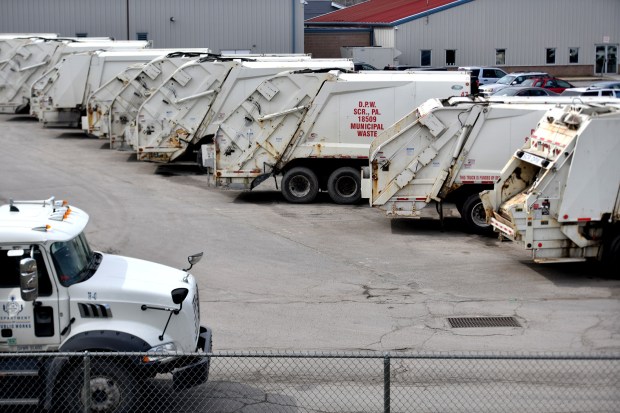 Garbage trucks are parked in the Scranton Department of Public Works lot on W. Poplar St. in Scranton Wednesday, March 25, 2026. (SEAN MCKEAG / STAFF PHOTOGRAPHER)
Under the new agreement, Scranton will have “greater flexibility to deploy DPW staff to ensure the City’s needs are being met, particularly during weather-related emergencies,” the city press release notes.
Cognetti administration officials previously said the response to a significant late-January winter storm was hampered by staffing shortages from high numbers of DPW callouts.
The administration noted in a after-action report to council last month that the storm of Sunday, Jan. 25, into Monday, Jan. 26, dumped about 9.7 inches of snow on the city. Forty DPW workers called off that Monday, the highest number in a single day over the past six years, followed by 34 callouts on Tuesday, Jan. 27, which was the fourth highest number since 2020, per the report.
Larry Wynne, president of the DPW union, told the newspaper last month that no workers intentionally called off because of the storm and that the callouts were not orchestrated.
Wynne did not immediately respond to a request for comment on the new union contract.
In the city press release, Cognetti said all city employees “deserve fair pay, excellent healthcare, retirement savings, safe working conditions, and opportunity paths to make a career out of public service.”
“This agreement is a fair deal that gets our DPW team the wages and benefits they deserve, while strengthening the City administration’s ability to ensure that our residents receive excellent daily services and immediate emergency response,” she said. “We dedicated long hours to making sure we got this right – for our residents and for our public servants.”
“We appreciate their willingness to come to the table not only for their own interests, but also to hear our concerns, and work with us to ensure that our residents’ needs are met,” the mayor’s statement continues. “This contract addresses a number of longstanding workforce issues – one in particular that has been long been an issue: From now on, when bad weather hits, we will be able to deploy our DPW crew to ensure round-the-clock coverage so our residents needs are met without driving up costs for our taxpayers.”