
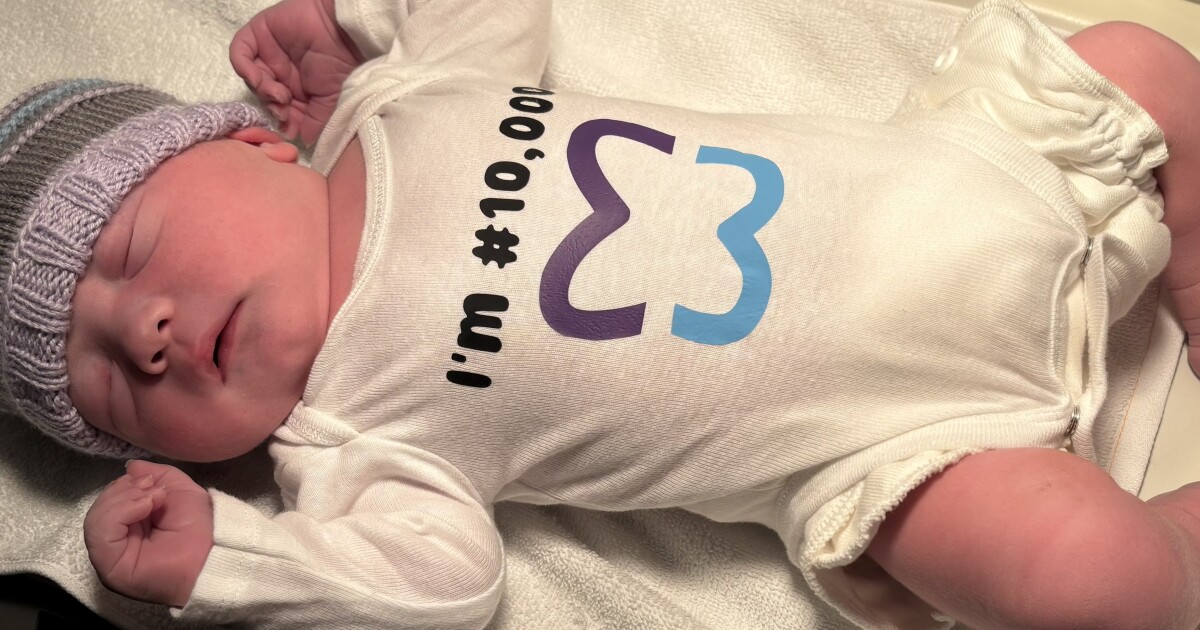
The rhythmic cry of a newborn is a common sound in the halls of The Midwife Center in Pittsburgh’s Strip District. Three hundred babies are born there each year and employees say the space has “the-veil-is-thin energy.”
One of the babies crying in Western Pennsylvania’s only free standing birth center on March 19 represented a special milestone: He is the 10,000th child born at the center since its inception in 1982.
Harvey Allen Lantz was born that evening at 6:20, weighing 9 lbs 4 oz. Caitlin Lantz, Harvey’s mother, arrived with family around 11:30 p.m. the night before. Her healthy baby boy was born in one of the center’s birthing tubs after 18 hours of labor and another hour of pushing. Caitlin said the experience went according to plan.
“ We were hoping for a water birth and that’s what we got,” she said.
Caitlin’s is among the latest birthing stories in The Midwife Center’s (TMC) 43-year history. Clinical director Emily McGahey, who has been with the center for 14 years, said people who have been born there are now returning to have babies of their own.
“I’ve been with families through such joyous moments and really hard moments,” McGahey said.
When recalling the moments that matter most in her time with TMC she said “it’s often the quiet moments.”
“Like you connect in the office and you realize somebody needed something that they struggled to say and you can help provide it. Or it’s those moments where a baby comes after someone works so hard and you get to witness the power of a human being… it’s truly an honor.”
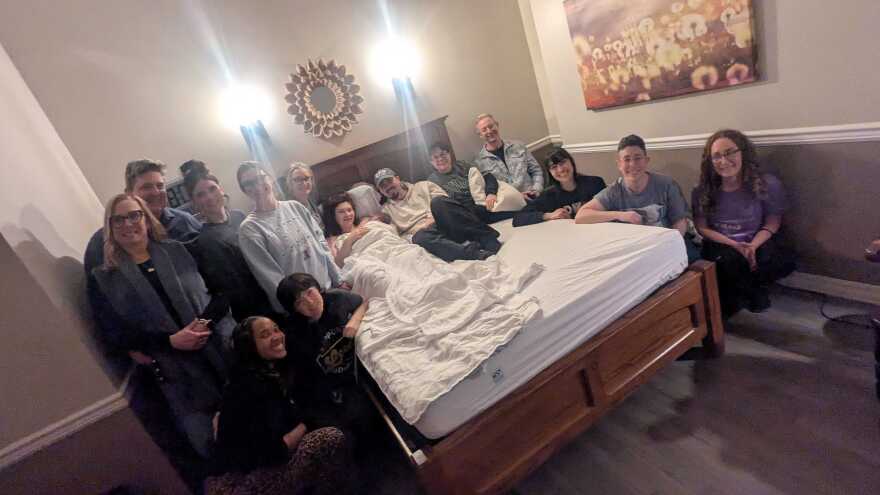
The Lantz extended family surround Harvey Allen and his parents Catlin and Eric Lantz just after he was born at The Midwife Center in Pittsburgh.
A client-centric model of care
The midwifery model of care tends to prioritize building relationships and promoting trust, communication, and one-on-one care with an aim of empowering patients and promoting autonomy.
Though their training is not as extensive as an obstetrics physician, midwives are licensed professionals, often nurses.
McGahey explained modern midwifery looks like advanced practice health care providers versed in everything from pharmacology to mental health support; they provide gynecological exams from the onset of puberty through postmenopause, offering contraception and treating everything from sexually transmitted diseases to mood disorders.
The holistic approach offers low-intervention care for pregnancies with lower risk of complications.
Beyond clinical monitoring, midwives trace how a pregnancy is affected by social and environmental determinants of health, according to McGahey.
“We’re not gonna only focus on your blood pressure and the baby’s heart rate. We’re gonna make sure your family feels safe in their home — you have enough food to eat, your educational resources are there, you’re supported in your job environment to be able to take breaks, get the time off after the baby’s born, have safe pumping — we do lactation support,” she said.
National and international evidence indicates births attended by midwives have fewer interventions, cesarean deliveries, preterm births, inductions of labor, and more vaginal births after cesarean delivery.
Joan Combellick, a certified nurse midwife and assistant professor at Yale School of Nursing, said the approach likely contributes to higher rates of positive birthing outcomes associated with midwifery.
“ I would say midwives try to bring an approach that keeps the patient at the center as an active part of shared decision making in clinical decisions and decisions about their care and their priorities and their social and cultural priorities as well,” she said.
Combellick’s research has contributed to growing bodies of science that point to many benefits associated with systems that support midwifery.
“ Many countries where maternal mortality statistics are so much better than [the U.S.], there are more midwives, and physicians are used as their high-risk consultants.”
But because it’s more time-intensive, midwifery tends to fall outside economic constraints of medical systems in the U.S.
“ We do not have a health healthcare system that is really structured to support the kind of care that we’re trained to give,” Combellick said.
In Pittsburgh, TMC — a member of the American College of Nurse Midwives — maintains close working relationships with local hospitals. Designed to exclusively accommodate healthy, low risk pregnancies, TMC provides “an environment that helps them stay healthy and low risk,” according to McGahey.
TMC said its preterm birth rate — when a baby is born too early — is more than four times less than the state average: 2.22% compared to 9.8%. The nationwide preterm birth rate is 10.4%, according to a recent March of Dimes report. McGahey said the impact of lower preterm birth rates goes beyond healthier babies.
“Not only do we have all of these great outcomes, but we also see a decreased cost to the system,” McGahey explained. “We’re helping the whole system thrive better.”
TMC offers a walk-in program every Friday afternoon for gynecological care. Licensed by the Pennsylvania’s Department of Health and accredited by the Commission for the Accreditation of Birth Centers, the center accepts most public and private insurance plans.