
On April 5, 1986, Jeanne Clery was raped and killed in her Lower Centennial dorm room on Lehigh’s campus.
Her death sparked policy changes regarding campus safety protocols, including enactment of the Jeanne Clery Campus Safety Act — a right to know which law requires colleges and universities to publicly report campus crime data and safety procedures.
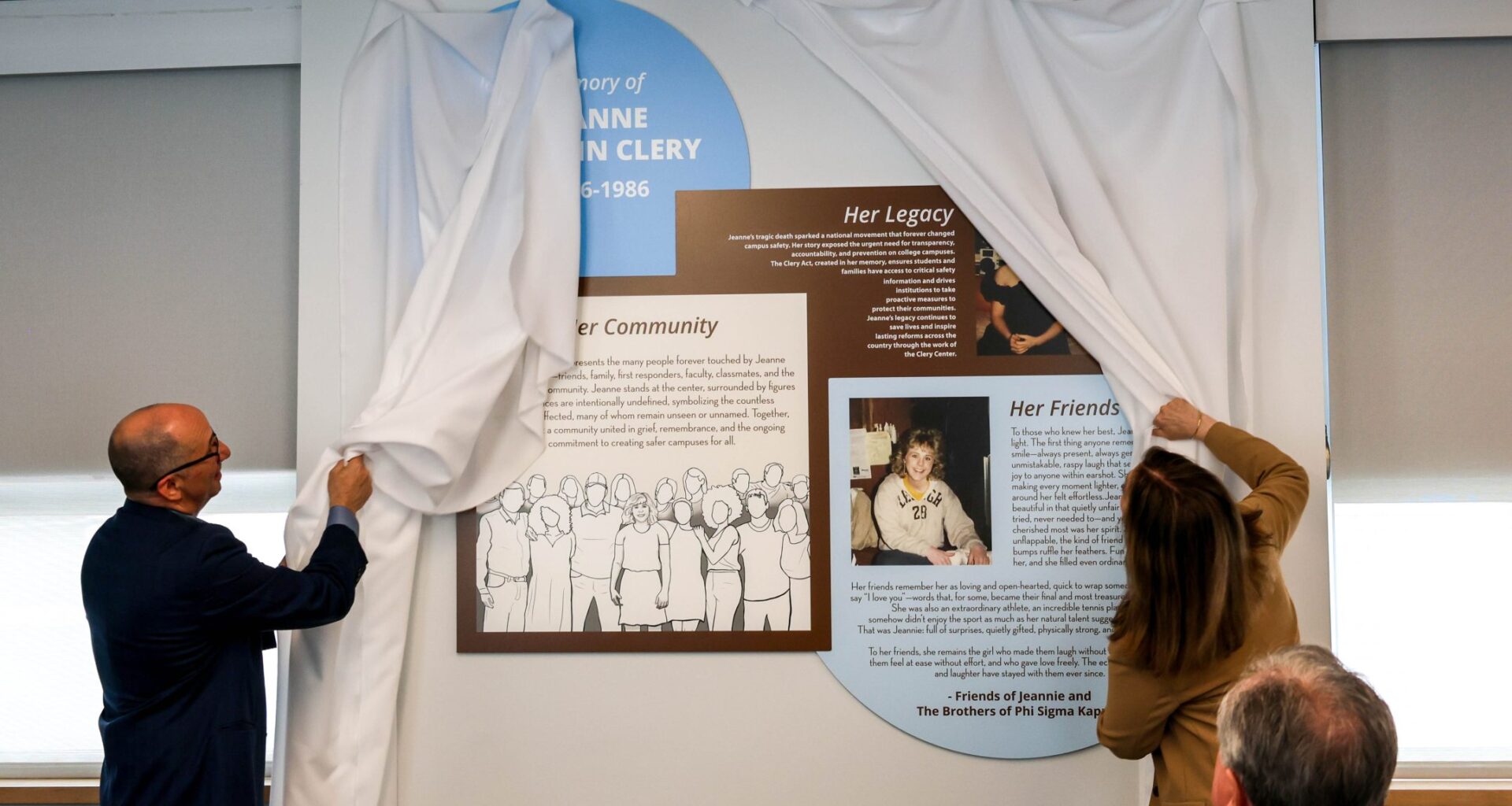
On Tuesday, nearly 40 years after Clery’s death, people gathered at the Lehigh University Police Department to unveil a memorial in honor of her and the legacy in her name to uphold campus safety.
Members of the Clery Center, a nonprofit dedicated to helping universities meet the Clery Act’s standards, along with LUPD officers, administrators and Clery’s friends and classmates sat in remembrance to listen to speakers and witness the memorial’s reveal.
In his opening remarks, LUPD Chief Jason Schiffer said Clery is the cornerstone of campus safety officers’ jobs. This includes integrating her story in the department’s training, as well as the training of officers across Lehigh including Gryphons, orientation leaders and tour guides.
He said when students hear stories about Clery they learn about her spirit and energy, like how she was a competitive tennis player who used to tell the people she challenged they’d have to take their contact lenses out to have a chance of winning.
“This memorial illustrates a circle of people united in remembrance, and we are proud to be part of that circle now,” Schiffer said. “So Jeanne, the laughter still echoes, and the stories we tell in your spirit continue to lead our way.”
 A memorial was unveiled at LUPD on Tuesday, in honor of Jeanne Clery, who was a Lehigh student killed in her dorm room in 1986. People gathered to honor Clery 40 years later. (Natalie Javitt/B&W Staff)
Bob Alig, the center’s executive director, said the organization’s work is grounded in the belief that every student deserves a transparent and supportive campus community.
He said while no law, policy, or program can erase Clery’s death, education, awareness, accountability and partnership are what the center aims to achieve and significantly matter.
Amid the speakers and unveiling of the memorial, Alig said his favorite aspect of the ceremony was the diversity of people who gathered to celebrate Clery’s memory and the advocacy that keeps it alive.
Sarah Bean Apmann, ‘89, Clery’s roommate, said at her core, Clery was an outstanding person with a beautiful laugh. She said it’s a testament to her character that 40 years later people who knew her still gather to honor her.
Apmann recalled a time they were sitting and joking in their dorm room.
“I said as a joke, half-heartedly, ‘What do you want to be when you grow up?’ She said, ‘Happy.’ That was Jeanne. That’s what I miss.”
Andrew Cagnetta, ‘87, the center’s chairman and a friend of Clery, said the answer to that question is why Clery’s death still matters 40 years later — she wanted to be happy and didn’t have that chance, while everyone else got to move on in life.
One of the people still affected by Clery is Ed Shupp, a member of LUPD at the time of her death who worked with the department for 39 years.
Although unable to attend, Shupp shared a few words with Cagnetta to read. He wrote that not a day goes by where he doesn’t carry Clery and her family in his thoughts and prayers.
“Those days following Clery’s brutal murder are still crystal clear in my mind,” Shupp wrote. “It was the most difficult and heart wrenching tragedy of my professional career as a police officer.”
While it may never be known the number of lives the Clery Act has saved over the years, Shupp wrote he’s certain the number is significant.
He wrote that he continually applauds Clery’s family and the center for the work they do in advocacy for campus safety.
Cagnetta said Shupp’s writing is proof that many people carry the weight of Clery’s death, both outwardly and quietly.
 Sarah Bean Apmann, ’89, speaks during an event honoring her roomate Jeanne Clery. Apmann said it’s a testament to Clery’s character that 40 years later people still gather to honor her. (Natalie Javitt/B&W Staff)
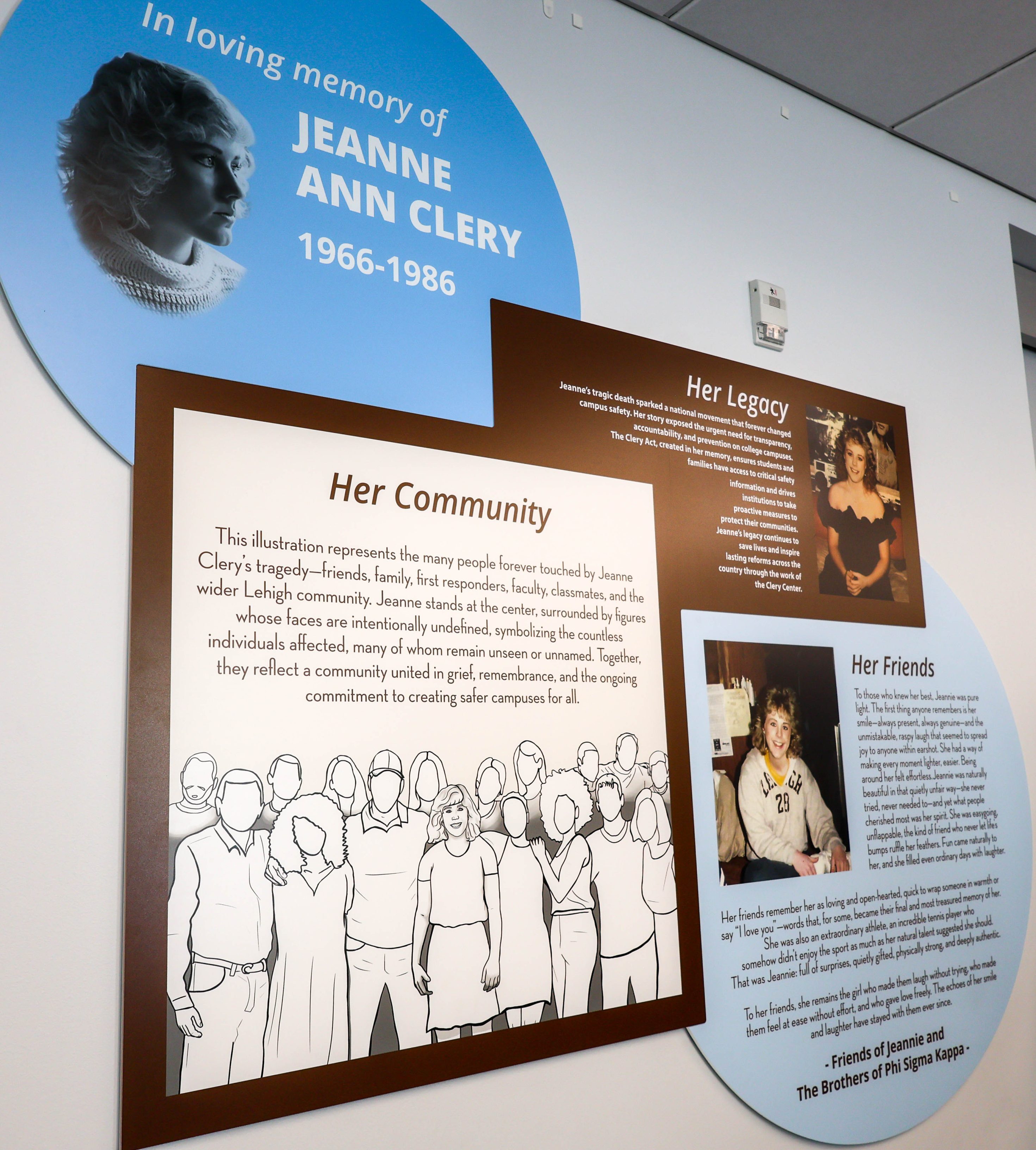
Together, Cagnetta and Appmann revealed the memorial, showing photos of Clery and notes about her legacy, community and friends.
A picture illustrated by Cagnetta’s daughter depicted Clery surrounded by faceless people. Cagnetta said the image illustrated the number of people affected no matter how they identify whether it was students, family members, administrators or officers.
He said his favorite photo of Clery is the one of her smiling in her Lehigh sweatshirt — showing who she was as an athlete and how approachable and kind she was as a person.
While he serves as the center’s chairman, Cagnetta said he was in attendance not officially, but as Clery’s friend.
“(The memorial) isn’t about making a statement,” he said. “It’s something we felt we needed to do to show everybody who (Clery) was.”