
Sign up for Chalkbeat Philadelphia’s free newsletter to keep up with the city’s public school system.
A second member of Philadelphia’s City Council wants to introduce zoning changes that could influence the school district’s school closure plans and what would happen after closures.
Councilmember Jeffery Young Jr., whose district includes parts of North Philadelphia where the school district wants to close three schools, told Chalkbeat he is looking into proposing legislation that would limit how their respective properties could be redeveloped.
The proposal “would be very similar” to a bill that Councilmember Jamie Gauthier introduced last week to restrict the zoning for four West Philadelphia schools, Young said. That bill would rezone the school parcels to civic, educational, or medical use, which would mean any developer looking to build commercial or residential property would have to go through the lengthy process of getting a zoning variance.
“Rezoning the parcels gives the community more say in what will happen,” Young said. He added that he has not finalized his plan yet because he is in discussions with other members of the City Council whose districts send students to schools in his.
In theory, Young’s proposal could complicate the district’s plan to close certain schools, because it could be harder for the district to sell or offload those buildings if the schools do close.
The City Council has no direct say over which schools close — that decision is ultimately up to the Board of Education. But they do largely get to determine changes to how land can be used in their districts, following a Philadelphia government tradition.
We’re here to help.
Every day, Chalkbeat Philadelphia reporters are answering your questions, following the money, and digging into what’s happening in the city’s public schools. Keep up with our free newsletter, delivered every Wednesday and Friday morning.
Gauthier’s zoning proposal has not yet passed, but is likely to. The legislation is under review by the Committee on Rules.
District leaders have said the list of schools to close is based on data about building quality, enrollment, and the programs they can offer. Many of the buildings slated for closure are over a century old and require costly repairs. District enrollment has also shrunk over the past decade, leaving many schools with more than 100 empty seats.
But some school communities worry they’re being targeted for closure because their buildings sit on valuable land. Young and Gauthier say rezoning school buildings would ensure the district isn’t motivated to close schools based on their resale value, and that neighborhoods have a say over what happens to the land if their schools close.
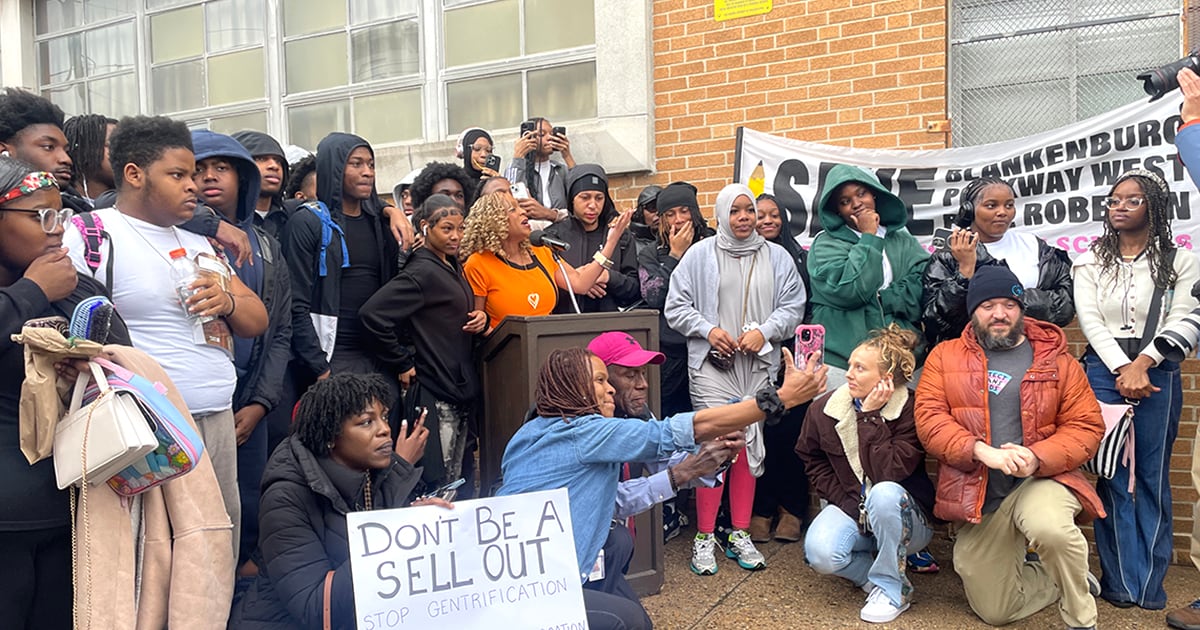
“Look around you, several new buildings are going up as we speak,” Gauthier said Monday at a rally outside of Paul Robeson High School in West Philadelphia, one of four schools that would be closed or repurposed in her district. “What does it say that we’re making space for all of these uses, but the district won’t even try to find something for our kids?”
But urban planning advocates say restricting zoning doesn’t guarantee benefits for the neighborhood. Instead, it could cause greater strain on the cash-strapped school district by limiting who would want to buy old school buildings, they say.
“Trying to take real estate out of the equation by trying to limit the upside that somebody might pay to do a residential conversion of a school is really just hurting the school district,” said Jon Geeting, policy and advocacy director for Build Philly Now, a local economic development think tank. “I just don’t really think we’re helping anything by making it harder to redevelop.”
City Council wants more say on school closures
In addition to Robeson, the schools in Gauthier’s district that the district plans to close or relocate are Blankenburg Elementary, Martha Washington School, and Parkway West High School. Her bills would designate all of them as “Special Purpose” zoning, along with Motivation High School, which the district removed from the closure list last month.
That designation would zone the land for uses like schools and libraries. To build something else, developers would have to receive a zoning adjustment. Receiving that adjustment can be a political and time consuming process, with no guarantees.
Geeting and some other advocates say they worry zoning restrictions could lead to vacant school buildings sitting empty — a problem the district is already dealing with from the last round of school closures. It has around 20 school properties that have been vacant for years. Last year, a woman’s body was found behind one of them.
Gauthier “supports finding productive use for vacant school buildings,” Harrison Feinman, Gauthier’s director of communications, said in a statement. “But it is inappropriate to plan the redevelopment of schools while students are still in them.”
Superintendent Tony Watlington has said this round of proposed closures would not lead to any vacant buildings. Of the 18 schools slated for closure, the district plans to repurpose 10 for district use. The district wants to convey the other eight to the city or sell them.
Mayor Cherelle Parker has said she supports the plan, and has indicated she wants to turn some closed schools into housing. But none of that is a done deal. The Board of Education still needs to approve Watlington’s plan.
In the meantime, Young said he’s been looking into introducing a rezoning proposal to ensure his constituents’ perspectives are considered in school decisions, but he did not release further details. The district plans to repurpose two schools slated for closure in his district, Robert Morris and Laura W. Waring. But it wants to convey James R. Ludlow School to the city for redevelopment.
Young said his district has plenty of other vacant land that could be redeveloped for housing.
Young has flexed his power with respect to the school district in other ways. On Tuesday, he held his own town hall about some proposed closures in his district, which district officials attended. And earlier this year, he introduced legislation that would enable the City Council to remove members of the school board. Currently, only the mayor has power to do so.
His aim, he said, is to ensure school decisions serve the local communities he represents.
“The people in those communities directly hold me as their council member accountable for the local issues,” Young said. “Education is a local issue. I’m the only person that they can directly take their frustration out on.”
Rebecca Redelmeier is a reporter at Chalkbeat Philadelphia. She writes about public schools, early childhood education, and issues that affect students, families, and educators across Philadelphia. Contact Rebecca at rredelmeier@chalkbeat.org.