
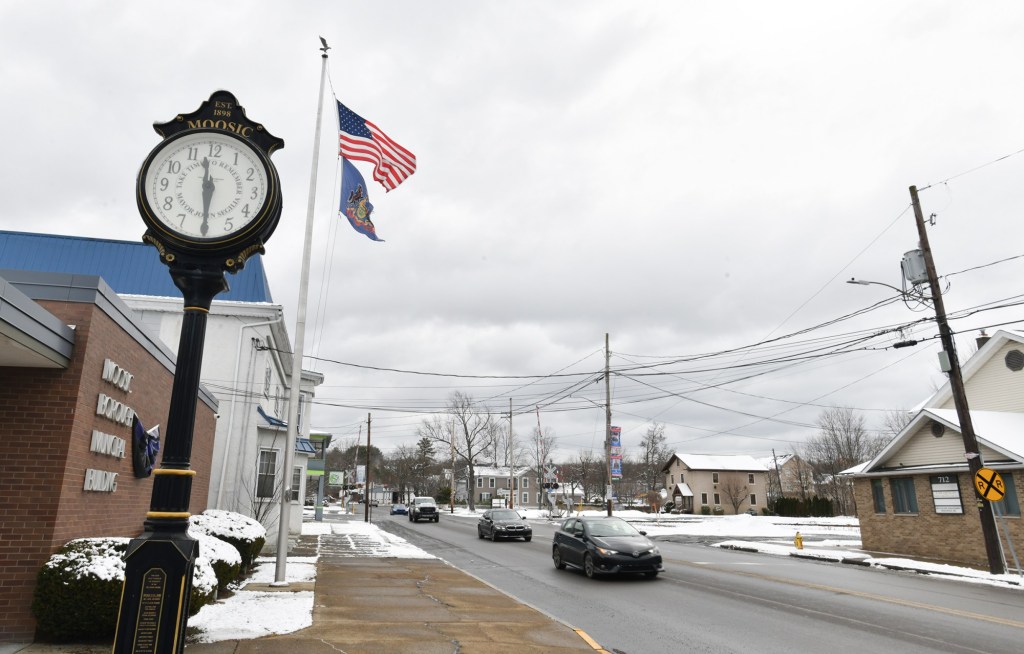
Moosic is making progress on regulations for data centers.
The borough’s planning commission reviewed a proposed data center ordinance Wednesday, receiving feedback from a crowd of residents and, for the first time, the data center industry, Mayor Bob Bennie said.
“We’re fortunate from the the standpoint of being able to have this be a multi-step process so that when we get to the finished product, as far as the finished ordinance that then would be presented to the public, we make sure that we’ve overturned every stone and we’ve looked at any possibilities,” Bennie said in a phone interview Thursday. “We want to make sure we’re protecting the borough.”
Moosic has not received any applications or requests from data centers, and under a pending ordinance doctrine, if the borough receives any applications for data center campuses, they will be bound by the upcoming standards that council will adopt, Bennie said.
Seeing increasing data center proposals locally, Moosic Borough Council voted in September to begin the process of amending its zoning to regulate the industry.
Municipalities in Pennsylvania are required to allow for every type of lawful land use somewhere within their borders, including data centers, and failing to do so exposes them to legal challenges for exclusionary zoning.
So far, Lackawanna County has at least 12 data center proposals, including six in Archbald, two in Jessup, and other campuses proposed in Clifton and Covington townships, Dickson City, Ransom Twp. and Olyphant. Many of those proposals are tied up in either zoning or court. A data center developer also proposed to build a power plant in Archbald.
Throughout the meeting, the public’s concerns included water and energy consumption, noise pollution and air pollution, Bennie said.
Although Bennie was unsure of their names, he said the borough had its first encounter with the data center industry during the meeting. Engineers from a data center developer gave input regarding exclusionary zoning, Bennie said.
“If you’re too restrictive and it’s specific to a data center versus a general manufacturing application, you could end up in court,” he said. “You don’t want to be so restrictive that it’s like you’re singling out a data center and excluding them from being able to do business in your borough.”
At the same time, the borough is focused on protecting its residents and itself, Bennie said.
Moosic intends to make data centers special exceptions in its manufacturing zoning district, he said.
Lackawanna County communities adopting data center zoning ordinances have either designated them as special exceptions or conditional uses, with the latter being more common.
Both designations are comparable in that they allow a local government to establish standards tailored to data centers that developers are required to adhere to, but they differ in the governing body that actually approves the projects.
Conditional uses go before the elected officials, whether that’s a council or board of supervisors, while special exceptions are considered by zoning hearing boards.
While Bennie favored conditional uses, he said the benefit of special exceptions is that they allow Moosic’s elected officials to comment. They would not be allowed to do so with conditional uses, Bennie said.
“Having a special exception gives us the ability to speak to the public at a zoning meeting,” he said.
Data centers would be required to have a 30-acre minimum site, which only leaves three potential locations for the developments in Moosic, with one of those sites already slated for warehouses, Bennie said.
The sites are: Moosic’s northern tier near the Scranton border by Davis Street, the site of the former DuPont or Goex gunpowder plant on Moosic’s southern border near the Wilkes-Barre/Scranton International Airport and Moosic’s western boundary between the turnpike and its borders with Old Forge and Taylor.
The northernmost location, the former McKinney Products Company, will be a warehouse with up to 72 docks known as the “Davis Street Warehouse,” Bennie said, adding that representatives for the warehouse attended the planning meeting.
Data centers will be limited to 45 feet tall, with proposed criteria involving aesthetics, noise and electricity consumption, among others, according to Bennie.
The borough is still refining the legislation, he said. For example, a Moosic resident who’s an engineer with experience building data centers pointed out that Moosic only proposed to regulate decibels on the dBA scale and not dBC, which monitors lower frequencies associated with data centers, Bennie said. Some towns, including Blakely, added dBC standards in their data center zoning.
Residents also referenced proposed Archbald data centers, Bennie said, whose developers have recently discussed having hundreds of backup diesel generators per campus and over 1 million gallons of diesel fuel stored on site.
The mayor floated the idea of developers using natural gas generators with a pipeline rather than storing large volumes of diesel fuel.
The Lackawanna County Regional Planning Commission will review Moosic’s proposed ordinance during its April 9 meeting, and if all goes to plan, the borough could hold a public hearing to consider it in May or June, he said.