
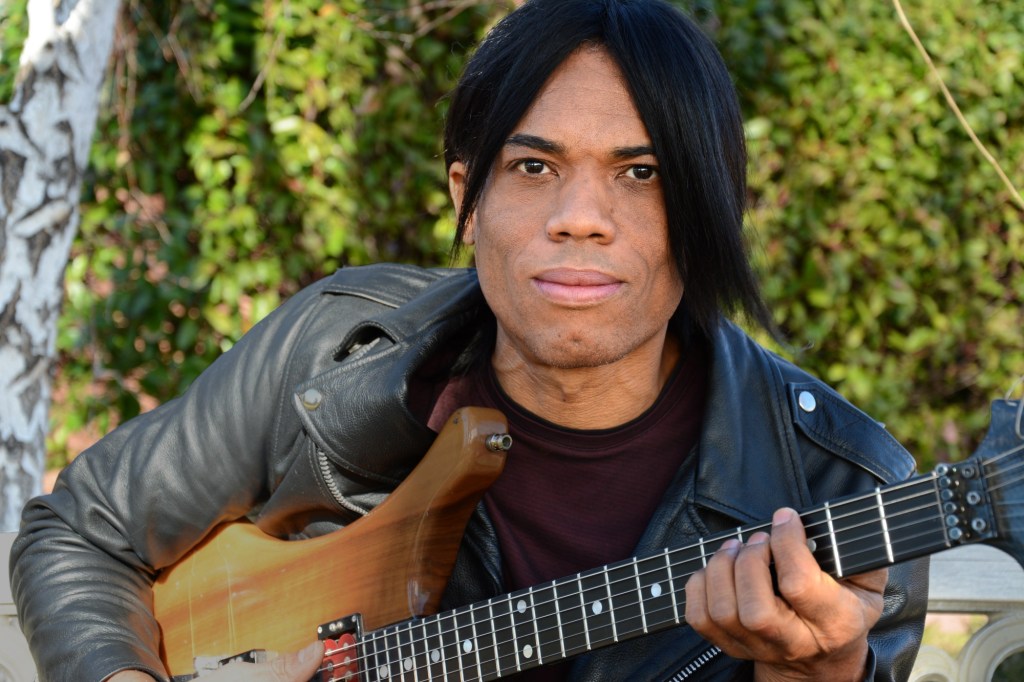
Guitarist Stanley Jordan, renowned for his innovative techniques and wide-ranging musical explorations, will perform music of the Grateful Dead with his quartet Saturday at 2 p.m. at the DoubleTree by Hilton Reading as part of Boscov’s Berks Jazz Fest.
Ever since his groundbreaking album, “Magic Touch,” came out in 1985, Jordan has been a force in various genres of music, including jazz, rock, country and ultra-modern improvisation.
While his innovative “touch technique,” in which he has expanded the use of tapping on the fretboard with both hands, like hammers on piano strings, has been his signature, he is not about technique alone. His wide-ranging curiosity and highly expressive playing have made him one of the most acclaimed guitarists of his generation.
He has performed in more than 60 countries and at major festivals and collaborated with artists as diverse as Richie Cole, Stanley Clarke, Kenny Rogers, Les Paul, Dave Matthews, Sharon Isbin and the late Phil Lesh, bassist for The Grateful Dead.
Hence, the “Stanley Plays the Dead” concert. Growing up in San Francisco’s Bay Area, Jordan was always aware of Grateful Dead music and later attended a few of their concerts.
But when he began performing regularly with Phil Lesh and Friends, he learned to appreciate the music even more; he has called it “an important part of the Great American Songbook.”
He and his quartet — guitarist/vocalist Jesse Hiatt, bassist Greg Koerner and drummer Kenwood Dennard — recently performed “one of our best shows,” Jordan said in a recent interview.
“We had a chance to do some really intensive rehearsing this time around and had a wonderful show,” he said. “We’ve been learning new music — they had a big songbook — and tightening up what we had, and we’ll be riding on that for a while.”
He said that when he worked with Lesh, who passed away in 2024, “he had 200 lead sheets and multiple versions of the songs. There’s a lot of subtleties that aren’t written down, that audiences expect. They decided early on to have a big songbook, because they were having happenings and be-ins, where people would follow them, and they didn’t want to bore them. You never knew what they’d be playing.”
Jordan explained that some tribute bands stay meticulously true to the original performances; others use entirely different interpretations of the music.
“We’re in-between,” he said. “We don’t change the music in a drastic way, but we take a lot of liberties, and there’s room to bring that in; but we try to stay true to the music.”
(He also performs a Jimi Hendrix tribute in which he approaches Hendrix as an actor would but plays “as if he were doing it today,” he said.)
When asked about his unique approach to guitar technique, Jordan, whose first instrument was piano, said, “Classical piano definitely influenced the way I play the guitar … I’m glad I’ve been able to take a lot of the textural and orchestral possibilities of the piano and bring them to the guitar.”
To hammer the strings with his fingers and produce the sound he wanted, he needed to work with luthiers to bring the strings closer to the fretboard, using “some really accurate fretwork.”
Guitarists will be interested to note that Jordan plays a 35-year-old Vigier “Arpege” guitar, which is a collectors’ item since the French owner, Patrice Vigier, retired last year. When he plays two guitars in tandem, he uses a Travis Bean model, or more recently, a Paul Reed Smith Santana model.
Jordan said his mother, an amateur pianist, made sure both he and his sister got lessons in classical piano at age 7. He switched to guitar when, at 12, he temporarily lost access to a piano and was starting to listen to the Beatles, the Rolling Stones, blues and rock.
Later, he returned to playing the piano and found that his guitar playing was now informing his keyboard approach. These days he usually performs one or two pieces on piano during performances.
When Jordan studied theory and composition at Princeton University (Class of 1981), one of his professors was the late contemporary composer and theorist Milton Babbitt, who also taught the late Stephen Sondheim.
“He was so brilliant, and so interesting and so witty,” Jordan said. “And he was one of the most eloquent speakers I’ve ever heard. He would spend enormous amounts of time with students who came to talk to him.
“He gave me really helpful advice. He said I shouldn’t copy what other people have done; I should follow my own system of analyzing jazz harmonies. He encouraged me to stay true to myself.”
Jordan has released 14 albums as a leader and many more as a collaborator. He will be releasing a new album, “Feather in the Wind,” later this spring, with two or three singles dropping before the official launch.
“I’m really excited about this album,” he said. “It’s my favorite of all my albums. I feel it has so much heart and depth of expression. There are a lot of experiences I went through while making it. It’s about rising above things, and how to find constancy in the face of change, and to find value in the face of loss. It’s a good time for this, with all the turbulence in the world.”
He said he has been recording an educational video with fellow guitarist Mimi Fox, and he has completed a master’s degree in music therapy from Arizona State University. His daughter Julia Jordan Kamanda, also a performing musician, is owner and creative director of the Young Musician Academy in Lancaster, where she resides.
For complete information about Boscov’s Berks Jazz Fest and how to purchase tickets, visit www.berksjazzfest.com.