
Zavien Robinson was arrested in Philadelphia last year on a charge of gun possession. While being held at the youth detention center, Robinson, then 17, met Mark Johnson-Taylor, coordinator of the Group Violence Intervention Juvenile program.
GVIJ is a new city effort to redirect youth from lives of violence by providing counseling, therapy, employment assistance, and help completing high school or enrolling in GED programs. Robinson joined GVIJ after meeting Johnson-Taylor. Now, Robinson has completed an internship at a radio station and is slated to earn his high school diploma in May. He credits the program with helping him settle down and begin planning his future.
“It felt like God gave me another chance,” Robinson said. “I ain’t had nothing to do before I joined the program. When I joined, I had stuff to do instead of just going to the streets.”
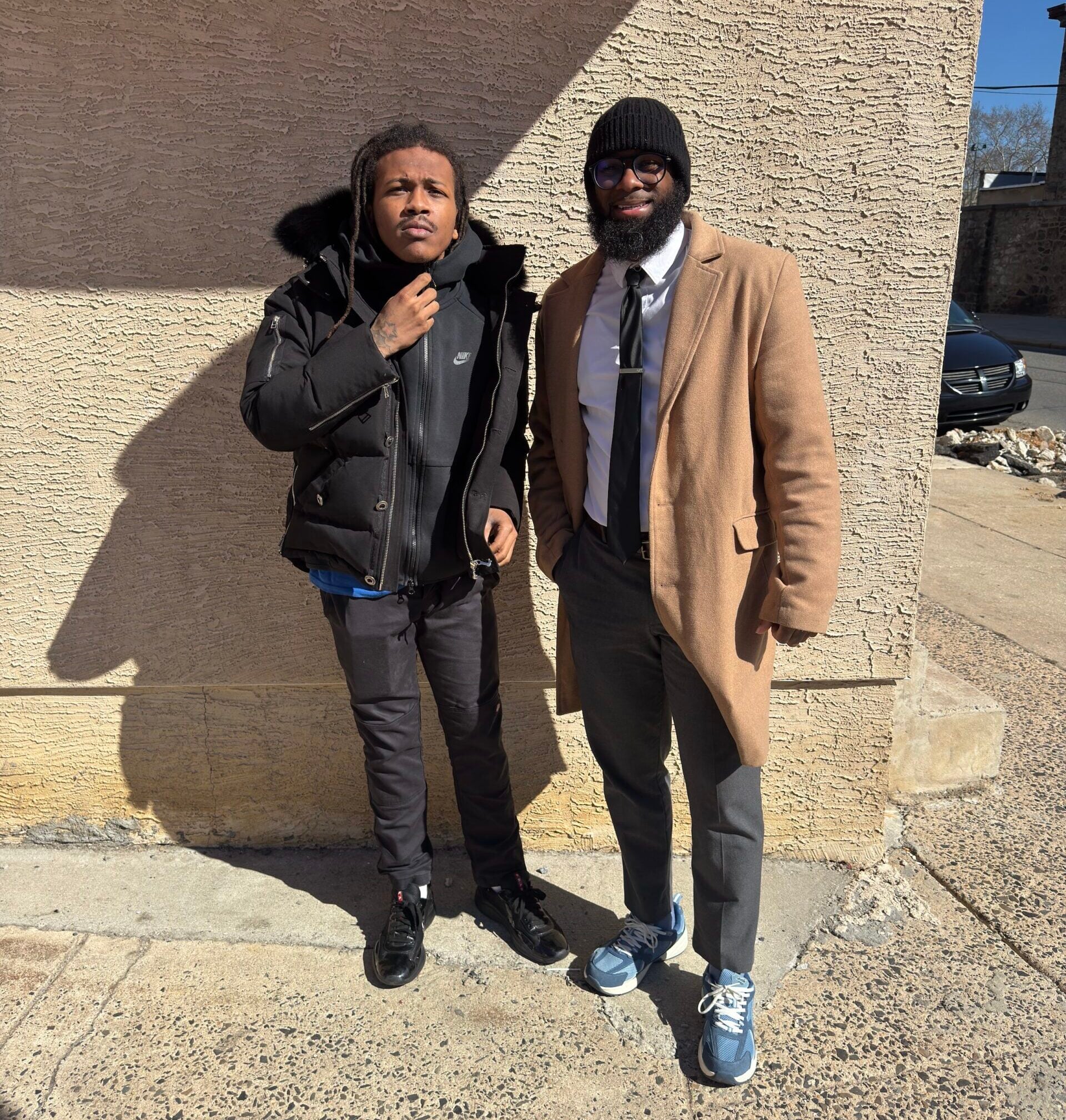 Zavien Robinson, a participant in Philadelphia’s Group Violence Intervention Juvenile program, left, with program coordinator Mark Johnson-Taylor.
Photo provided by GVIJ
When Philadelphia launched GVIJ in fall 2024, shootings across the city were already declining, but the number of teens charged with gun crimes was on the rise. While an independent evaluation of GVIJ’s effectiveness is still in the planning stages, officials say the program has become a valuable tool in the city’s efforts to repair the social disorder that often leads to violence.
There are currently 55 young people between the ages of 12 and 17 enrolled in the program. They all hail from the 22nd Police District, the part of North Philadelphia that includes a portion of Temple University’s vibrant urban campus and gentrifying communities like Brewerytown. But the area is more often associated with neighborhoods like Strawberry Mansion and Sharswood, places that have endured generational poverty.
“We noticed that there is a high volume of juvenile-related offenses taking place in that specific area,” Johnson-Taylor told The Trace. “We wanted to launch the strategy in an area where we could have the most impact with the most youth as quickly as possible.”
City records indicate that at least 223 juveniles have been shot in the 22nd District since 2015, the highest total of any Philadelphia police district during that period. But the violence has been waning: In 2021 — the city’s most violent year on record — 42 juveniles were shot in the 22nd, compared to 22 last year. The number of youth arrested for gun crimes has also fallen, from 32 five years ago to 22 in 2025.
“It’s kind of a bad area, but it’s getting better,” Robinson said. “Young boys, younger than me — 12, 13, 14, 15 — those are the ones that are getting into the most trouble. I feel like, ain’t nothing for them to do.”
GVIJ is an offshoot of the Group Violence Intervention program for men that the city launched in 2020, when the COVID pandemic started pushing gun violence to record highs. Like the adult program, GVIJ is based on a crime prevention strategy known as focused deterrence, in which law enforcement, government, and community leaders identify the small number of people believed responsible for a disproportionate amount of crime and tailor interventions to steer them toward law-abiding choices. Youth who’ve had contact with law enforcement or are connected to groups involved in violence are eligible for the program.
“Sometimes these programs fill the gaps that we used to see extended families play a role in,” said Sasha Cotton, executive director of the National Network for Safe Communities at John Jay College, which partnered with the city to create GVIJ. “We know that people have needs that are not always met that used to be met by aunties and uncles and neighbors. Now, social services and the government are having to step up and fill those gaps because those gaps, unfortunately, lead to violence if we’re not careful.”
The idea to start GVIJ grew from observations staffers made while visiting the homes of participants in the adult program. “We work with individuals already deeply embedded in gun violence,” Deion Sumpter, the city’s deputy director of Violence Prevention Initiatives, said about the adult participants. “However, upon visiting their homes, there were often siblings, individuals who were between the ages of 12 and 17. We wanted to reach them to ensure that they didn’t fall between the cracks.”
A $615,000 federal grant is funding GVIJ’s first two years, Sumpter said. The city has committed to covering the cost thereafter.
Brian Lentz, an attorney and advisor to the adult and juvenile programs, spent years leading the Philadelphia District Attorney’s Office Gun Violence Task Force. He said the experience convinced him that a sound way to reduce gun violence is to reach potential shooters as early as possible. “The further you reach back in somebody’s life, the greater the impact to prevention,” he said. “Getting ahead of it is something people have talked about, but now we’re actually doing it.”
Youth are referred to GVIJ by schools, city agencies, parents, and guardians. As part of the admissions process, a team from the city’s Division of Safe Neighborhoods visits the youth’s home to determine whether they are a good fit. Officials stressed that, unlike in the adult program, police officers do not take part in home visits for GVIJ.
“We don’t want to scare them,” Johnson-Taylor said. “These are youths who may be truant, who may be getting into fights, here and there, sneaking out late at night. They haven’t really begun to get into trouble, and we don’t want them scared of law enforcement.”
22nd District Police Captain Brian Sprowal said the program’s team can reach young people in ways his officers sometimes cannot. “They have a nontraditional way and approach to meet with some children who may not want to meet with the uniform,” he said. “The uniform is a symbol, and when you see the uniform, some people are just not as open or trusting. That’s the reality of life.”
Kileath Watson said he’s grateful he learned about GVIJ when he did. He was “being young and dumb” when he got into a street brawl in North Philadelphia that Johnson-Taylor happened to witness. After breaking up the fight, Johnson-Taylor told him about the program. Watson entered GVIJ at age 17. He found a janitorial job, is working toward his high school diploma, and is receiving assistance applying to trade school to study welding. (Watson and Robinson, the other GVIJ participant, are now 18 and have transferred to the city’s adult program.)
Watson said the therapy he received from GVIJ helped him stay off the streets and control his anger. “To be honest, this is a great program that the kids of today need,” he said. “With all the anger and violence in the community, they just need role models and support.”