
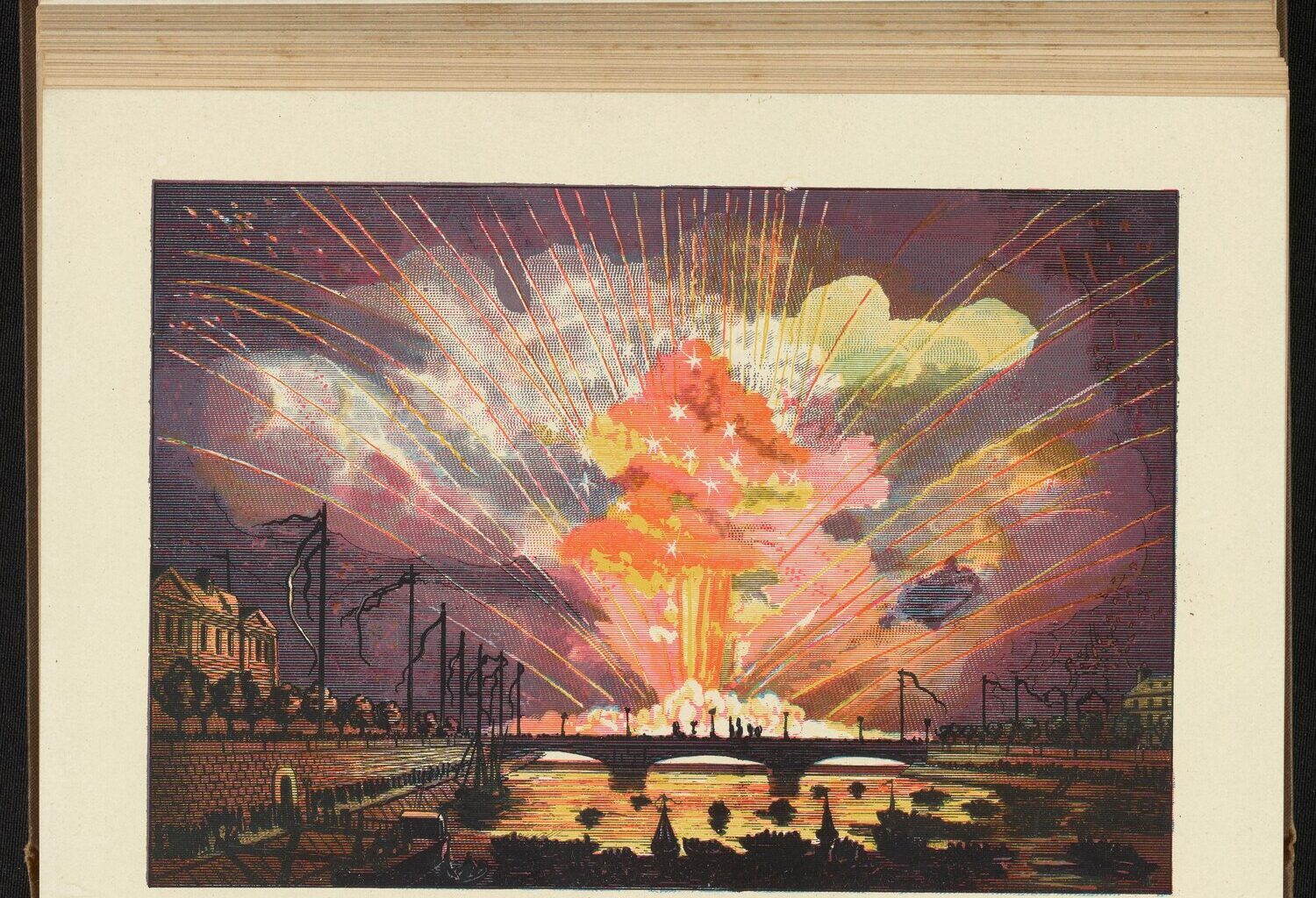
The Science History Institute is unveiling an exhibition this year that aims to be a total blast.
‘Flash! Bang! Boom! A History of Fireworks’ is set to open at the cultural institution this spring in honor of the country’s semiquincentennial and the signing of the Declaration of Independence.
The showcase will feature the origins of fireworks and the science behind them—from the way they are made, designed, and tested, to how they are ultimately launched into the sky. Essentially, instead of just watching the sky light up, visitors will get an up-close look at how these explosive displays came to be, tracing their origins across the globe before zeroing in on their journey in the United States.
“The long and global history of fireworks isn’t told chronologically in this exhibition, but rather through the different elements of putting on a fireworks show,” says exhibition co-curator Jesse Smith. “Fireworks are chemistry, they are art, they are a craft. There are amateur enthusiasts, professionals, and hobbyists. We touch on all of that.”
The exhibition will open with a party on April 10 (which is open to the public). From 5 to 8 p.m., the event will feature a curator’s talk, a look at the inside of a firework, pyrotechnic-themed objects from their collections, hands-on activities, refreshments and much more.
“What makes this exciting is the combination of familiar and unfamiliar. Pyrotechnics are technologies that not only produce spectacular effects, but also provoke big feelings—awe, grandeur, terror, patriotism, unity, delight. Even though a 17th-century royal fireworks spectacle might not at all resemble what we see on the 4th of July, the differences and similarities are illuminating,” says exhibition co-curator Nadia Berenstein, a historian of science and former Institute fellow.
The “Making Fireworks” section will examine how 19th-century Italian immigrants brought their pyrotechnic expertise—shaped by Roman Catholic celebrations—to states like Pennsylvania, Ohio, New Jersey, and Maryland, building a family-driven craft that has been passed down for generations.
“Designing Fireworks” explores how pyrotechnics once served as a form of theatrical storytelling, featuring elaborate papier-mâché structures and floating displays enhanced with carefully placed effects. And “Testing Fireworks” looks at how, in the early 20th century, growing concerns led many U.S. communities to restrict personal firework use, with rules varying widely by location. In response, the industry helped establish the American Fireworks Safety Laboratory (AFSL), which created and enforced national guidelines.
There’s also “Selling Fireworks” and “Launching Fireworks.” The former will showcase a selection of printing plates, catalogs, and sales booklets that reveal the commercial side of the fireworks industry, showcasing how their effects are marketed and described. And with the latter, visitors can check out different historic equipment like a 1970s “home run” box and detonator used at baseball games, alongside modern technology that delivers bigger, more synchronized bursts of light and sound.
‘Flash! Bang! Boom! A History of Fireworks’ will open April 10 at the Science History Institute (315 Chestnut St.). For more information, visit sciencehistory.org/fireworks